
Unmasking the Truth Behind Hal Jordan’s Shocking Demise: A Deep Dive into the HBO Max Series Lanterns
Main Facts
The critically acclaimed, True Detective-inspired HBO Max series Lanterns has officially reached its narrative turning point, shattering fan expectations and rewriting established DC lore in the process. For seven gripping episodes, viewers have grappled with an overarching temporal mystery spanning both 2016 and 2026. From the very first episode, the shadow of mortality hung heavily over veteran Green Lantern Hal Jordan, played with world-weary gravitas by Kyle Chandler. Viewers knew with chilling certainty that Jordan was destined to meet his end via a fatal gunshot wound to the head.
The penultimate episode, titled "Dirt and Stars," blew the lid off the central conspiracy. John Stewart (Aaron Pierre), utilizing Hal’s ring and the digital consciousness known as the "Halogram," embarked on an interstellar quest to planet Ryut. What Stewart and the audience discovered was a narrative far more intimate, heartbreaking, and grounded than a sprawling cosmic war. Hal Jordan was not felled by a galactic tyrant, a rival alien species, or an interstellar warlord. Instead, his death was the tragic byproduct of small-town desperation, forbidden love, and deep-seated maternal protection.
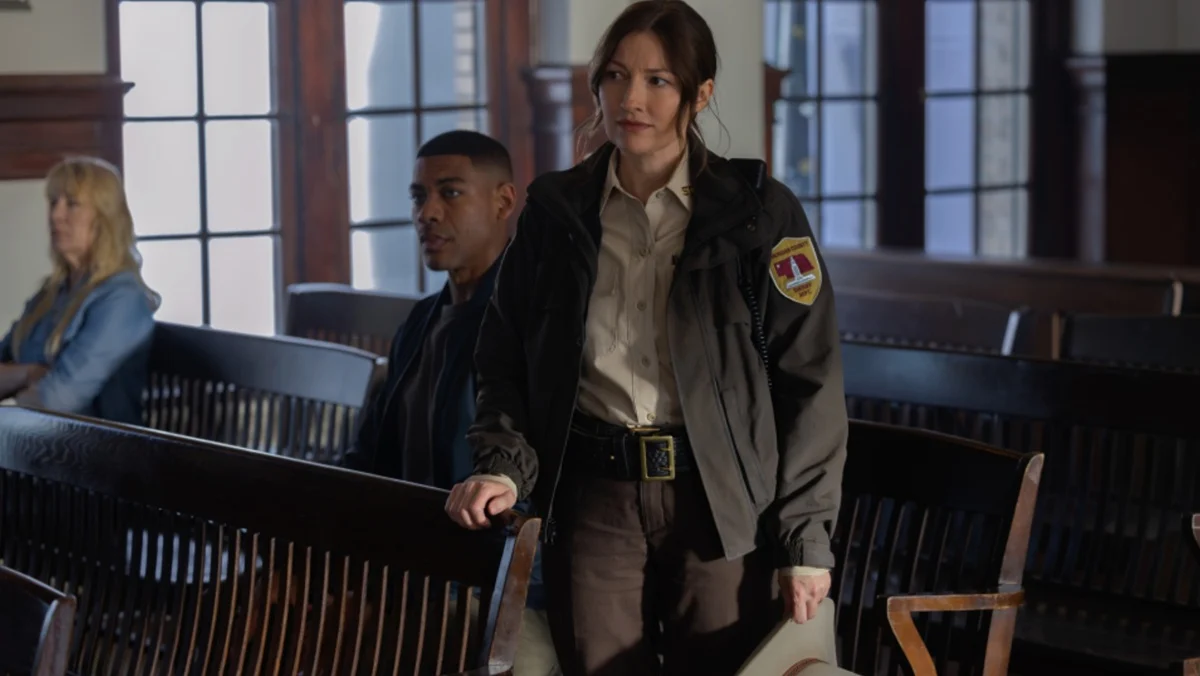
The killer was none other than Sheriff Kerry Kane (Kelly Macdonald), Jordan’s romantic partner in 2026, who pulled the trigger in a desperate bid to shield her adopted son, Noah (Shea Pritchard)—who happens to be a covert Manhunter.
Chronology of Events
To fully understand how a veteran space cop met his end on a dusty football field in Rushville, one must trace the timeline of events that unravels across the series.
Early 2026: The Unlikely Romance
The episode "Dirt and Stars" opens with a tense yet tender flashback. Sheriff Kerry Kane picks Hal Jordan up upon his release from prison. Despite the hostile, unforgiving atmosphere of Rushville—where townsfolk openly despise Jordan and view him as a pariah—Kerry boldly stakes her reputation on his redemption. She publicly defends him in a local diner, establishing a genuine, albeit fragile, romance between the two damaged souls.
The Firebombing and the Macon Slaughterhouse
The fragile peace is violently shattered when unidentified assailants firebomb Jordan’s home. Left for dead in the blazing inferno, Jordan miraculously survives, only to awaken inside the chilling confines of the Macon slaughterhouse. Standing over him is Noah, Kerry’s young son. Noah uses advanced, forbidden Manhunter technology to rebuild Jordan’s severely burned flesh. It is revealed here that Noah is not merely a human boy; he is a biological anomaly harboring Manhunter DNA, carrying on a covert lineage tied directly to his grandmother, Zoe.
Planet Ryut and the Sinestro Connection
Despite promising to keep Noah’s terrifying secret, Jordan’s instincts as a Green Lantern kick in. He tails the boy to a local storage unit, discovering a portal orb capable of instantaneous interstellar transport. The portal whisks Jordan away to the desolate alien world of Ryut. There, Jordan uncovers a staggering truth: Noah was the mastermind behind the prison break of Sinestro (Ulrich Thomsen). Noah engineered the breakout specifically to forge a power ring of his own, intending to assassinate the Guardians of the Universe.

Jordan later surfaces at a local diner, crossing paths with John Stewart, who has arrived seeking an overdue apology. Urgently whispering to Stewart, Jordan begs him never to reveal that they spoke. Hal is terrified that Noah will suspect him of being a snitch, which would endanger his life further.
The Fatal Confrontation at the Football Field
Armed with the knowledge of Noah’s true nature and his apocalyptic ambitions, Jordan confronts Kerry at the town’s local football field. Desperate to protect the boy, Jordan urges Kerry to flee Rushville with him, proposing they escape to a distant planet far beyond the prying eyes of the Green Lantern Corps and the Guardians.
Kerry, deep in denial, refuses to accept that her son is morphing into a ruthless Manhunter. She drops a bombshell revelation: years prior, when Zoe severed her own finger to save Kerry from local mobsters, she infused Manhunter DNA into the cybernetic replacement. Miraculously—or perhaps artificially—Kerry subsequently became pregnant without a partner. Though Noah was biologically Zoe’s creation rather than Kerry’s traditional child, Kerry raised him, growing fiercely protective.
As Jordan passionately insists they must run before Noah destroys them all, a panicked Kerry spins around and fires her service weapon. The bullet strikes Jordan squarely in the forehead, ending his life instantly—just as his dying breath whispers that he loves her.
Supporting Data and Production Insights
The narrative architecture of Lanterns has been praised by television critics for subverting traditional superhero tropes. By framing a cosmic property through the intimate, slow-burn lens of a rural noir detective story, showrunners created a distinct viewing experience.
- The Cast: Kyle Chandler’s portrayal of Hal Jordan captures a weary, fallen hero trying to reconcile past mistakes, while Kelly Macdonald’s Sheriff Kerry Kane provides a nuanced portrait of a mother torn between civic duty and maternal instinct. Aaron Pierre’s John Stewart acts as the audience’s anchor, piecing together a fractured mystery across space and time.
- The Mythology Integration: The series successfully integrates deep DC Comics lore—specifically the ancient conflict between the Guardians of the Universe and the robotic Manhunters—into a grounded, rural American setting. The introduction of planet Ryut and the manipulation of Sinestro by a human-Manhunter hybrid bridges classic cosmic comic book arcs with modern prestige television writing.
- Audience Reception: Early metrics from HBO Max indicate that Lanterns has resonated strongly with both long-time comic book readers and mainstream drama enthusiasts, largely due to its willingness to kill off legacy characters in emotionally complex, non-sensationalized ways.
Official Responses and Creative Direction
The creative team behind Lanterns has been vocal about their intentional choice to avoid typical comic-book-movie tropes. In recent interviews, the series creators emphasized that Hal Jordan’s death needed to feel tragic, messy, and fundamentally human rather than being a CGI-heavy spectacle.
"We didn’t want Hal to die because a giant laser beam hit him from the sky," one of the show’s lead writers noted during a recent press event. "We wanted his death to sting because it was born out of human emotion, denial, and a tragic lack of communication. Kerry didn’t want to murder the man she loved; she was paralyzed by the impossible choice between protecting her son and saving the man trying to warn her."

DC Studios executives have similarly praised the creative direction, noting that the gritty, grounded approach to the Green Lantern mythology allows the streaming series to stand apart from traditional cinematic universe offerings, giving characters room to breathe, fail, and suffer genuine consequences.
Implications for the Future of the Franchise
Hal Jordan’s death at the hands of Sheriff Kerry Kane carries massive implications for the remainder of the Lanterns series and the broader DC television landscape.
1. The Burden on John Stewart
With Hal dead, John Stewart is left to shoulder the heavy burden of uncovering the full extent of the Manhunter conspiracy. Stewart holds the tragic truth: that Hal was killed not by a malicious villain, but by an innocent woman driven to panic, protecting a child who was already slipping past the point of redemption. This emotional weight will undoubtedly shape Stewart’s arc as he confronts Noah and Sinestro in the remaining episodes.
2. The Fate of Noah and the Manhunter Threat
Noah’s arc shifts from a mysterious background element to the primary existential threat of the series. Having acquired the means to forge his own ring and harboring a burning desire to kill the Guardians, Noah represents a bridge between old cosmic vendettas and contemporary terrestrial danger. How John Stewart handles a young, emotionally volatile adversary who possesses ancient robotic technology will define the climax of the season.
3. Could Hal Jordan Ever Return?
Comic book adaptations operate under unique rules regarding mortality. During the penultimate episode, Sinestro taunted the digital Halogram, hinting that he possessed the power to bring Hal back to life "for real." While this may have been a manipulative psychological tactic to escape his imprisonment on Ryut, comic purists know that death is rarely permanent for Green Lanterns.
In the source material, Hal Jordan famously returned from the grave—first serving as the host for the Spectre, the literal spirit of vengeance, before eventually reclaiming his humanity and his ring. While his death in Lanterns is definitive for the current narrative arc, the door remains cracked open for future returns, should the creative team choose to explore resurrection storylines in subsequent seasons.
For now, however, the tragic irony remains: the man without fear was ultimately undone not by the terrors of the cosmos, but by the devastating power of a mother’s love.
