
Beyond the Delta Quadrant: Analyzing the High-Stakes Space Battles of Star Trek: Voyager

For seven seasons, Star Trek: Voyager defined the "lone wolf" paradigm of the Star Trek franchise. Unlike the Enterprise-D, which operated under the protective umbrella of Starfleet’s massive infrastructure, the USS Voyager was a vessel adrift in the uncharted Delta Quadrant, 70,000 light-years from home. This isolation was the crucible that forged the series’ identity, transforming a standard exploration mission into a grueling survival story.
When you are thousands of light-years away from the nearest repair facility or ammunition stockpile, every skirmish carries the weight of finality. The tactical realities of the Voyager were defined by scarcity, ingenuity, and the necessity of victory. As we examine the most iconic space battles in the series, we uncover not just technical spectacles, but the narrative pivot points that tested the resolve of Captain Kathryn Janeway and her crew.
The Strategic Landscape: Why Voyager Fought Differently
To understand the tactical nature of Voyager, one must appreciate the premise of its design. The Intrepid-class starship was a state-of-the-art vessel, yet it was never intended for prolonged, autonomous deep-space warfare. In the Alpha Quadrant, a starship’s duty is to mediate, explore, and defend. In the Delta Quadrant, Voyager became a scavenger, a diplomat, and a warship simultaneously.
The Logistics of Survival
Because the Voyager could not restock photon torpedoes or replicate infinite supplies of hull plating, the writers leaned into a "hard-luck" aesthetic. Battles were not merely about firing phasers; they were about resource management. Every strike had to be efficient, and every tactical decision had to account for the long-term survival of the ship. This created a heightened sense of tension that permeated the show’s most explosive encounters.

Chronology of Conflict: Defining Battle Episodes
The trajectory of Voyager was marked by encounters that pushed the ship to its breaking point. Below are five episodes where the tactical stakes reached their absolute zenith.
5. "Message in a Bottle" (Season 4)
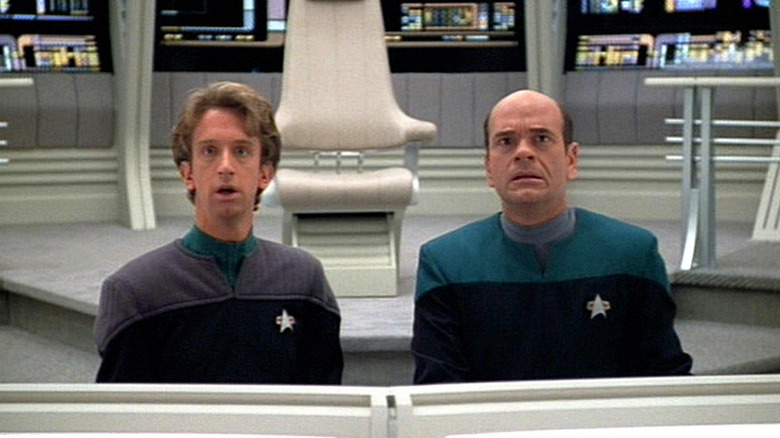
This episode served as a massive paradigm shift. When the Doctor is transmitted through a network of ancient alien relays, he arrives on the USS Prometheus, a prototype Federation vessel. The discovery of the Prometheus—and its advanced Multi-Vector Assault Mode—provided a visual spectacle rarely seen in Trek.
The battle sequences between the Prometheus and the Romulan Warbirds highlighted the lethality of Starfleet’s cutting-edge tech. The ability for the ship to split into three independent attack vessels allowed for a coordinated, multi-angle assault that effectively neutralized superior numbers. It remains a fan favorite, not only for the banter between the two holographic doctors but for the raw kinetic energy of the space combat.
4. "Basics" (Season 2-3)
The Kazon conflict remains one of the most divisive arcs in Trek history, but its conclusion, "Basics," offered a masterclass in ship-to-ship tactical warfare. After the crew is exiled to a volcanic planet, the Voyager falls into enemy hands.

The engagement here is distinct because it involves the Voyager being operated by a hostile force, forcing the crew to use their wits to regain control from the outside. Lieutenant Tom Paris’s orchestration of a tactical strike against his own ship, utilizing sabotaged phaser arrays and internal vulnerabilities, turned the episode into a suspenseful cat-and-mouse game. It was a tactical victory born of necessity, proving that the crew understood their ship’s limitations better than any adversary.
3. "Year of Hell" (Season 4)
Often cited as the best Voyager story, "Year of Hell" introduced the Krenim temporal weapon ship. By using a "causality ray," the Krenim could prune history, effectively erasing threats before they manifested.
The battle here is existential. The Voyager isn’t just fighting for its life; it is fighting for its place in the timeline. The visual of a battered, scorched Voyager fighting an enemy that could rewrite the battlefield in real-time provided a level of stakes that was previously unseen. The tactical implication—that the ship could be destroyed and then restored by the very nature of time travel—allowed the production team to push the boundaries of ship destruction and repair, resulting in some of the most visceral damage sequences in the franchise.
2. "Unimatrix Zero" (Season 6-7)
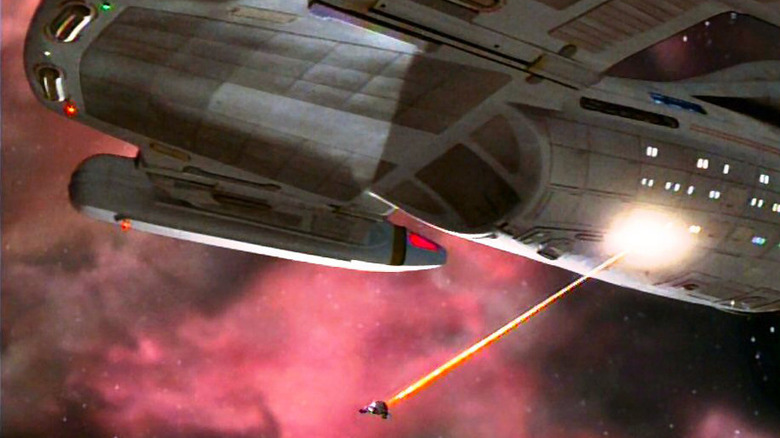
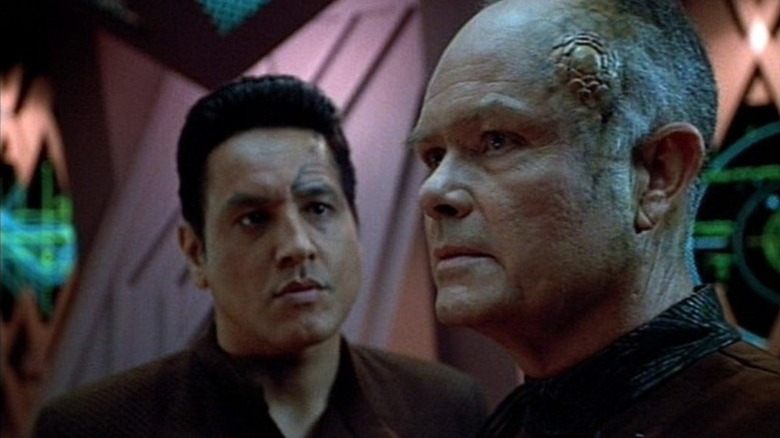
The Borg were the overarching threat of the Voyager series, and their presence always guaranteed high-intensity combat. "Unimatrix Zero" expanded the scope of this threat by introducing the idea of internal dissent within the Collective.
The battles here are characterized by scale. We are no longer seeing a lone ship firing on a Cube; we are witnessing the precursor to a Borg Civil War. While the episode relies heavily on political maneuvering and the subversion of Borg drones, the impending threat of total assimilation and the sheer firepower of the Borg fleet kept the audience in a state of constant, high-stakes anticipation. It mirrored the tension of The Next Generation’s "The Best of Both Worlds," grounding the series in a feeling of genuine peril.
1. "Endgame" (Season 7)
The series finale remains the definitive tactical showcase of the series. Admiral Janeway’s decision to travel back in time to provide her younger self with transphasic torpedoes and ablative armor represented the ultimate "power fantasy" for the crew.
After seven years of being the underdog, seeing the Voyager decimate Borg vessels with ease was a cathartic experience for the audience. The tactical implication—the introduction of weaponry capable of shattering a Borg hub—marked the official end of the crew’s struggle for survival. It was a grand, sweeping conclusion that emphasized that while the Voyager started as a fragile explorer, it ended as a force that could alter the balance of power in the quadrant.
Supporting Data: The Evolution of Tactical Capabilities
From a production standpoint, the combat in Voyager evolved alongside the VFX technology of the late 90s and early 2000s.
| Episode | Primary Threat | Tactical Feature | Outcome |
|---|---|---|---|
| Message in a Bottle | Romulans | Multi-Vector Assault | Successful Retrieval |
| Basics | Kazon | Internal Sabotage | Recapture of Ship |
| Year of Hell | Krenim | Temporal Weaponry | Reset Timeline |
| Unimatrix Zero | The Borg | Cyber-Infiltration | Strategic Disruption |
| Endgame | The Borg | Transphasic Torpedoes | Safe Return to Earth |
The move from traditional beam-based phaser fire to the integration of specialized weaponry in later seasons signaled the crew’s growth. They ceased to be merely survivors and became masters of their own environment.
Official Perspectives and Behind-the-Scenes Implications
In various retrospective interviews, the cast and crew of Voyager have noted the difficulty of filming space battles. Unlike modern CGI-heavy productions, the battle sequences of the 90s relied on a blend of practical model work and emerging digital effects.
Kate Mulgrew (Captain Janeway) has often spoken about the "weight of command" inherent in these battle episodes. For Janeway, the decision to engage in combat was never taken lightly; it was a violation of the utopian Starfleet ideals she represented. However, as the series progressed, the "Janeway Protocol" evolved into a pragmatic approach: if the survival of the crew is at stake, the rulebook becomes secondary to the ship’s safety.
Implications for the Future of Star Trek
The legacy of the battles in Voyager is felt in modern Star Trek series, such as Star Trek: Discovery and Star Trek: Strange New Worlds. The idea that a ship is a "character" with its own vulnerabilities, history, and tactical evolution was firmly cemented by Voyager.
The series demonstrated that space combat is most effective when it serves a character arc rather than just a visual spectacle. Whether it was the Doctor learning to fight, or Janeway choosing to alter time to save her crew, the battles were always about the people behind the consoles. As the franchise continues to expand, the blueprint left by Voyager—where every shot fired is a desperate plea for survival—remains the gold standard for high-stakes science fiction.
In conclusion, Star Trek: Voyager did more than just tell a story about a ship getting home; it provided a masterclass in how to maintain hope, integrity, and tactical superiority in the face of impossible odds. The "Great Battles" of Voyager are not just memories of explosions and phaser fire; they are the milestones of a crew that refused to be forgotten.
