
Beyond the Final Frontier: How Star Trek: Deep Space Nine Revolutionized Sci-Fi Space Combat

Main Facts: Breaking the Mold of Gene Roddenberry’s Utopia
When Star Trek: Deep Space Nine (DS9) premiered in January 1993, it faced an immediate, vocal backlash from a segment of the fandom. For a quarter-century, the Star Trek formula had been anchored by the philosophy of space exploration: a starship—whether captained by James T. Kirk or Jean-Luc Picard—would warp to a new alien world each week, solve a moral or diplomatic puzzle, and fly off into the sunset.
Deep Space Nine deliberately shattered that formula. Instead of a sleek starship cruising through the galaxy, the series anchored its narrative to a stationary, dilapidated Cardassian-built space station orbiting the planet Bajor, situated right next to a newly discovered stable wormhole leading to the distant Gamma Quadrant.
Yet, contrary to expectations that a stationary setting would result in a slower, more dialogue-driven chamber drama, DS9 evolved into the most action-packed, serialized, and propulsive series in the franchise’s history. Driven by Captain Benjamin Sisko (Avery Brooks)—a leader far more pragmatic, morally grey, and willing to cross ethical lines than his predecessors—the series introduced long-form storytelling to the franchise. This ultimately culminated in the Dominion War, a multi-season geopolitical conflict that redefined the Star Trek universe and brought grand-scale, cinematic space battles to television screens in a way the franchise had never seen before.
Chronology of Conflict: Five Definitive DS9 Battles That Shaped the Galaxy
While both The Original Series and The Next Generation featured memorable tactical encounters, Deep Space Nine outranked them all by turning space warfare into a sustained narrative engine. Here is the chronological breakdown of the five episodes that best captured the sheer scale, dread, and tactical brilliance of DS9‘s space battles.

1. "The Die Is Cast" (Season 3, Episode 21) — A Preemptive Strike Turned Massacre
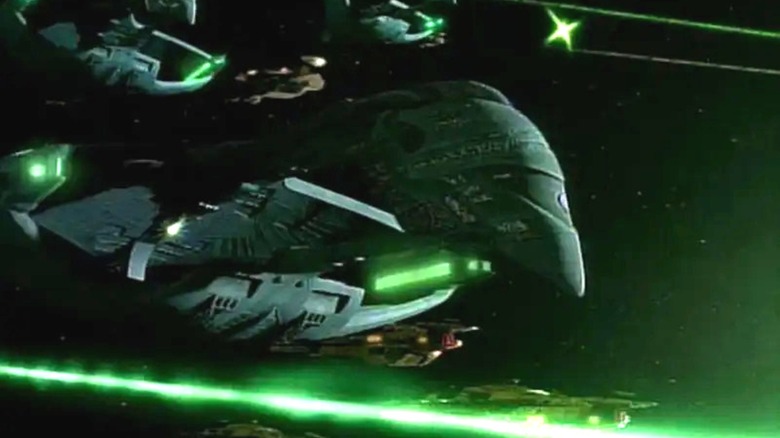
The political tension of the Alpha Quadrant reached a boiling point when two formidable intelligence agencies—the Cardassian Obsidian Order and the Romulan Tal Shiar—formed a clandestine alliance. Equipped with a fleet of cloaked warships, they launched a rogue, preemptive strike against the Founders’ homeworld in the Gamma Quadrant, hoping to eradicate the Dominion before an invasion could begin.
However, the shapeshifting Founders, possessing master-level infiltration tactics, played right into the trap. The allied fleet arrived only to find an evacuated planet. Moments later, an overwhelmingly massive Dominion fleet emerged from the shadows. The ensuing battle was a devastating bloodbath.
Tactical Impact: Seeing massive Romulan D’deridex-class warbirds—vessels that previously dwarfed Picard’s Enterprise-D—get systematically obliterated underscored the terrifying, unchecked power of the Dominion years before full-scale war broke out.
2. "The Way of the Warrior" (Season 4, Episode 1) — Klingons at the Doorstep
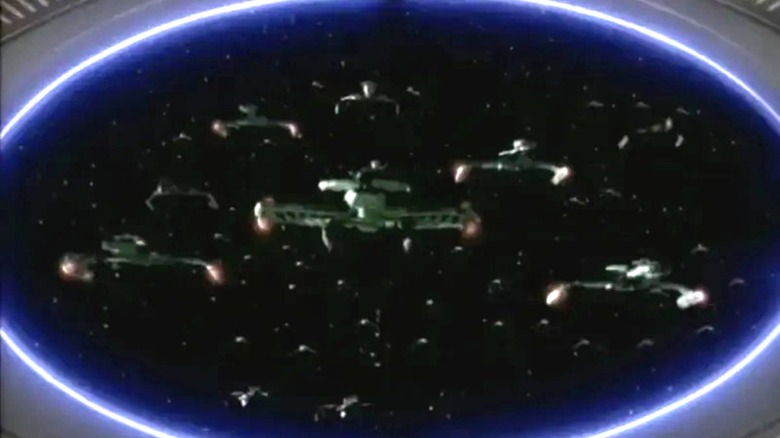
The fragile peace between the Federation and the Klingon Empire shattered in the explosive Season 4 premiere. Paralyzed by the fear of Dominion infiltration within the highest ranks of neighboring governments, the Klingon Empire, led by Chancellor Gowron and General Martok, prepared to invade Cardassia. When the Federation condemned the action, the alliance dissolved overnight.

A massive Klingon armada descended upon Deep Space Nine itself. Outnumbered and outgunned, the station was forced to utilize every dormant defense system in its arsenal, turning the station into a floating fortress that traded heavy laser fire with swarming Klingon birds-of-prey and Vor’cha-class battlecruisers.
Tactical Impact: Beyond the breathtaking exterior VFX sequences of ships swarming the station, the episode broke new ground by combining massive fleet combat with close-quarters, boots-on-the-ground boarding actions as Klingon warriors beamed directly onto the habitat rings.
3. "Call to Arms" (Season 5, Episode 26) — The Fall of Deep Space Nine
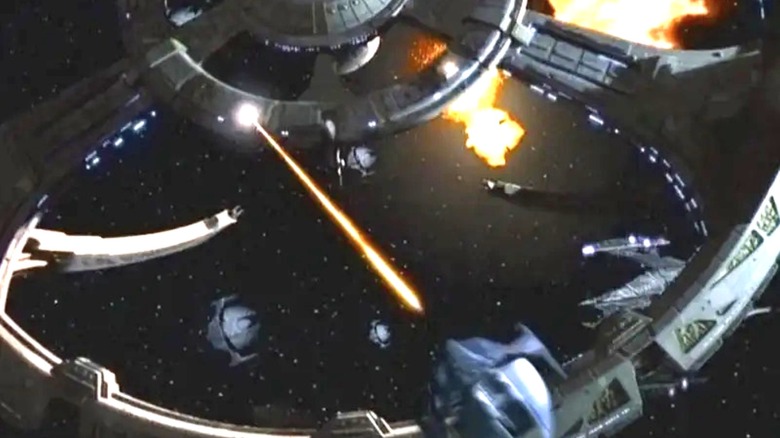
As the cold war with the Dominion transformed into an all-out apocalyptic conflict, the Season 5 finale delivered a heartbreaking turning point. Realizing that the Dominion and their Cardassian allies intended to use the Bajoran wormhole as an unlimited pipeline for military reinforcements, Starfleet ordered Sisko to mine the mouth of the wormhole.
With only the station, the stubborn Klingon bird-of-prey IKS Rotarran, and the USS Defiant—Starfleet’s first dedicated warship—to hold the line, defeat was mathematically guaranteed. The heroes bought just enough time to activate the minefield before abandoning the station.
Tactical Impact: The episode combined relentless waves of Dominion attacks with the tragic psychological weight of displacement. Bajor’s declaration of neutrality meant non-Starfleet characters were left behind under Dominion occupation, fracturing the core cast and setting a bleak, uncertain tone for the war to come.
4. "Sacrifice of Angels" (Season 6, Episode 6) — Reclaiming the Gateway
Serving as the climax of an intense, six-part serialized narrative arc, "Sacrifice of Angels" represents the emotional and tactical high-water mark of Deep Space Nine. Half the main cast had spent episodes surviving under Dominion occupation on the station, while the other half fought on the frontlines aboard the Defiant.
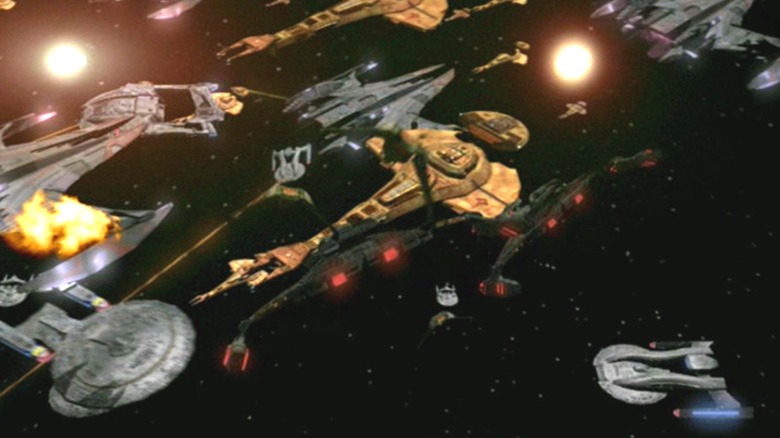
In this episode, the two narratives converged as a massive Starfleet armada launched a desperate offensive to retake the station before the Dominion could dismantle the wormhole minefield. Heavily outnumbered two-to-one, the Federation fleet engaged in a sprawling, multi-tiered battle that filled the screen with starships weaving through crossfires and suffering fiery, tragic ends.
Tactical Impact: This battle solidified the Miranda-class starship as the workhorse—and frequent casualty—of the fleet. Ultimately, victory was achieved not just through tactical grit, but through a literal deus ex machina when Sisko appealed to the non-corporeal Prophets of the wormhole to make the incoming Dominion reinforcements vanish.
5. "Tears of the Prophets" (Season 6, Episode 26) — Automated Terror at Chin’toka
By Season 6, the tide had turned with the entry of the Romulan Star Empire into the alliance. In the season finale, the allied forces launched a major offensive into enemy territory, targeting the under-defended, Cardassian-held Chin’toka system.
While Martok’s Klingon squadrons engaged in brutal dogfights against fanatical Jem’Hadar fighters—who frequently resorted to kamikaze ramming maneuvers—the Federation and Romulans faced a terrifying new technological horror: automated, heavily armed planetary weapons platforms.
Tactical Impact: The sequence featuring the USS Defiant executing a high-stakes bombing run inside an asteroid cave network to trick the platforms into destroying their own power generator stands as one of the most mechanically creative and heart-pounding combat sequences in the franchise’s history.
Supporting Data: The Mechanics of Scale in DS9 Space Combat
To understand why Deep Space Nine’s space battles felt so revolutionary, it helps to examine the production metrics and narrative design philosophy that separated it from its predecessor, Star Trek: The Next Generation (TNG):
- Transition to CGI: While early seasons relied on traditional physical models, the escalating scale of the Dominion War forced visual effects teams to pioneer early computer-generated imagery (CGI) models. This allowed directors to feature dozens, and eventually hundreds, of ships on screen simultaneously.
- Ship Class Diversity: TNG largely focused on a single ship type (the Galaxy-class Enterprise-D). In contrast, DS9 established a diverse naval ecosystem, introducing specialized tactical classes such as the war-focused Defiant, the heavy-hitting Akira, Steamrunner, Saber, and Norway classes, alongside legacy vessels like the Miranda and Excelsior classes.
- Tactical Vulnerability: Unlike earlier shows where shields rarely dropped below 50% before a swift escape via warp drive, DS9 portrayed starships as fragile, explosive environments where bridge consoles literally exploded, structural integrity failed, and ships were routinely destroyed on screen to emphasize real stakes.
Official Responses and Creative Intent
The creative minds behind Deep Space Nine—including co-creators Rick Berman and Michael Piller, and showrunner Ira Steven Behr—frequently spoke about the deliberate decision to steer the franchise into darker, more militaristic waters.
In retrospective interviews, Behr noted that the geopolitical climate of the 1990s, particularly the Yugoslav Wars and the Gulf War, deeply influenced the writers’ room. They wanted to explore how a utopian society like the United Federation of Planets would react when forced to fight an existential, total war for survival.
Paramount executives were initially hesitant about serializing Star Trek and introducing prolonged military conflicts, fearing it would alienate casual viewers who preferred standalone episodes. However, the critical acclaim and passionate fan engagement proved that audiences were hungry for complex, serialized storytelling where choices had permanent consequences. Avery Brooks frequently praised the depth of Benjamin Sisko’s character arc, noting that portraying a leader who wrestled with the moral compromises of wartime gave the show a distinct psychological weight missing from earlier iterations.
Implications for the Broader Star Trek Franchise
The legacy of Deep Space Nine‘s space battles extends far beyond its seven-season run. Before DS9, Star Trek was largely viewed by mainstream television audiences as an episodic adventure of the week. By proving that serialized, war-centric science fiction could achieve both critical praise and commercial success, DS9 laid the essential narrative groundwork for modern television sci-fi.
The DNA of the Dominion War can be clearly traced through subsequent franchise entries:
- The Xindi Arc (Star Trek: Enterprise): The third season of Enterprise adopted a serialized, year-long conflict against an existential threat directly modeled after the Dominion War pacing.
- Modern Streaming Era (Discovery, Picard, Strange New Worlds): Modern Star Trek shows routinely employ cinematic, multi-vessel fleet engagements and serialized political intrigue—elements that were considered risky anomalies when Deep Space Nine first aired them in the mid-1990s.
Ultimately, Deep Space Nine proved that the final frontier was vast enough to accommodate not just peaceful diplomacy and scientific discovery, but also the gritty, tactical realities of survival when the lights of utopia are threatened by the dark.
