
Bureaucracy at the Beach: How Tom McCarthy’s A Statement Exposes the Paralysis of Early Climate Politics
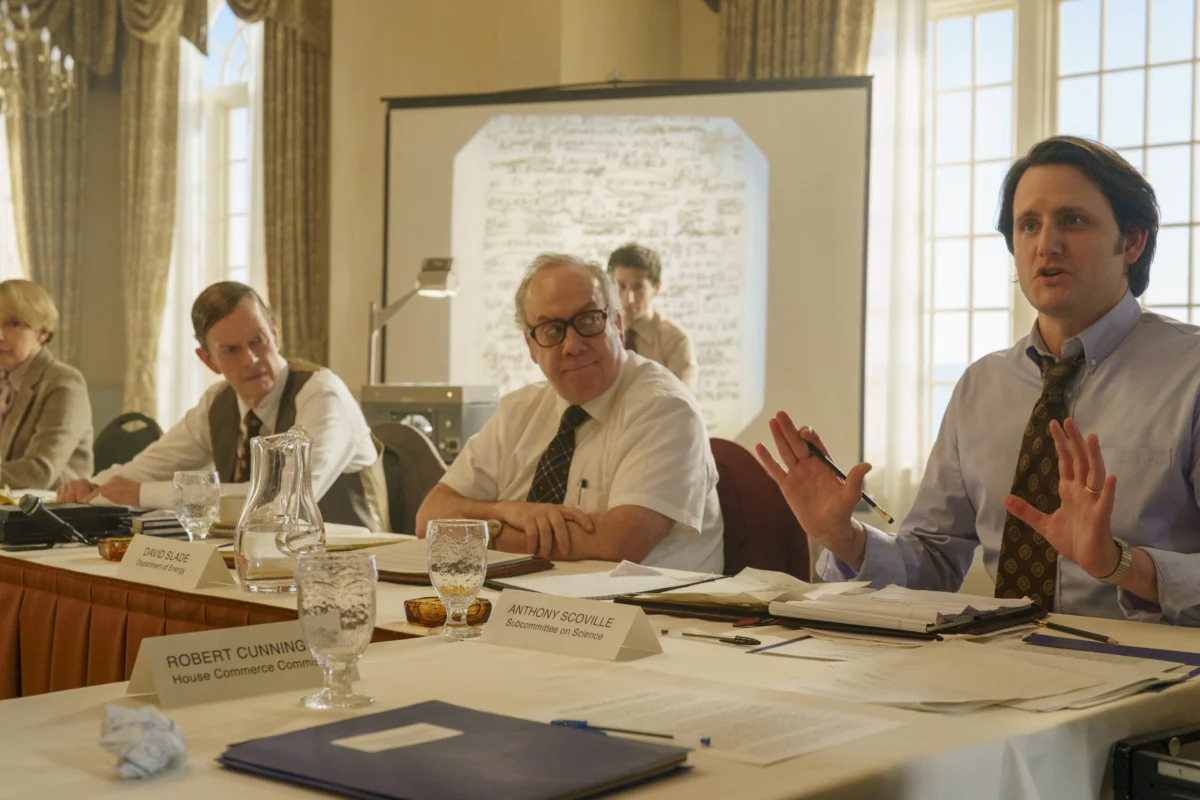
NEW YORK — In a hotel conference room overlooking the vast, indifferent expanse of the ocean in St. Petersburg, Florida, two men nervously adjust a series of tables. It is October 1980. They are preparing for a gathering that sounds, on paper at least, immensely consequential. Congress is finally poised to act on what it has identified as an impending, systemic risk: rising carbon dioxide emissions.
Yet, as director Tom McCarthy demonstrates in his new feature film, A Statement—which premiered at the 2026 New York Film Festival—this scene captures the surreal collision between the banality of human administration and the staggering scale of a planetary crisis. Though Irish physicist John Tyndall first laid out the mechanics of the greenhouse effect in 1859, the socio-political vocabulary of "climate change" was only beginning to enter the public lexicon more than a century later.
Adapted from Nathaniel Rich’s acclaimed nonfiction climate history Losing Earth, A Statement examines a forgotten, real-life episode: a Congress-tasked ad hoc commission that convened at the luxurious Don CeSar beachfront resort to "solve" the carbon dioxide problem. What unfolds on screen, however, is not a piece of heavy-handed agitprop, but rather a talky, sharply observed treatise on the failure of language itself to construct a stable architecture for collective action.
Main Facts: The Anatomy of a Doomed Convening
At its core, A Statement is a cinematic chamber piece about semantic paralysis. The film follows a 36-hour marathon meeting held on October 30–31, 1980, bringing together 20 of the nation’s leading minds—professors, researchers, lawyers, physicists, and industry heads. Their singular charge was to draft a unified national strategy regarding profligate American energy consumption and its destabilizing atmospheric consequences.
Instead, they spent a day and a half arguing over whether to take action on or merely take account of the crisis.
The film features an ensemble cast playing the historical figures caught in this bureaucratic trap:
- Paul Rudd stars as Thomas Jorling, a Clean Air Act advisor and the meeting’s beleaguered moderator.
- Evan Peters portrays Rafe Pomerance, the scruffy-haired director of the nonprofit Friends of the Earth.
- Amy Ryan plays Annemarie Crocetti, a frustrated public health scholar.
- Paul Giamatti takes on the role of David Slade, a Department of Energy director acting as an institutional devil’s advocate.
- John Turturro appears as David Rose, a maverick M.I.T. nuclear engineer.
- Tatiana Maslany stars as Edith Brown Weiss, a Georgetown legal scholar who serves as a crucial mouthpiece for women navigating the institutionalized misogyny of late-20th-century technocracy.
For most of the runtime, these brilliant minds are confined to a stifling conference room, splitting hairs rather than atoms. In a devastating historical footnote revealed in the film’s closing moments, the real-world commission never actually produced a statement at all. A lifetime of accumulated expertise, squandered over a single weekend by the sea.

Chronology: Thirty-Six Hours of Stasis
The narrative structure of A Statement mirrors the claustrophobic timeline of the actual retreat.
Phase One: The Setup and the Script
Co-written by Tom McCarthy, Thomas Bidegain, and Noé Debré, the film’s first half leans heavily into its theatrical roots. Much of the dialogue is pulled verbatim from the official transcripts recorded by congressional stenographers—a figure memorably brought to life by Laura Flannery as a mildly flirtatious, occasionally boozy observer of elite impotence. Because the screenplay relies so heavily on primary sources, watching the film genuinely feels like reading a historical transcript.
Phase Two: The Polarization of the Room
As the hours tick by, the ideological fault lines harden. Giamatti’s David Slade constantly undermines ambitious proposals, acutely aware that whatever is agreed upon must be brought back to a skeptical, industry-beholden Congress. The room divides cleanly between those sounding urgent alarms—such as Peters’ Pomerance and Turturro’s Rose—and institutional actors paralyzed by political risk.
Phase Three: The Escape and the Aftermath
Seeking refuge from the suffocating air of the conference room (and the omnipresent haze of 1980s cigarette smoke), Dr. Rose briefly crashes a lively wedding happening elsewhere in the hotel alongside a junior atmospheric scientist, played with rakish charm by Noah Robbins. This brief injection of life outside the bubble only serves to highlight the irrelevance of the men inside it.
The film’s timeline places this bureaucratic failure just days before the November 1980 U.S. presidential election, which saw Republican challenger Ronald Reagan defeat incumbent Democrat Jimmy Carter—ushering in an era of mixed environmental stewardship and shifting federal priorities.
Supporting Data: Stylistic Choices and Performances
While McCarthy’s direction employs a beige, muted color palette that evokes the weary administration of the late Carter era, the technical elements work overtime to inject momentum into a fundamentally static premise.
- Cinematography & Editing: Stuart Dryburgh (cinematography) and Jane Rizzo (editor) adopt a 1970s New Hollywood aesthetic, utilizing framing and pacing reminiscent of political thrillers of the decade. However, critics note that the film lacks the overlapping, Altmanesque chaos that might have enlivened the proceedings; the characters are too relentlessly polite, waiting their turn to speak in an orderly fashion even as the world burns.
- Musical Score: Bryce Dessner provides a driving, percussive score that successfully introduces dramatic tension where the conversational sparring occasionally lags.
- Character Limitations: While Maslany and Ryan deliver standout performances—culminating in powerful third-act monologues addressing the systemic sidelining of women’s voices in technocratic spaces—some critics have pointed out that their characters occasionally lean too heavily into "poster people" archetypes rather than fully rounded human beings.
Official Responses and Industry Reception
A Statement premiered to a thoughtful, sober reception at the 2026 New York Film Festival, marking another nuanced character study for McCarthy, whose previous work includes the Academy Award-winning Spotlight. Sony Pictures Classics has acquired distribution rights for a wider theatrical release.

Critics have noted the stark meta-narrative of releasing a film about the utter failure of 1980s climate governance in the wake of contemporary setbacks—notably the United States’ official withdrawal from the Paris Climate Agreement earlier this year.
Rather than offering comforting Hollywood heroics or villainous caricatures, McCarthy’s film presents a sobering truth: the destruction of the biosphere was not merely engineered by mustache-twirling industrialists, but was equally enabled by well-meaning intellectuals trapped in endless loops of procedure, semantic debate, and institutional cowardice.
Implications: What Did We Learn?
Ultimately, A Statement answers the question of whether humanity can solve the climate crisis with a blunt, disquieting "no."
The film concludes on a distinctly Beckettian note of existential absurdity. It invites direct comparison to the pitch-black satire of the Coen brothers’ Burn After Reading, where an exhaustive, high-stakes intelligence inquiry ultimately yields nothing except a testament to human folly. As J.K. Simmons’ exasperated CIA superior famously asks at that film’s conclusion, "What did we learn?" The only honest answer is a collective shrug.
By stripping away the comforting myth that crises are solved simply by putting smart people in a room, A Statement offers a timeless warning. It suggests that when faced with civilizational collapse, human institutions do not necessarily break with a dramatic crash—they merely convene, deliberate, argue over definitions, and adjourn with nothing to show for it.
Grade: B-
