
The Symphony of Silence and Sound: How ‘The Wild Robot’ Redefined Audio Storytelling
In the world of feature film production, the departments responsible for the musical score and those tasked with sound design often operate in parallel silos. Composers typically deliver their cues to the dubbing stage only after the sound effects have been largely finalized, leaving the re-recording mixers to perform the delicate, often contentious task of balancing the two. However, when these creative forces synchronize their efforts from the earliest stages of production, the result can be transformative.
DreamWorks Animation’s The Wild Robot, directed by Chris Sanders, stands as a masterclass in this collaborative philosophy. By dissolving the rigid boundaries between music and sound design, the film’s creative team—led by composer Kris Bowers and a powerhouse sound department including supervising sound editors Leff Lefferts and Randy Thom, and re-recording mixer Gary Rizzo—has crafted an auditory experience where the score and the environment exist in a symbiotic, living relationship.
The Architecture of a Wilderness: Crafting the Soundscape
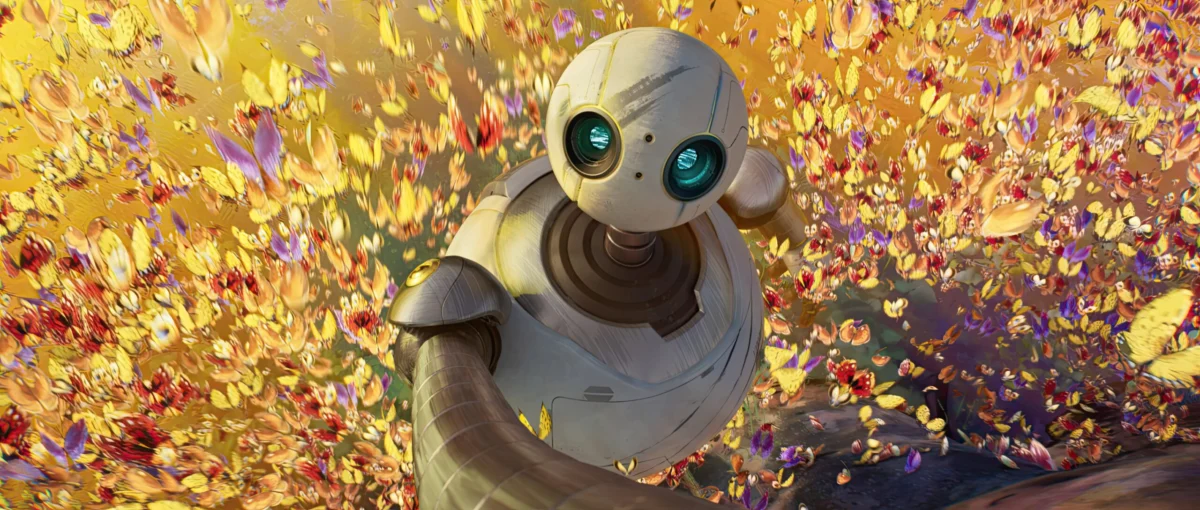
The score for The Wild Robot is a sprawling, adventurous tapestry that mirrors the film’s central protagonist, the robot Roz (voiced by Lupita Nyong’o). Kris Bowers, known for his ability to weave complex emotional narratives through instrumentation, faced a unique challenge: he needed to evoke the natural world without tethering the audience to a specific geographic or cultural sound palette.
To achieve this, Bowers employed a hybrid approach, blending traditional orchestral arrangements with synthesizers and highly unconventional percussion. Notably, the percussion tracks were performed by the Sandbox Percussion ensemble and mixed with a distinct, close-mic aesthetic that allowed them to function less like a traditional film score and more like an immersive, animalistic sound design element.
"The percussion had its own sonic lane," Bowers explained in an interview with IndieWire. "It was like this ASMR, close-mic sound. There were many moments where there was significant activity in the frequency ranges typically occupied by sound design. It’s a testament to Leff, Randy, and Gary that they were so open to letting the story be told evenly by both the music and the sound effects."

This "sonic lane" approach allowed the film to feel grounded, tactile, and alive. By treating the percussion as a rhythmic heartbeat of the forest rather than mere musical accompaniment, the team created a world that feels as if it is breathing along with the audience.
Chronology of Collaboration: From Concept to Mix
The collaborative process for The Wild Robot began long before the final mix. In a significant departure from standard industry practices, Chris Sanders encouraged Bowers to compose music independent of the existing footage.
"Chris first encouraged me to write away from the picture," Bowers noted. "Usually, my work is very picture-intensive. On this film, the process was flipped: we would establish the musical pace, and then the animators would adjust their work to the rhythm of the score."
This reversal allowed for a seamless integration of emotion and action. A prime example is the character arc of Brightbill, the orphaned gosling voiced by Kit Connor. As Brightbill learns to fly, the score provides the emotional momentum for his journey, while the sound effects—the frantic flapping of wings, the rush of wind, and the visceral snap of feathers—provide the necessary grounding for the physical reality of the scene.
As the production moved into the final mixing stage, the team continued to iterate, treating the audio as a fluid, malleable entity. Transitions were smoothed by blurring the lines between melody and texture. Leff Lefferts, the film’s supervising sound editor, was particularly focused on ensuring that environmental sounds possessed a "melodic sensibility" that complemented the score, creating a cohesive acoustic environment that felt intentional rather than haphazard.

The Power of the Pivot: Why Silence is the Loudest Choice
Perhaps the most striking achievement in The Wild Robot is the team’s willingness to discard perfectly good work in favor of stronger narrative outcomes. During the film’s most emotionally devastating sequence—when Brightbill finds Roz powered down within the confines of a Rossum ship—Bowers had originally composed a poignant, beautiful musical cue.
However, during the final mix, the team collectively realized that the emotional weight of the scene was being undercut by the presence of music. "We found it on the stage," Bowers recalled. "We watched it, and we all realized it would be much more devastating if there was no music at all."
Lefferts concurred, noting that removing the music stripped away the audience’s "emotional buffer."
"All of a sudden, your heart was just ripped in half because you were left alone with Brightbill," Lefferts said. "But the silence was so profound it felt too empty. So, Randy [Thom] disappeared and created a montage of the ongoing battle outside the ship. I spent the time filtering it and moving it around the space to create a sense of deathly, stifling quiet inside, while the chaos of the battle raged just beyond the walls. It created a contrast that was far more powerful than any score could have provided."
This sequence highlights the maturity of the film’s creative direction. By recognizing that music is not always the most effective tool for conveying grief, the team allowed the sound design to carry the weight of the moment, creating an "earned" emotional climax that resonates far longer than a traditional musical swell.

Implications for Future Animation
The success of The Wild Robot serves as a compelling argument for a shift in how sound and music are integrated into the animation pipeline. In an industry where budgets and schedules often force departments into silos, the "Wild Robot" model suggests that the additional time spent on cross-departmental collaboration yields a significantly higher artistic return.
By allowing the score to drive the animation and the sound design to drive the emotional intensity of the mix, the team created a film where the audience is never consciously aware of the "hand-offs" between sound and music. As Bowers noted, "Score needs to be like a great massage. You shouldn’t really be too mindful of where the hands come on and come off."
This seamlessness is not merely a technical achievement; it is a narrative one. When the music takes the lead—as it does during the migration sequence, where the score dictates the pacing and emotional scope—it feels like an organic extension of the film’s soul. When the sound design takes the lead—as it does during the tense, quiet moments of discovery—it feels like an unavoidable reality.
A Legacy of Sonic Innovation
As The Wild Robot continues to earn critical acclaim, its technical achievements in audio are being recognized as a high-water mark for the medium. The film demonstrates that when a composer, a sound designer, and a director view their work as a single, unified performance, they can elevate a film from a visual experience to a fully realized sensory environment.
The collaboration between Kris Bowers, Leff Lefferts, Randy Thom, and Gary Rizzo proves that the most effective cinematic moments are often the ones where the ego of the individual department is sacrificed for the sake of the story. Whether it is the subtle, rhythmic pulse of the forest or the agonizing silence of a broken bond, the audio of The Wild Robot does more than support the image; it defines it.

For future animators and sound designers, the takeaway is clear: stop treating sound and music as separate lanes. Start treating them as a single, fluid language that, when spoken correctly, can make an audience feel everything. As Bowers aptly put it, the process felt like "a pursuit—like things are coming to me, and I’m just trying to catch up to it." In this film, he and his team not only caught up; they arrived at a new destination for animated audio storytelling.
