
Sonic Frontiers: How Rob Simonsen Scored Pixar’s Cosmic Odyssey ‘Elio’
When Rob Simonsen—the visionary composer behind the synth-heavy soundscapes of Deadpool & Wolverine and the nostalgic, atmospheric textures of Ghostbusters: Afterlife—was brought on to score Pixar’s upcoming animated feature Elio, he knew he was stepping into a unique sonic territory. Elio, a coming-of-age story that traverses the lonely expanse of space and the search for belonging, demanded a musical identity that was as expansive as the universe itself, yet as intimate as the heart of an eleven-year-old boy.
In his animated debut, Simonsen has crafted a score that serves as the backbone of the film, utilizing a blend of warm, traditional piano melodies and cutting-edge, experimental synthesis. The result is a sound that feels both grounded in human emotion and thrillingly alien.
The Genesis of a Cosmic Vision: Early Inspirations and Pixar’s Philosophy
The journey began with an invitation to the Pixar campus, a pilgrimage that would set the tone for the entire project. "They brought me up to Pixar and I sat down and heard what the film was all about, and I was very moved; I felt very connected," Simonsen told IndieWire.
Simonsen’s own background as an unabashed "alien and UFO nerd" made him a natural fit for the project. The studio was seeking a specific, elusive quality: a soundscape characterized by "spaciousness" and "warm piano melodies," but one that maintained a sense of grand, interstellar expansiveness. For Simonsen, this meant balancing the technical requirements of a sci-fi epic with the emotional vulnerability of a child protagonist.

The score’s development was characterized by a rare continuity. Despite the shifting directorial landscape—initially led by Adrian Molina, then later transitioned to Madeline Sharafian and Domee Shi—the core musical DNA remained intact. Simonsen credits the directing duo for their ability to broaden the world-building of Elio while steadfastly protecting the "heart" of the narrative.
Chronology of Composition: From the Major Seventh to the Communiverse
The musical narrative of Elio was built around a singular, defining theme. Upon his initial hiring, Simonsen wrote the titular "Elio" theme, a piece that would anchor the film from its opening frames to its climactic resolution.
The thematic foundation rests on the Major Seventh chord. In musical theory, the Major Seventh is often associated with a sense of yearning and aspiration—a perfect auditory metaphor for a boy reaching for the stars. "That was something I kept playing around with at the beginning," Simonsen explained. "That Major Seventh just felt right, and then figuring out how to support it with the chords underneath. I gravitate towards simple piano melodies with a big synth-fueled expansiveness around it. And it worked. Now it opens the film and we hear that theme as the Disney logo is playing."
The score’s emotional timing was equally precise. Simonsen worked closely with the animation team, who he noted possess "great instincts" regarding human emotion. A poignant example occurs during an early scene in a planetarium, where Elio watches the Golden Record Voyager departing Earth. The theme is deliberately held back until the exact moment a tear forms on the young protagonist’s face—a testament to the symbiotic relationship between the visual storytelling and the musical score.

Technical Innovations: Hacking the Sound of the Stars
One of the most fascinating aspects of the Elio score is its technical construction. To capture the feeling of the "Communiverse"—an interplanetary organization of diverse alien life—Simonsen sought a sound that felt inherently non-human yet oddly familiar.
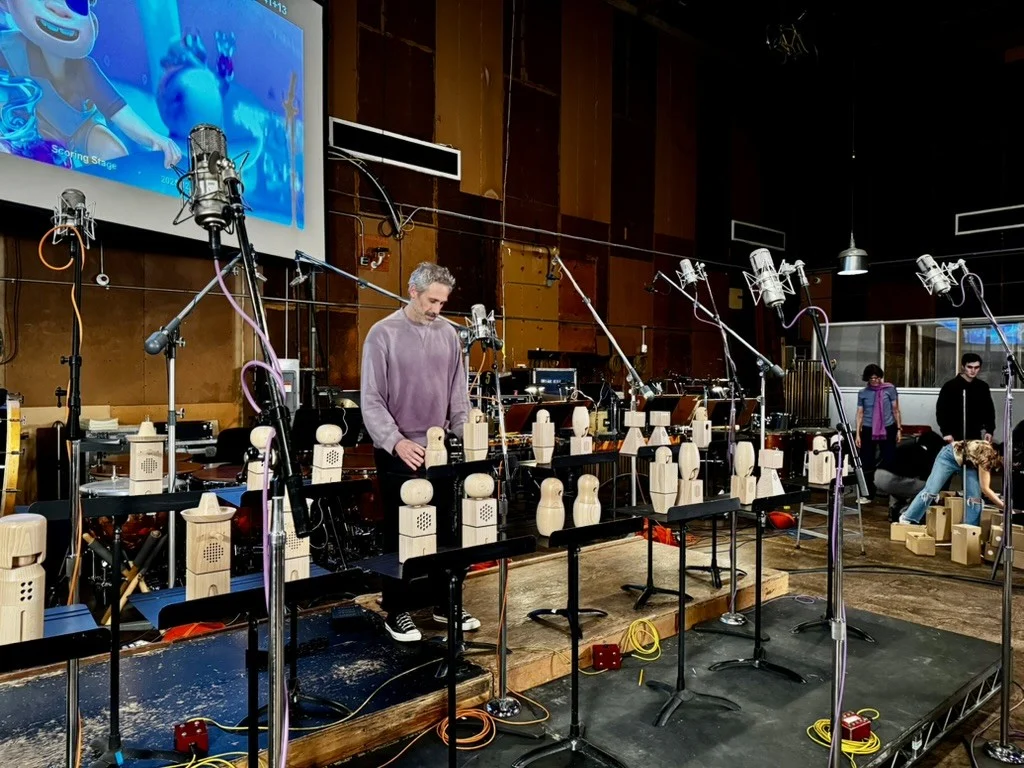
Rather than relying on a traditional human choir, which might feel too terrestrial, Simonsen turned to an unconventional source: "choir dolls" from the Swedish tech company Teenage Engineering. These are small, wooden robotic speakers designed to mimic vocal textures.
"They’ve built these speakers into these wooden bodies," Simonsen said. "These little choir dolls have this very unique sound that I’ve never heard. They sound human, but clearly not human. The shape of the wood gives a shape for their voice, and they function like a choir."
To achieve the desired "robust" sound, the production team went to extraordinary lengths. Simonsen’s assistant, Tiger Lily, a coding expert, used Python to "hack" the dolls, expanding their functionality beyond their factory settings. The team eventually sourced enough units to create a 30-voice robotic choir. The sight of these tiny, wooden automatons singing in a cavernous, world-class recording space like the Sony scoring stage represents the meeting point of high-concept technology and whimsical artistic vision.

Supporting Data: The Architecture of a Signal
The film’s score operates on a concept of "call and response." Simonsen devised a one-note signal sound representing the Golden Record Voyager as it drifts through the void.
- The Initial Signal: A custom-created synth sound that echoes and reverberates, representing the loneliness of the probe.
- The Response: When the universe answers back, the motif becomes "fully realized," incorporating more notes and complex textures.
- The Resolution: The signal is eventually transformed into the massive, orchestral, and synth-heavy theme of the Communiverse, signifying Elio’s arrival in a world that is as grand as his own imagination.
This progression ensures that the audience feels the scale of the universe expanding alongside the character. As Elio is greeted by alien lifeforms who mistakenly identify him as the leader of Earth, the music reflects his awe and confusion, ballooning with orchestral support, popping textures, and the haunting, ethereal quality of the wooden choir.
Implications for Future Animated Scores
The score for Elio is more than just a collection of cues; it is a masterclass in modern film composition. By blending the organic warmth of the piano with the digital precision of hacked robotics, Simonsen has pushed the boundaries of what is expected from an animated feature.
The success of this approach highlights a shift in how composers are approaching the "sci-fi" genre. Instead of relying on tired tropes of bombastic brass or predictable electronic pulses, the industry is increasingly turning toward "textured" sound design—where the instrument itself is engineered to tell part of the story.

Official Perspectives: A Unified Vision
The transition between directors—from Adrian Molina to the collaborative team of Madeline Sharafian and Domee Shi—could have resulted in a fractured musical score. However, all parties involved prioritized the emotional arc of Elio, played by Yonas Kibreab.
"I think in a lot of ways they expanded the world, but they held onto the heart that I felt was there at the beginning, and carried it through in a really beautiful way," Simonsen noted. This unity of vision ensured that the score did not merely accompany the film but became a narrative device in its own right. The music is not just wallpaper; it is an active participant in the audience’s journey from a quiet, lonely observatory to the bustling, imaginative corridors of the Communiverse.
Conclusion
As the June 20, 2025 release date approaches, Elio stands as a testament to the power of collaborative, innovative filmmaking. Rob Simonsen’s score is poised to be one of the most memorable elements of the production, offering a sonic bridge between the grounded, relatable feelings of childhood loneliness and the limitless, vibrant possibilities of the cosmos.
By marrying the technical ingenuity of "hacked" hardware with the timeless emotional depth of a well-placed Major Seventh chord, Simonsen has proven that the most effective way to score a movie about the universe is to treat the music itself as a living, breathing, and ever-evolving organism. When the Disney logo fades and that first, lingering piano note hits the screen, audiences will know they are about to embark on a journey that is as much about the music as it is about the stars.
