Tuning the Netherworld: How Sound Designer Michael Babcock Crafted the Sonic Universe of ‘Kpop Demon Hunters’
In the realm of cinematic sound design, it is entirely possible to fly too close to the sun. Burdened by too many competing audio layers, the emotional resonance of a pivotal moment can easily melt away into a muddy, chaotic mess of noise. To sidestep this auditory pitfall, the creative team behind Netflix’s animated feature KpopDemonHunters took an unconventional approach. Alongside their relentless work to turn the film’s musical numbers into legitimate chart-topping bops, the filmmakers brought supervising sound editor and re-recording mixer MichaelBabcock onto the project unusually early—long before a single frame of animation had even been drawn.
Working in tandem with directors Chris Appelhans and Maggie Kang, Babcock set out to define the sonic identities of the film’s opposing forces: the demonic voices of the villainous boy band the Saja Boys, and the vocal stress points of HUNTR/X lead singer Rumi (voiced by Arden Cho). Because Babcock possesses a professional musician’s background himself, he immediately dove into a deep study of contemporary K-pop and broader pop production techniques. His mission was to formulate a sonic landscape that felt fantastical and transportive while remaining firmly rooted within the musical language of the film.
Main Facts
Early Collaboration: Supervising sound editor and re-recording mixer Michael Babcock joined Kpop Demon Hunters before animation began, collaborating closely with directors Chris Appelhans and Maggie Kang.
Inspirational Palette: Babcock studied contemporary K-pop alongside pop artists like Billie Eilish and Imogen Heap to construct layered, polished vocal treatments and demonic transformations.
Organic Soundscapes: To avoid overly digital or harsh audio, Babcock utilized everyday items—including a batch of Amazon-purchased tuning forks—to create organic, resonant sword effects tied directly to the film’s musical beats.
Balancing Cuteness and Terror: The film’s spirit animal companions (a tiger and magpie inspired by Korean folklore, affectionately nicknamed "Derpy" and "Sussie" by the crew) required careful vocal manipulation blending real animal sounds with Babcock’s own altered voice.
Precise Synchronization: Sound design elements throughout action sequences were explicitly pitched and timed to the beat of the soundtrack, allowing heavy audio integration without overwhelming the music.
Chronology: From Concept to the Final Mix
The meticulous audio construction of Kpop Demon Hunters followed a deliberate timeline that prioritized sound integration from the project’s inception.
Phase 1: Pre-Animation Exploration
Before visual artists rendered backgrounds or character models, Babcock began experimenting with vocal processing. Recognizing that K-pop production relies heavily on pristine, intricate vocal stacking, compression, and harmonic layering, he established the core auditory palette. This early phase focused heavily on formulating the supernatural transformations—figuring out how the Saja Boys would sound when their angelic boy-band facade slipped to reveal their demonic nature, and how Rumi’s voice would buckle or soar under intense narrative pressure.
Phase 2: Materializing the Magic and Combat
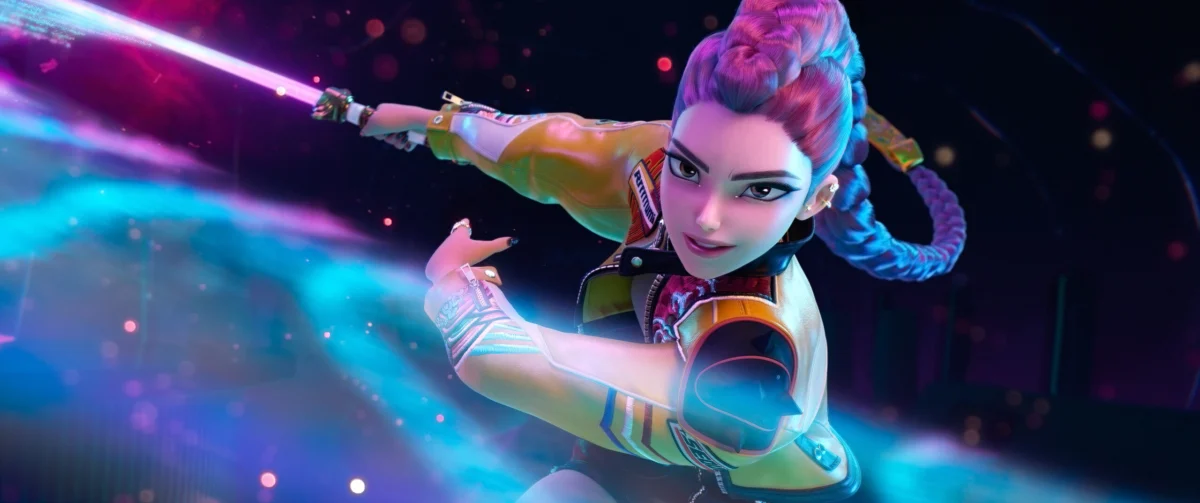
As the animation pipeline gathered speed, Babcock turned his attention to the physical world of the film, specifically HUNTR/X’s magical weapons and supernatural communication tools. Rather than relying solely on stock sound libraries, Babcock sought physical, tangible sources. By ordering tuning forks online and manipulating their resonance, he forged a distinct, organic clang for the characters’ swords that matched the key and tempo of the background tracks.
Phase 3: Character Animation and Spirit Messengers
Midway through production, the sound team tackled the film’s non-human characters: the shapeshifting spirit messengers (a tiger and a magpie representing Korean societal archetypes). Because the animators infused these creatures with an endearing, comedic clumsiness, Babcock had to walk a fine line. Animating cute characters requires a softer, more nuanced touch in the sound booth than creating outright monsters. Babcock combined raw animal vocalizations with his own pitch-shifted voice treatments to give characters like "Derpy" a living, breathing emotional range.
Phase 4: The Climax and Final Mix
The project culminated in what Babcock describes as one of the most intensely rewarding mixing sessions of his career. Spanning from the Saja Boys’ performance of their signature track “My Idol” straight through to the film’s sprawling narrative finale, the sequence demanded absolute synchronization. Every hit, swoosh, and supernatural groan had to lock precisely into the musical meter, resulting in a dense wall of sound that feels massive yet remarkably transparent.
Supporting Data & Technical Craftsmanship
K-pop music is defined by its immaculate, highly polished production value. To capture that exact sheen within an action-animation hybrid, Babcock had to reverse-engineer modern recording studio techniques.
“K-pop music is very intricate and has a certain polished sound to it,” Babcock explained in an interview with IndieWire. “So it really gave me the excuse to listen to a bunch of different K-pop music and pop music.”
This research directly influenced how the demonic entities were vocalized. By studying production tricks popularized by avant-garde and mainstream pop vocalists like Billie Eilish and Imogen Heap, Babcock deployed complex chains of reverbs, delays, and chorusing effects. Because harmony serves as a major thematic pillar of the narrative, these vocal layering techniques were mirrored in both the heroes’ musical numbers and the villains’ corrupting influence.
Furthermore, the integration of sound effects into the musical score required strict mathematical and rhythmic precision.
"They’re in the beat," Babcock noted regarding the film’s kinetic combat sequences. "If there are any kind of hits, anywhere in any of the songs, they’re to the beat. So that’s a lot of fun. But also finding an organic way to do that and not take away from those great songs — for example, the swords, I’m super proud of them. I didn’t want them to sound too processed, for them to have some organic genesis to them, so I went on Amazon and bought a bunch of tuning forks, and we manipulated those. They kind of sound like swords when they resonate."
This philosophy extended to the creature work. Bringing the folkloric tiger and magpie to life required a hybrid approach of organic field recordings and custom vocal tracking. Balancing the creature’s visual goofiness with its mythological weight proved to be a masterclass in restraint.
Official Responses and Creative Perspectives
The collaborative synergy between the directors and the sound department was vital in preventing the film’s audio landscape from fracturing under the weight of its dual identities as both an action movie and a musical. Directors Chris Appelhans and Maggie Kang gave Babcock the creative latitude to experiment early, trusting that a musical foundation would anchor the film’s more chaotic supernatural elements.
Reflecting on the sheer volume of audio packed into the final cut, Babcock expressed astonishment at how much sonic material the team managed to smuggle into the mix without crowding out the musical score.
"There’s actually more sound design than I thought we’d get away with, and it doesn’t sound different than how you’d hear the songs on the album," Babcock said. "It’s a combination of being exactly precise and, frankly, tasteful, between the music and anything else going on."
Implications for Animated Musicals and Sound Design
The success of the sound design pipeline on Kpop Demon Hunters establishes a compelling new blueprint for future animated musicals, particularly those operating within high-concept fantasy or sci-fi genres.
Traditionally, sound design in animation is treated as a post-production layer added after the picture and score are largely locked. By bringing a supervising sound editor into the fold before the animation phase even commenced, the production of Kpop Demon Hunters bridged the historical gap between the music department and the sound effects editorial team.
When sound effects are written, pitched, and timed to act as percussive extensions of the musical score, the traditional friction between dialogue, sound effects, and music disappears. The action sequences do not interrupt the songs; rather, the action becomes part of the song’s rhythm.
As streaming platforms and studios continue to chase high-concept, culturally specific animated spectacles, the rigorous methodology pioneered by Babcock, Appelhans, and Kang demonstrates that heavy sonic layering does not have to result in noise. Through early collaboration, meticulous pitch-matching, and a profound respect for the source musical genre, Kpop Demon Hunters proves that sound design can fly as close to the sun as it dares—provided it stays right on the beat.