
Inside the Making of Wildwood: How Laika Pushed Stop-Motion Animation to Its Absolute Breaking Point
By Jamie Lang | October 14, 2026
Main Facts
Laika, the acclaimed stop-motion animation studio renowned for its artistic and technical wizardry in films like Coraline, ParaNorman, and Missing Link, has once again raised the bar for the entire animation medium. Its upcoming feature, Wildwood, stands as not only the studio’s most colossal and ambitious production to date, but arguably the most complex stop-motion film ever attempted in cinematic history.
At the prestigious View Conference in Turin, Italy, Laika’s effects supervisor Steve Emerson pulled back the curtain on the grueling, multi-year production pipeline. Sharing extensive behind-the-scenes insights, Emerson outlined the staggering scale of the project, which required a marriage of meticulous handcrafted artistry and cutting-edge digital visual effects.
The numbers associated with Wildwood border on the surreal: 223 handcrafted puppets, 132 meticulously detailed practical sets, 728 handmade trees representing 10 authentic Pacific Northwest species, and a jaw-dropping 142,030 replacement faces. Among these figures lies a new stop-motion record—a single shot that required 1,124 individual facial replacements to achieve a seamless, highly expressive performance.
Beyond the physical builds, the production’s digital and compositional scope doubled nearly every metric of Laika’s previous output. For an industry that measures progress in fractions of an inch and frames per second, Wildwood represents a tectonic shift in how stop-motion features are conceptualized, shot, and executed.
Chronology: A Production That Defined a Decade
The journey of Wildwood has been a marathon of endurance for the artists and technicians involved. The timeline of its creation speaks volumes about the sheer patience required to bring Laika’s vision to life.
- February 2020: Stage animation officially commences on Wildwood. Concurrently, Steve Emerson’s personal life begins a parallel timeline—his daughter starts elementary school just as the first frames of the film are being shot.
- The Pandemic and Production Years (2020–2025): Like many major Hollywood productions, Wildwood had to navigate the global disruptions of the early 2020s. However, unlike live-action or fully digital animation films that could easily pivot to remote workflows, stop-motion requires physical stages, tactile materials, and localized teamwork. The animation and visual effects pipeline stretched across a monumental 265 weeks from the start of stage animation to final delivery.
- October 2026: Speaking at the View Conference in Turin, Steve Emerson reflects on the passage of time, noting that his daughter is now a senior in high school, visiting colleges, driving a car, and dating—vividly illustrating that the film’s production cycle spanned nearly an entire era of childhood development.
Supporting Data: The Statistics of Scale
To truly understand the monumental undertaking of Wildwood, one must examine the raw data of its production. During his presentation, Steve Emerson provided a breakdown of the assets, shot counts, and technical thresholds that separated Wildwood from its predecessors.
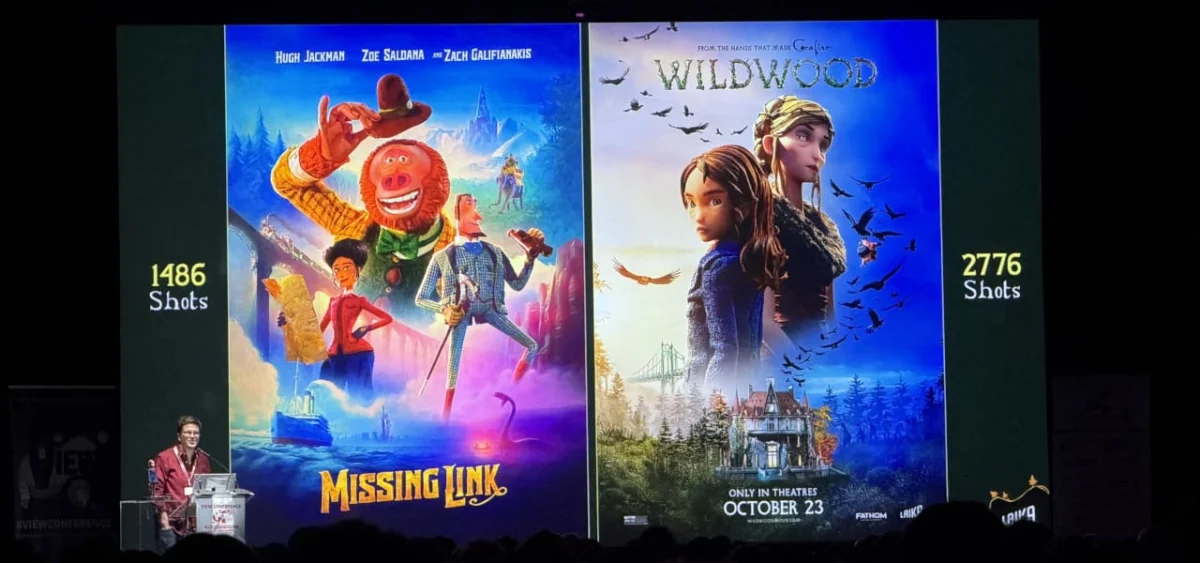
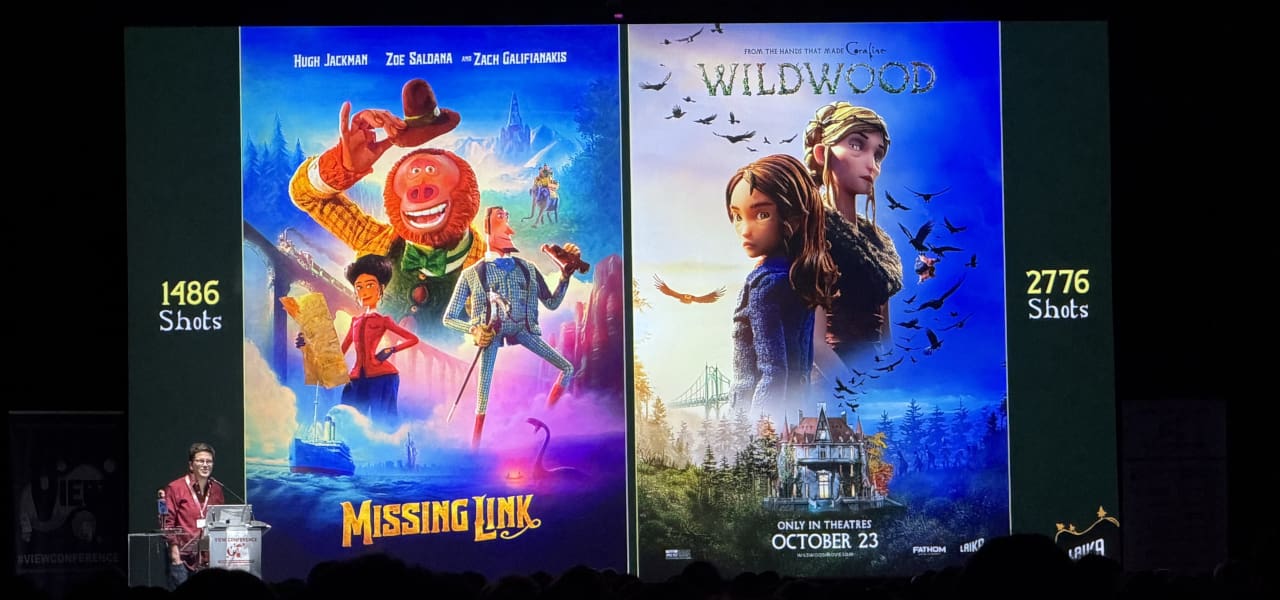
- Shot Count Expansion: Laika’s previous largest feature film, 2019’s Missing Link, clocked in at 1,486 shots—a massive, bold project by any historical animation standard. Wildwood, by comparison, shattered that record with a staggering 2,776 shots. Emerson noted that the studio was essentially tasked with making the equivalent of two full-length feature films, but with shots that were infinitely more complex.
- Puppet and Set Metrics: The production brought to life 223 handcrafted puppets and utilized 132 practical sets.
- The Flora of the Pacific Northwest: Setting the atmospheric mood of the film required 728 handmade trees, accurately representing 10 distinct Pacific Northwest tree species (a challenge that required the team to undergo a brief internal dendrology lesson to ensure authenticity).
- Facial Animation Records: To capture nuanced emotional performances, the studio produced 142,030 replacement faces. Most notably, one individual sequence required 1,124 facial replacements in a single continuous shot—establishing a new benchmark for the stop-motion industry.
Official Responses and Creative Methodology
During the View Conference panel, Emerson detailed how Laika managed the logistical nightmare of multiplying shots and complex character interactions. Rather than relying on traditional multi-puppet setups on a single physical stage—which often severely limits an animator’s physical access and framing options—Laika utilized an advanced separation pipeline.
"What’s more sort of consistent at the studio these days is that we will rehearse and we will block with multiple puppets, but then when it comes time to get the actual performance, we’ll split them out," Emerson explained. By shooting characters independently against green screens or matching plates and later compositing their performances together, animators could devote 100% of their focus to a single 10-inch puppet.
The ultimate goal of this technical wizardry, according to Emerson, remains deeply human: "Remember, we have basically a 10-inch inanimate object, and our goal is to get this thing into a movie theater and present it to the world and to human beings and create empathy and emotion."
The Nightmare Logic of the Animate Ivy
One of the most technically innovative and creatively risky elements of Wildwood involved the film’s sinister, moving ivy. Instead of defaulting to standard procedural digital simulations in software like Houdini—which would have been the path of least resistance—the visual effects and animation teams deliberately chose a harder path.
To create the uncanny, creeping movement of the villainous plant, the crew conducted physical stop-motion tests. They filmed miniature trees with wires being actively pulled, recorded the physical motion at an ultra-high 240 frames per second, and then played the footage backward.
.png)
The resulting movement was intentionally unorthodox. "It’s weird, and it’s twitchy, and it’s aggressive, and it’s nightmarish, and it was exactly the look that we were gunning for," Emerson said.
This hybrid methodology underscores Laika’s overarching creative philosophy: leveraging digital tools not to replace tactile filmmaking, but to honor and amplify it. "They’re keeping us honest," Emerson remarked regarding the physical arts departments, "and we’re making sure anything that is digital that’s being done for the film belongs and is representative of that stop-motion universe."
Implications for the Future of Stop-Motion Animation
The completion and eventual release of Wildwood carry profound implications for the animation industry at large, signaling a paradigm shift in what is believed to be possible within the stop-motion medium.
- Redefining Medium Boundaries: For decades, stop-motion has been viewed as a charmingly artisanal, albeit structurally limited, medium best suited for intimate stories or modest shot counts due to the immense labor involved. By scaling up to nearly 2,800 shots and managing hundreds of thousands of digital and practical assets, Laika has proven that stop-motion can match the sweeping scope and visual complexity of CGI-heavy blockbusters without losing its soul.
- The Evolution of Hybrid Pipelines: Wildwood serves as a masterclass in how practical artistry and digital compositing can coexist harmoniously. By utilizing multi-pass shooting and tactile physical experiments (such as the backward-played wire-pulled ivy), Laika has established a new blueprint for VFX supervisors working in stop-motion. It proves that digital tools are most effective when they mimic the imperfections and tactile weight of the physical world rather than glossing over them.
- Raising Industry Standards for Labor and Time: Emerson’s anecdote about his daughter growing from elementary school to college-bound while he worked on a single film highlights the immense human investment required for high-end stop-motion. While Wildwood showcases technical triumph, it also underscores the reality of long-term artistic stewardship, setting a standard of dedication that few studios globally can match.
As Wildwood prepares to meet audiences, it stands not just as a cinematic event, but as a monument to human perseverance, tactile craftsmanship, and the relentless pursuit of emotional resonance through miniature art.
