Disney’s High-Stakes Gamble: How ‘Avengers: Endgame — Encore’ and ‘Infinity Vision’ Are Reshaping the Premium Theatrical Landscape
By Media & Entertainment Desk
October 20, 2026
Introduction: A Nostalgic Blockbuster and a Strategic Test
Over the weekend, Hollywood witnessed a fascinating box office anomaly that highlights both the enduring power of cinematic nostalgia and the aggressive tactical maneuvering of modern studio distribution. Seven years after its initial historic theatrical run, Avengers: Endgame — Encore reclaimed the No. 1 spot at the American box office, pulling in an impressive $26 million.
While Walt Disney Studios is undoubtedly thrilled by the sheer drawing power of Earth’s Mightiest Heroes on the big screen once again, executive suites in Burbank are hyper-fixated on a much more specific metric: $13.5 million. That is the exact figure generated by Endgame: Encore on screens specifically bearing Disney’s new proprietary badge: InfinityVision.
This re-release was never merely about dusting off a past blockbuster to capture some easy weekend cash. Instead, it served as a live-fire stress test for a brand-new theatrical certification initiative designed to solve a massive logistical headache: what happens when your multi-million-dollar superhero tentpole gets locked out of IMAX screens by a competitive titan?
Main Facts: The Anatomy of Infinity Vision
To understand why Disney engineered the Endgame re-release, one must understand the genesis of Infinity Vision.
What is Infinity Vision?
Infinity Vision is Disney’s newly minted branding designation applied to theater screens that meet specific, internally vetted audio and visual standards. Crucially, it is not a new physical projection format, nor is it a traditional Premium Large Format (PLF) screen, and it is explicitly not IMAX.
The concept was born out of stark scheduling necessity. When Disney and Marvel Studios roll out Avengers: Doomsday on December 18, they will face a formidable roadblock: the entire footprint of domestic and international IMAX screens is already spoken for. Warner Bros.’ highly anticipated Dune: Part Three opens on the exact same weekend. Because Denis Villeneuve’s epic was shot natively on IMAX cameras, the return to Arrakis secured first-dibs on IMAX real estate, leaving the Marvel Cinematic Universe flagship high and dry.
Faced with the prospect of losing out on crucial premium-screen revenue, Disney crafted Infinity Vision. By certifying existing screens that offer superior audiovisual capabilities, Disney aims to convince consumers that watching a movie in an Infinity Vision theater provides a curated, top-tier event experience—even if it isn’t IMAX.
Chronology: From Scheduling Conflict to Box Office Beta Test
The timeline of Disney’s bold gambit reveals a tightly orchestrated rollout strategy:
The IMAX Roadblock: Months ahead of the holiday season, scheduling reveals that Avengers: Doomsday cannot access IMAX screens due to contractual obligations with Dune: Part Three.
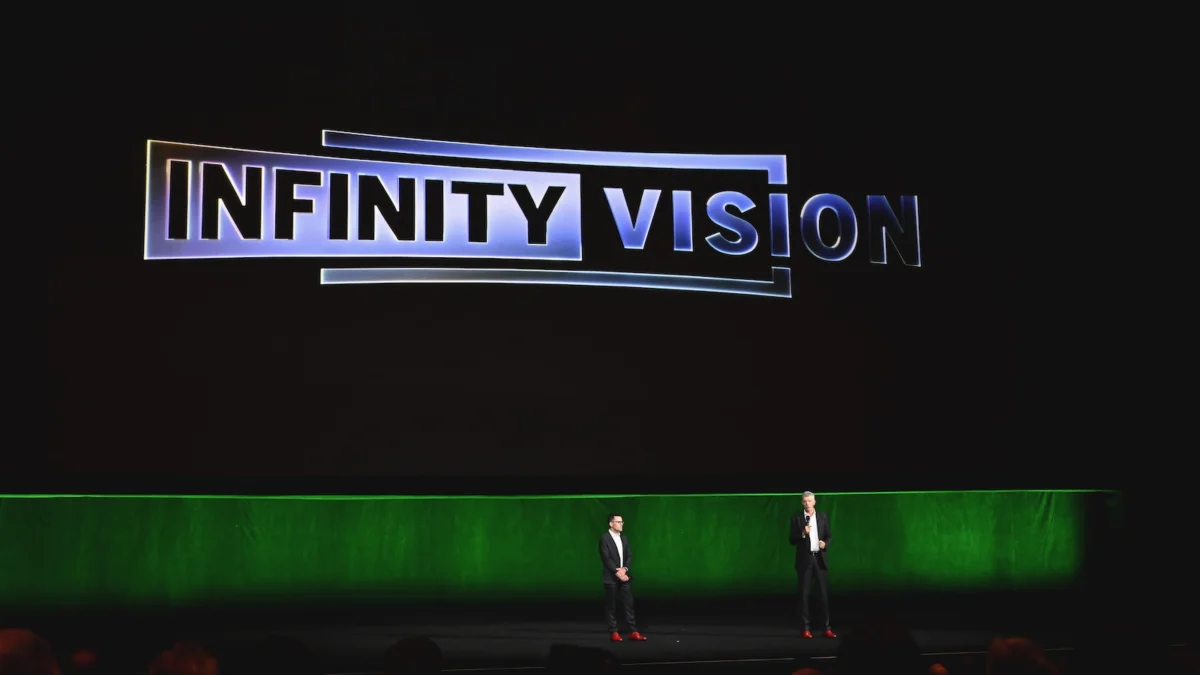
The Birth of the Brand: At CinemaCon earlier in the year, Disney unveils Infinity Vision, framing it as a quality-assurance standard rather than a new technology format.
The Beta Test (Endgame: Encore): Disney schedules a limited theatrical re-release of Avengers: Endgame — Encore across more than 3,000 screens. Out of those, exactly 1,300+ screens are certified and marketed under the Infinity Vision banner.
The Pre-Sale Window: Disney implements an early-access ticketing strategy, making Infinity Vision pre-sale tickets available before general admission passes go on sale, targeting core fans eager for the best possible viewing conditions.
The Weekend Payoff:Endgame: Encore wins the weekend box office with $26 million, with nearly 52 percent of that gross originating from Infinity Vision screens, despite those screens accounting for only 43 percent of the film’s total footprint.
Supporting Data: The Numbers Behind the Experiment
The financial breakdown of the Endgame: Encore weekend offers profound insights into consumer behavior and exhibition trends.
The Share Split:Avengers: Endgame — Encore played on over 3,000 screens nationwide. Of those, 1,300-plus were certified as Infinity Vision. These specific screens generated $13.5 million out of the film’s $26 million total domestic haul.
Efficiency Metrics: Capturing 52 percent of the total box office revenue from just 43 percent of the playing screens demonstrates a disproportionately high yield. For Disney, this proves that audiences actively notice the branding, seek it out on ticketing apps, and are willing to funnel toward certified auditoriums.
The Doomsday Pre-Sale Pipeline: The success of the Endgame test mirrors what is already happening with Avengers: Doomsday. IndieWire previously reported that a staggering 73 percent of Doomsday’s massive $50 million pre-sale haul has been logged on Infinity Vision screens. Because Endgame: Encore actually contended with a small number of competing IMAX engagements that Doomsday won’t have access to, industry analysts predict the eventual box office split for Doomsday on Infinity Vision screens could eclipse these numbers entirely.
Furthermore, unlike traditional PLF upgrades that often carry a steep ticket surcharge dictated by chains or premium formats, Infinity Vision does not automatically mandate an extra fee. It only triggers an upcharge if the individual theater exhibitor has already classified that specific auditorium as a PLF screen. This consumer-friendly nuance likely contributed to the high conversion rate during pre-sales.
Official Responses: Industry Perspectives
Transitioning a brand-new theatrical marketing concept from an internal idea to a consumer-facing reality is no small feat. Andrew Cripps, Disney’s Head of Theatrical Distribution, spoke candidly with IndieWire about the strategy, execution, and long-term outlook of the initiative.
"I think we’re all going to learn more about this," Cripps told IndieWire. "This is the first time out for Infinity Vision. We have marketed it, and we’ve had our exhibitor partners very engaged with this. If you go on the ticketing websites, there’s Infinity Vision banners on them. We’ve set up an Infinity Vision website with frequently asked questions so people can understand. But as you know, it takes a while to launch a brand and a new concept. So hopefully over time, people will become familiar with it and seek out Infinity Vision theaters."
Exhibitor buy-in is critical for a program like this to succeed. Fortunately for Disney, theater chains are responding proactively. Cripps noted that multiple major circuits are making active pushes to upgrade their hardware to meet certification requirements. For instance, several Cinemark locations in Latin America are currently overhauling their auditoriums to integrate Dolby 7.1 audio systems to secure the Infinity Vision badge.
Regarding consumer enthusiasm, Cripps emphasized that protecting the theatrical viewing experience remains paramount:
"We want those first audiences to see it in the best possible environment, and the fact that they’re snapping up the biggest and best screens is a very positive thing."
Implications: What Infinity Vision Means for the Future of Exhibition
As the dust settles on the Endgame: Encore weekend, the broader implications for Hollywood exhibition and distribution are coming into focus.
1. Breaking the IMAX Monopoly
For over a decade, IMAX has held an effective stranglehold on premium holiday event cinema. Studios releasing massive blockbusters without IMAX compatibility often saw their opening-weekend potential clipped. By creating Infinity Vision, Disney is effectively building a walled garden of premium presentation that it controls. It proves that a studio can direct traffic toward specific screens through clever marketing, early ticketing windows, and strategic partnerships with exhibitors.
2. Exhibitor Incentives and Theater Upgrades
Theater owners have struggled in recent years to incentivize capital expenditures on aging auditoriums. Programs like Infinity Vision give exhibitors a direct financial incentive to upgrade their sound and projection systems. When a major studio guarantees that its next $100M+ opening weekend will heavily prioritize certified screens, theater chains will race to hit those benchmarks to capture higher revenue splits.
3. Will Other Studios Adopt the Playbook?
While Infinity Vision is currently a Disney-exclusive initiative—with no other non-Marvel or non-Disney films currently scheduled under the banner—the long-term viability of the brand could pave the way for a broader industry shift. If independent studios or competing conglomerates like Universal or Paramount see that consumers willingly seek out curated "high-standard" auditoriums, similar quality-assurance branding could become standard practice across the entire theatrical landscape.
4. Managing Long-Term Expectations
Despite the successful beta test, Disney acknowledges that consumer education is a marathon, not a sprint.
"Long-term expectations are still evolving," Cripps admitted. "We’ll learn with every release that we have. We’re doing a deep dive with all of our markets around the world, and with our exhibitor partners, and we will get to a good place with all of this."
Conclusion
Disney’s deployment of Infinity Vision via the Avengers: Endgame — Encore re-release is a masterclass in modern studio problem-solving. Confronted with an immovable IMAX roadblock for Avengers: Doomsday, the studio didn’t just accept a compromised rollout—they invented a new category of prestige exhibition, marketed it effectively to die-hard fans, and validated its success with a staggering $13.5 million weekend test run.
As the December 18 release date for Avengers: Doomsday rapidly approaches, all eyes will be on those certified Infinity Vision screens. If the pre-sale trends and weekend metrics hold up, Disney will have successfully proven that when it comes to the theatrical box office, sometimes you don’t need the biggest brand in format technology—you just need to convince the audience that your badge means magic.