
Beyond the Formula: Screenwriting Legend Dan O’Bannon’s Legacy and the Art of the Craft
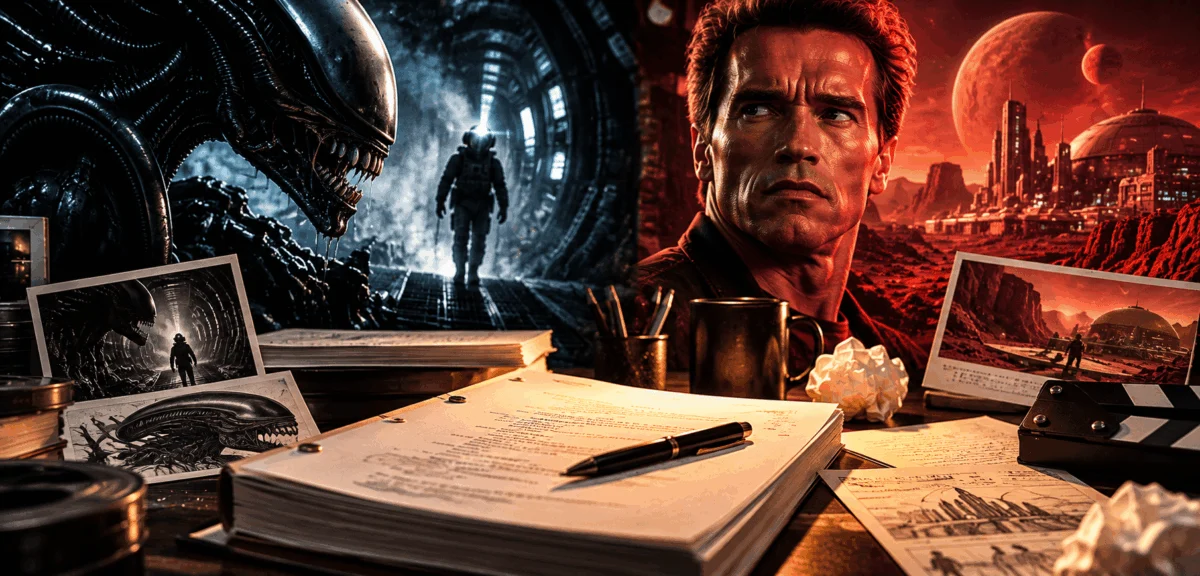
An in-depth retrospective and conversation with award-winning screenwriter and co-author Matt R. Lohr on the architecture of cinematic storytelling.
Main Facts: The Blueprint of Masterful Screenwriting
In the labyrinth of modern screenwriting, endless hours are dedicated to chasing the elusive "perfect formula." Aspiring writers pore over textbooks preaching the absolute dogma of the three-act structure, timing the exact page a protagonist must undergo a seismic shift, and mapping out predictable sequences designed to elevate an ordinary spec script into Hollywood gold. Yet, cinema history proves that the greatest films ever made treat structure not as a rigid cage or a golden destination, but rather as the essential, mechanical scaffolding that allows a living, breathing story to function.
Few individuals understand this philosophy better than Matt R. Lohr. An award-winning screenwriter, essayist, film critic, and co-author of The Dan O’Bannon Guide to Screenplay Structure, Lohr spent years working alongside one of the most wildly imaginative, boundary-pushing architects in Hollywood history: Dan O’Bannon. Best known as the creative force behind cinematic milestones such as Alien, Total Recall, and The Return of the Living Dead, O’Bannon left behind a legacy that continues to define how writers think about dramatic momentum, tension, and narrative mechanics.
Through a deep-dive interview, Lohr unpacks the unconventional lessons learned from collaborating with O’Bannon, offering a masterclass in how genre, structure, and raw storytelling instincts intersect to create timeless cinema.
Chronology: From Chapman University to Pacific Palisades
Matt Lohr’s journey into O’Bannon’s orbit reads like a classic Hollywood anecdote, born of academic ambition and a timely stroke of luck. In the early 2000s, Lohr was pursuing his Master of Fine Arts (MFA) in screenwriting at Chapman University. At the time, he was crafting his thesis screenplay under the mentorship of Leonard Schrader, the Academy Award-nominated writer celebrated for Kiss of the Spider Woman.
The turning point arrived when Schrader casually announced that Dan O’Bannon—then serving as the school’s filmmaker-in-residence—was looking for a bright, capable assistant to help him organize and develop a comprehensive book on screenplay structure. Lohr’s peers immediately recognized the weight of the opportunity. Before long, Lohr found himself renting cars, driving from Orange County up to O’Bannon’s home in Pacific Palisades, and stepping into a collaborative partnership that would forever reshape his approach to narrative art.
Their initial meeting shattered any expectations of a traditional, stuffy academic masterclass. After only a few minutes of polite conversation, O’Bannon deadpan-asked Lohr if he had ever experimented with psychedelic drugs. When Lohr admitted he hadn’t, O’Bannon dryly observed that his young assistant looked precisely like Clark Kent.
It was a brilliantly eccentric introduction to a visionary whose entire career was built on subverting expectations. Over the next two years, Lohr immersed himself in O’Bannon’s world. They spent countless hours analyzing classic films, dissecting narrative frameworks, and drafting the foundational manuscript that would become O’Bannon’s ultimate creative manifesto.
Following O’Bannon’s passing in 2009, his widow, Diane, reached out to Lohr, entrusting him with the monumental task of completing the manuscript. Lohr spent another year meticulously polishing, organizing, and breathing life back into the material, fiercely determined to preserve the singular, uncompromising voice of the mentor who had taught him so much.
Supporting Data & Direct Insights: Anatomy of a Masterpiece
What elevates Lohr’s experience above standard screenwriting lore is the provenance of his education. He wasn’t learning abstract screenwriting theories from an academic speculating on what works; he was sitting knee-to-knee with a creator who had actively terrified, surprised, and entertained global audiences with original concepts. O’Bannon’s understanding of story structure was hard-won, forged through decades of wrestling with his own scripts, enduring production nightmares, and discovering what genuinely resonated on the silver screen.
The Genisys Shift: How Alien Redefined Genre Structure
One of the most illuminating case studies explored in Lohr’s work with O’Bannon is the structural genius of Alien (1979). The film serves as a masterclass in how a screenplay can radically evolve its emotional stakes mid-stream without losing its audience.
As Lohr points out, the first half of Alien operates almost entirely as a pure science fiction procedural. The crew of the Nostromo are driven by curiosity about the unknown. They intercept a mysterious signal, touch down on an alien planetoid, navigate an unfamiliar environment, and meticulously attempt to decode what they have encountered.
Then, the iconic chestburster sequence strikes.
In a heartbeat, the emotional DNA of the entire film mutates. Curiosity instantly curdles into pure, unadulterated terror. The characters no longer care about the creature’s evolutionary biology, its origins, or the commercial interests of Weyland-Yutani; they simply want to survive. The narrative has successfully crossed a chasm, transforming from an exploratory sci-fi puzzle into a merciless survival-horror nightmare.
This structural pivot is far more than a cheap genre trick. It underscores a fundamental rule of elite screenwriting: a successful screenplay must dynamically evolve the audience’s relationship with its characters and conflicts. Stories that merely amplify the volume of the exact same dramatic situation quickly grow exhausting. Alien triumphs because its tonal shift feels structurally inevitable rather than arbitrary. The crew members are firmly established as relatable blue-collar workers before the horror consumes them. Their interpersonal friction, casual dialogue, and professional camaraderie matter, ensuring that when the monster begins picking them off one by one, the audience’s emotional investment is absolute.
The Contrast of Prometheus
To further illustrate this principle, Lohr contrasts Alien with Ridley Scott’s later prequel, Prometheus (2012). While visually stunning, Prometheus frequently stumbles because its ensemble lacks the organic, lived-in camaraderie of the Nostromo crew. In the original film, the characters feel like colleagues who have logged lightyears together—complete with gripes, mutual respect, and casual banter. In Prometheus, the scientists and crew often act with baffling isolation from one another, rendering their interpersonal dynamics difficult to root for. The takeaway for writers is stark: while high-concept spectacle and visual effects may lure an audience into a theater, rich and believable character relationships are what keep them emotionally tethered to the screen.
The Improvised Masterclass on The Return of the Living Dead
Education under O’Bannon rarely followed a conventional syllabus. Lohr recalls an afternoon visiting O’Bannon’s home to work on the book manuscript, which abruptly transformed into an impromptu screening of The Return of the Living Dead. O’Bannon happened to be reviewing the film’s color-correction timing for an upcoming home-video release.
As the movie played, the director began casually dropping behind-the-scenes gold: anecdotes regarding practical special effects, frantic location logistics, budgetary constraints, and critical narrative decisions made in the editing room. For an aspiring filmmaker, it was the ultimate, unscripted director’s commentary. It reinforced a vital truth: aspiring writers must transition from watching films purely for passive entertainment to viewing them with an analytical, scalpel-like precision. Asking why a scene works, why a character’s choice feels earned, and how a script survives a massive tonal shift is the fastest path toward mastering the invisible architecture of storytelling.
Practical Craftsmanship: Reading Dialogue Aloud
Perhaps the most immediately actionable advice Lohr champions from his mentorship is deceptively simple: Read your dialogue aloud.
As Lohr articulates:
"You’re not writing words that have to live on a page. You’re writing lines that actors have to be able to say."
Writers frequently fall in love with dense, florid passages of prose inside screenwriting software like Final Draft, failing to realize how unnatural those lines sound when spoken by a human actor. Characters should never be deployed merely as mouthpieces to efficiently dump exposition. Dialogue requires rhythmic cadence, distinct psychological motivations, idiosyncratic personalities, and the unpredictable, messy cadence of authentic human speech. Developing this ear requires becoming an obsessive listener to real-world conversations.
Official Responses & Industry Realities: Navigating IP Obsession
While O’Bannon’s structural theories—synthesizing the wisdom of Aristotle, Lajos Egri, Syd Field, and Robert McKee—provide a rigorous roadmap for narrative mechanics, navigating the modern Hollywood landscape demands a clear-eyed view of industry economics.
Today’s screenwriters face an uphill battle against Hollywood’s relentless fixation on familiar Intellectual Property (IP). Modern studio executives are overwhelmingly obsessed with "presale value"—the built-in commercial advantage of audiences already recognizing a brand. This systemic risk-aversion explains the endless assembly line of remakes, reboots, comic book adaptations, and toy-line adaptations.
For original screenwriters, this climate can feel intensely demoralizing. A brilliantly constructed, highly original spec script may languish unread, while a recognizable, recycled brand is fast-tracked despite glaring narrative flaws.
However, Lohr notes that independent filmmaking offers a vital sanctuary for originality. Furthermore, genres like horror possess a unique structural advantage: the genre itself often functions as the star. Audiences possess such an appetite for horror that they are routinely willing to gamble on completely unfamiliar premises and unknown casts, provided the film respects their intelligence.
Yet, this built-in audience carries a profound ethical responsibility. Relying on lazy jump scares and exhausted tropes is a betrayal of the genre. The finest horror films utilize the liberating elasticity of the genre to dissect deeply human, psychological, and emotional truths.
Implications: The Core Philosophy of Storytelling
At the emotional core of Matt Lohr’s reflections lies the ultimate philosophy imparted by Dan O’Bannon. Despite working extensively across science fiction, horror, action, and dark comedy, O’Bannon never viewed himself primarily as a "genre writer." He viewed himself simply as a storyteller.
As Lohr fondly remembers O’Bannon stating:
"I’m a storyteller. A lot of my stories just happen to involve monsters and things from outer space."
This perspective cuts cleanly through the endless white noise of modern screenwriting advice. Before a writer fixates on shifting trends, streaming algorithms, or fashionable formulas, they must ruthlessly interrogate their own commitment to the fundamental story at hand.
For indie filmmakers scraping together micro-budgets to shoot creature features in basements, crafting contained thrillers with two actors, or developing ambitious sci-fi epics with virtually zero visual effects allocation, the takeaway is absolute: Scale does not dictate seriousness. A modest budget is never an excuse for sloppy execution. Writers and filmmakers owe it to their audience—and their characters—to treat every project with total artistic integrity.
Summary Checklist for Writers in Crisis
When a screenplay inevitably hits a wall, Lohr advises against blindly hunting for another quick-fix structural gimmick. Instead, writers should return to foundational truths:
- Strip away the mechanics: What do your characters desperately want, and what insurmountable forces stand in their way?
- Interrogate the emotional journey: Why should the audience care, and how does the central dramatic situation evolve over time?
- Test the voice: Read every line of dialogue aloud to ensure it breathes with authentic human rhythm.
- Study the masters: Deconstruct films that have weathered the test of time and learn directly from practitioners who have faced the exact same creative trenches.
Ultimately, the enduring appeal of Dan O’Bannon’s work does not stem purely from xenomorphs, rotting zombies, or lavish practical effects. His stories endure because beneath their visceral, extraordinary surfaces lie airtight narratives engineered to capture, hold, and reward an audience’s attention. Structure provided the skeleton, characters supplied the pulse, imagination gave them a face, and a profound, abiding love of storytelling tied it all together.
The ultimate goal of writing is never merely to churn out a marketable horror script, a sci-fi pitch, or a paint-by-numbers franchise starter. The goal is to craft a story truly worth experiencing.
