Unshackling History: How Ken Russell and Derek Jarman’s ‘The Devils’ Shattered the Myth of the Drab Pre-Modern World
Main Facts: The Enduring Shock of a Cinematic Masterpiece
Decades after its explosive and controversial debut, Ken Russell’s 1971 cinematic masterwork The Devils continues to demand a reckoning. Based on real-world historical events, the film opens with a stark title card reminding audiences that its narrative is rooted in documented fact: in the 1630s, a charismatic French priest named Urbain Grandier was scapegoated, tortured, and burned at the stake for purportedly causing the demonic possession of a convent of Ursuline nuns in the provincial town of Loudun.
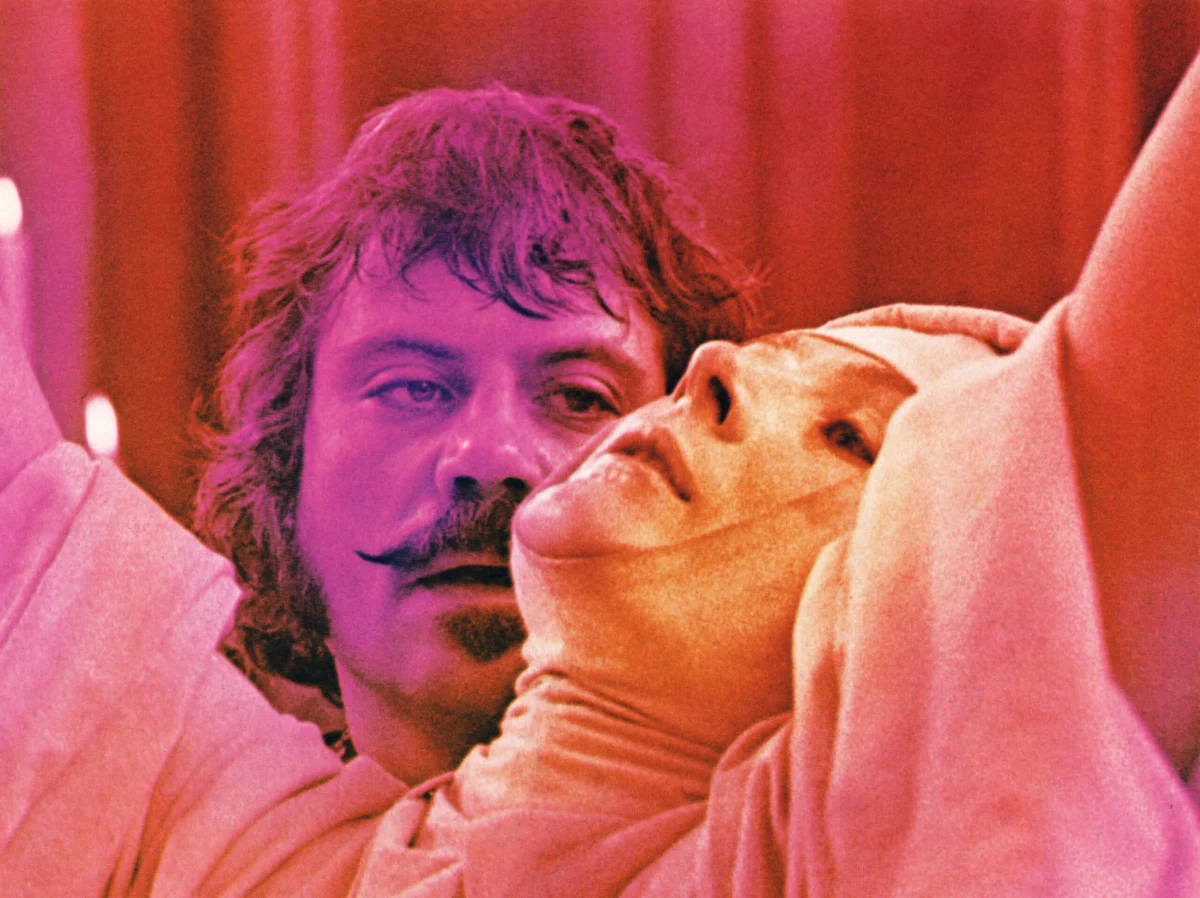
Yet, despite its historical foundations, The Devils looks utterly unlike the standard historical drama. While most period pieces settle for a predictable aesthetic of rugged authenticity or romanticized decay, Russell’s film employs a radically anachronistic, hyper-stylized visual design. It treats the seventeenth century not as a sepia-toned relic trapped behind glass, but as a vibrant, brutal, and viscerally immediate arena of political corruption, religious hysteria, and psychological repression.
At the heart of this visual triumph was a young production designer who would later become a legendary experimental filmmaker in his own right: DerekJarman. Stepping onto the soundstages of Pinewood Studios in London during pre-production, Jarman was tasked with building a world of titanic scale. The story demanded massive practical sets—not only to reflect the imposing fortifications of Loudun, which would eventually be dismantled by the state, but to visually capture the monumental clash between Grandier (portrayed with swaggering defiance by Oliver Reed), the tragically lovestruck Sister Jeanne des Anges (Vanessa Redgrave), local nobility, and the ruthless political operatives of Cardinal Richelieu.
What Pinewood initially offered Jarman, however, were standard moulds of seventeenth-century stone walls, artificially pre-distressed to look crumbling and weathered. Jarman rejected them outright, setting off a revolution in how cinema approaches the material reality of the pre-modern world.
Chronology: From Loudun to Pinewood, and the 4K Revival
To understand the radical nature of The Devils, one must trace both its historical origins and its turbulent cinematic timeline:
1630s: The historical tragedy unfolds in Loudun, France. Driven by political maneuvering, ecclesiastical jealousy, and mass hysteria, Urbain Grandier is put on trial for witchcraft and executed.
1952: Aldous Huxley publishes The Devils of Loudun, a sweeping nonfiction psychological and historical study of the possession case, providing the primary text for future adaptations.
1971: Ken Russell adapts Huxley’s work into a feature film. With Derek Jarman heading production design, the movie utilizes stark, modernistic white sets, clinical environments, and bold primary contrasts. Upon release, Warner Bros. and global censors subject the film to severe cuts, bans, and controversy due to its blending of religious satire, explicit sexuality, and graphic violence.
Decades in Limbo: For years, The Devils remains notoriously difficult to see legally, bogged down by rights issues and studio hesitancy. It achieves legendary status among cinephiles through bootlegs and rare retrospective screenings.
Present Day: A meticulously crafted 4K restoration of The Devils hits theaters, inviting a new generation of filmgoers and critics to reevaluate its astonishing production design, thematic prescience, and cinematic audacity.
Supporting Data: Dismantling the "Victorian Lens" of History
The visual language of The Devils is best understood as a direct assault on what film historians and design theorists refer to as the "Victorian lens" of history.
According to accounts in Richard Crouse’s book Raising Hell: Ken Russell and the Unmaking of ‘The Devils’, Jarman pointed out a fundamental historical truth that Hollywood has spent a century ignoring: in the 1630s, European buildings were not universally crumbling, soot-stained, or bare.
Much of our modern conception of the pre-modern world is filtered through nineteenth-century romanticism—the aesthetic shaped by Lord Byron and Mary Shelley, where medieval and early modern life is envisioned as stark gray stone standing in gloomy isolation against misty hillsides, lit exclusively by flickering candles beneath Gothic arches.
This lazy shorthand persists across contemporary cinema. Whether examining big-budget medieval epics like The Last Duel, historical television series like The Tudors and Wolf Hall, or recent festival features like The Uprising, contemporary production design overwhelmingly relies on a "mud-covered peasant" color palette. Bare stone walls and monochromatic grit are deployed to signal "history."
Yet, as historians note, pre-modern societies loved color. Plants yielded rich dyes, and anyone of means—let alone the church or the aristocracy—utilized tapestries, frescoes, murals, painted plaster, and limewash to brighten and decorate their living spaces. While recent films like Catherine Called Birdy have made strides in embracing the vibrant color palette of medieval and early modern life, they still frequently default to bare-stone feasting halls.
Jarman and Russell completely rejected this sanitized, monochromatic tradition. Instead of a dusty, historically detached Loudun, they constructed an environment defined by gleaming white tiles, minimalist geometric layouts, and stark black-and-white contrasts. Grandier’s office features layers of rich texture that make the eventual destruction of his Late Medieval statuary feel like an unbearable violation.
The aesthetic sits comfortably between Fritz Lang’s expressionist future-city in Metropolis and the gothic nightmares of Guillermo del Toro’s Crimson Peak.
Official Responses and Insights from the Creators
The genius of Jarman’s design lies in its deliberate use of anachronism to forge an unbreakable psychological link between the audience and the screen. In a 1997 retrospective piece for Sight and Sound, Jarman reflected on the core inspiration behind the film’s most shocking visual motifs, pointing directly to Aldous Huxley’s text.
"The exorcism of Sister Jeanne was equivalent to a rape in a public lavatory," Jarman recalled, quoting a passage from Huxley that deeply affected him. "The image of the public lavatory, the impersonality of it all, stayed in my mind. That’s why I went for white tiles for the convent."
By transforming the convent into a sterile, clinical environment resembling a modern hospital ward or a public restroom, Jarman stripped away the romantic haze of historical distance. The exorcism chambers do not feel like relics of a quaint, superstitious past; they feel uncomfortably modern, clinical, and institutionalized.
This design philosophy extended across all strata of the film’s world. The court of Louis XIII was rendered with an opulent, club-ready sheen that contrasted sharply with the austere, utopian white geometry of Loudun and the hallucinatory, emotionally drenched fantasy spaces inhabited by Sister Jeanne.
Film critics and architectural historians have long noted how these sets utilize shape and color to parallel modern techniques of institutional oppression. By evoking the architecture of asylums and hospitals, Russell and Jarman weaponized space to mirror how modern systems of power impose control over the body, the mind, and societal mores.
Implications: Why The Devils Matters Now More Than Ever
The true triumph of The Devils is that it refuses to let the viewer off the hook. By rejecting the cozy tropes of traditional period pieces, Russell and Jarman ensured that the film’s barbarism cannot be dismissed as something primitive or left behind by the march of progress.
The historical forces at play in Loudun—the opportunistic weaponization of superstition, the state-sanctioned persecution of the marginalized, the policing of female sexuality, and the manipulation of public fear for political gain—are not historical curiosities. They are perennial human failings.
The heightened, theatrical, and aggressively tactile nature of Jarman’s sets—augmented by practical effects, bodily fluids, and uncompromising framing—creates a world that feels as close to our material reality as it does to the seventeenth century. Viewers cannot stand outside the world of The Devils; they are trapped inside its clinical, suffocating white corridors, forced to confront the mechanisms of hysteria from within.
With the recent 4K theatrical re-release of The Devils, audiences are once again granted the opportunity to experience a work that redefined what historical cinema could achieve. It stands as a monument to a brief, lightning-in-a-bottle collaboration between a visionary director and a legendary production designer—proving that sometimes, to tell the absolute truth about the past, you have to tear down the fake stone walls and build something entirely, terrifyingly new.