
Immortal Icons of Cinema: The Definitive Evolution of the Vampire Film Legacy
Introduction and Main Facts
While spectral apparitions are ubiquitous in cinema and the living dead have enjoyed cyclical waves of mainstream dominance, no classic cinematic monster holds a claim to a richer, more enduring legacy than the vampire. Nearly as old as the medium of motion pictures itself, the cinematic vampire has transcended its origins in folklore and Gothic literature to become a flexible canvas for exploring human fears, desires, and cultural anxieties.

In celebration of the horror season, film critics and editors have continuously revisited and refreshed the definitive canon of vampire cinema. This sprawling survey of the undead spans more than a century of filmmaking, capturing everything from silent expressionist nightmares and classic Hollywood studio monster features to erotic European arthouse triumphs, contemporary indie mood pieces, and irreverent comedies.

The genre’s appeal lies in its adaptability. Unlike rigid slashers or straightforward creature features, the vampire functions simultaneously as a romantic anti-hero, a terrifying predator, a metaphor for addiction, a symbol of repressed sexuality, and a vehicle for social satire. As curated by a collaborative pool of film critics—including Sarah Shachat, Chris O’Fault, Ryan Lattanzio, Jude Dry, Tambay Obenson, Christian Blauvelt, Eric Kohn, and Zack Sharf—the ultimate vampire movie archive proves that while the creatures may feed on the living, the genre itself refuses to wither away.

Chronological Evolution of the Vampire Cinema
To understand the scope of the vampire film legacy, one must trace its lineage from the shadows of early 20th-century German Expressionism to the diverse, globalized landscape of the 21st century.

The Silent Era and the Birth of Cinematic Dread (1920s)
The cinematic bloodsucker was born in an era of silent shadows. F.W. Murnau’s unauthorized 1922 adaptation of Bram Stoker’s Dracula, titled Nosferatu, introduced the world to Count Orlok (portrayed unforgettably by Max Schreck). Unlike the suave aristocrats that would follow, Orlok was rodent-like, plague-ridden, and utterly monstrous. Nosferatu established the cinematic grammar of vampirism: sunlight as a lethal force, elongated shadows climbing stairwells, and the fatal allure of the undead. Though Bram Stoker’s estate famously attempted to destroy all prints of the film due to copyright infringement, a few survived, preserving a foundational masterpiece of horror history.

The Universal Monsters and Golden Age Hollywood (1930s–1950s)
Universal Studios codified the vampire in the American consciousness with Tod Browning’s 1931 adaptation of Dracula, starring Bela Lugosi. Lugosi’s performance—defined by his hypnotic European accent, formal evening wear, and magnetic posture—created the blueprint for the aristocratic vampire for decades to come.

Following Universal’s reign, the British studio Hammer Film Productions revitalized the genre in the late 1950s with color, visceral blood, and a surge of eroticism. Christopher Lee’s towering, feral portrayal of Dracula in 1958’s Dracula (released as Horror of Dracula in the US) alongside Peter Van Helsing countered Hollywood’s censorship codes with a thrillingly physical and aggressive style of horror.

The Global Expansion of the Undead (1970s–1980s)
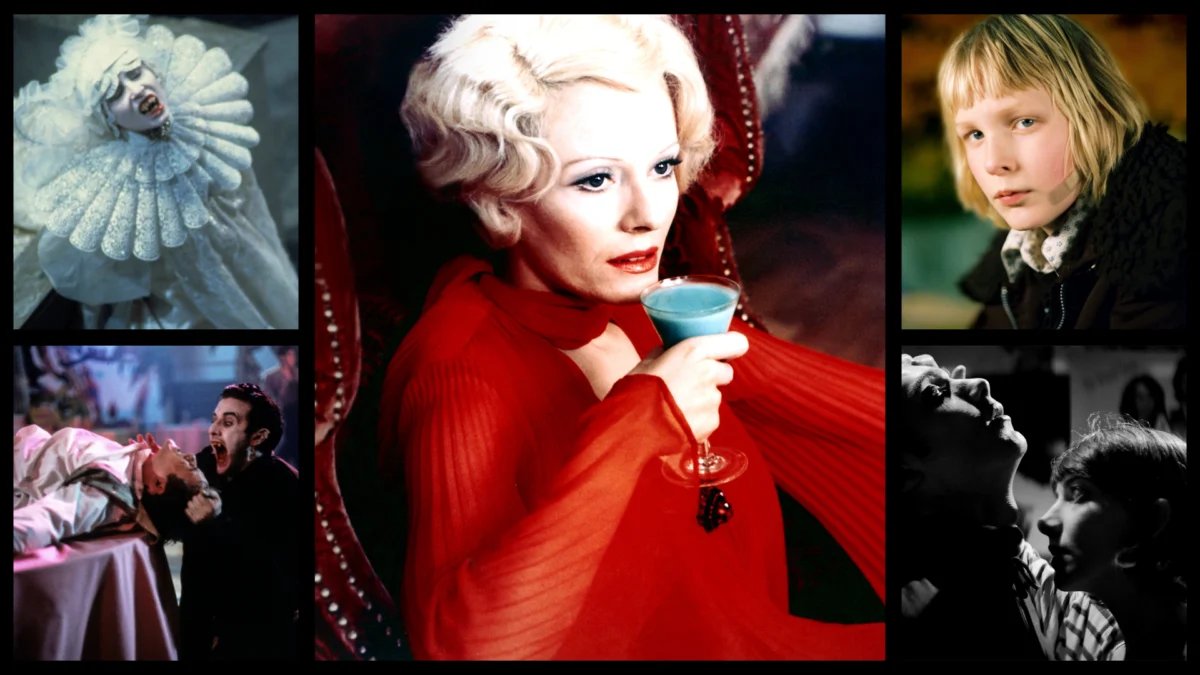
As the decades progressed, international filmmakers began bending the rules of vampire lore. Europe embraced atmospheric and transgressive interpretations, such as Harry Kümel’s 1971 Belgian cult classic Daughters of Darkness, a lush, lesbian-coded vampire tale set in an eerie off-season resort.

By the 1980s, vampires became sleek, modern, and stylized. Kathryn Bigelow’s Near Dark (1987) reframed vampires as a nomadic, leather-clad family of highway outlaws, marrying neo-Western grit with nocturnal horror. Concurrently, Joel Schumacher’s The Lost Boys (1987) fused MTV-era aesthetics, teenage angst, and rock-and-roll cool, proving that youth culture and vampirism were a natural match.

The Arthouse, Romantic, and Modern Renaissance (1990s–Present)
The 1990s ushered in a push toward grand romance and psychological depth. Francis Ford Coppola’s lush, operatic Bram Stoker’s Dracula (1992) returned to the literary source material while drenching it in theatrical excess, gothic tragedy, and breathtaking costume design by Eiko Ishioka.

As the genre entered the 21st century, global auteurs reinvented the mythology. South Korean master Park Chan-wook delivered Thirst (2009), an erotic, morally complex drama about a Catholic priest who contracts the virus, exploring faith, bodily fluids, and forbidden desire.

Independent cinema also found fresh, unexpected angles. Ana Lily Amirpour’s 2014 Iranian-American indie A Girl Walks Home Alone at Night combined the tropes of the Western, the graphic novel, and feminist empowerment, following a skateboarding chador-clad vampire stalking the desolate streets of "Bad City."

Meanwhile, the mockumentary format was brilliantly subverted by Taika Waititi and Jemaine Clement in What We Do in the Shadows (2014), proving that centuries-old undead roommates struggling with chores and nightclub entry policies could generate as many laughs as screams.

Supporting Data and Critical Consensus
What makes a vampire film endure across generations? According to critical aggregate data from long-running industry lists, the genre’s longevity stems from its refusal to stay tethered to a single tone.

- Diversity of Tone: The definitive pantheon of vampire cinema is remarkably balanced across sub-genres. Roughly 30% of critical favorites lean into psychological arthouse and gothic romance, 30% favor straight-ahead supernatural horror and gore, 20% explore modern urban realism, and 20% utilize satire and dark comedy.
- Longevity Across Decades: While the 1970s and 1980s produced some of the most culturally iconic cult classics, the 21st century has seen an unprecedented explosion of independent, international vampire storytelling. Filmmakers from Asia, the Middle East, and Europe have successfully localized the folklore to reflect contemporary socio-political realities.
- Financial and Critical Return: Historically, vampire films have offered studios high financial returns relative to their production budgets. Because the mythos relies heavily on atmosphere, practical effects, and interpersonal tension rather than massive CGI spectacles, works like Let the Right One In (2008) and Near Dark achieve critical acclaim and cult longevity on modest financing.
Official Perspectives and Critical Insights
Industry insiders and critics note that the enduring resilience of the vampire mythos is directly tied to its use as a psychological mirror.

"Vampires have always survived because they represent whatever culture fears or desires most at a given moment in history," notes senior film criticism. In the Victorian era, they represented repressed sexuality and the fear of foreign corruption. During the mid-20th century, they mirrored aristocratic decay and class anxiety. In the modern era, they frequently serve as metaphors for addiction, terminal illness, generational trauma, and the vampiric nature of consumer capitalism.

Furthermore, directors who have tackled the genre often emphasize the necessity of subversion. When speaking on his approach to Thirst, director Park Chan-wook noted that the challenge of vampire cinema is stripping away the cliché to find the raw, agonizing humanity beneath the fangs. Similarly, modern creators continue to find inventive frameworks—whether through comedy, feminist revenge narratives, or minimalist romance—to ensure the bloodsucker never feels stale.

Implications for the Future of Horror Cinema
The constant evolution and reappraisal of vampire cinema carry significant implications for the broader horror genre and the entertainment industry at large.

- A Blueprint for Franchise Longevity: As Hollywood increasingly relies on intellectual property and cinematic universes, the vampire genre offers a timeless, open-source-adjacent template. Because Stoker’s archetypes and folkloric roots exist in the public domain, independent and major studios alike can endlessly reinvent the mythology without being trapped in rigid continuity models.
- Globalized Storytelling: The shift toward international vampire narratives—from South Korea and Iran to Scandinavian arthouse cinema—signals a broader trend in modern film consumption. Audiences are increasingly receptive to horror that utilizes localized cultural lenses to tell universal stories about isolation, desire, and mortality.
- The Death of Monolithic Monsters: Gone are the days when a single cinematic interpretation of a monster could dominate for decades. Today’s audiences demand variety. The modern vampire canon proves that a single cinematic monster can simultaneously be a figure of profound romantic tragedy, a vehicle for biting social satire, and an agent of pure, visceral terror.
As long as humanity wrestles with the dual impulses of love and destruction, hunger and restraint, the cinematic vampire will continue to rise from its coffin, sharp-toothed and eternally relevant.
