
The Thirteen-Year Odyssey: How Barbed Wire City Redefined Wrestling Documentaries
Documentary filmmaking is rarely a linear path. While some projects are birthed from corporate commissions or high-budget grants, others emerge from a place of obsession—a deep-seated need to unravel a world that the mainstream has either dismissed as trash or ignored entirely. This is the origin story of Barbed Wire City, an ambitious, grueling, and ultimately revelatory documentary that chronicled the rise and fall of Extreme Championship Wrestling (ECW).
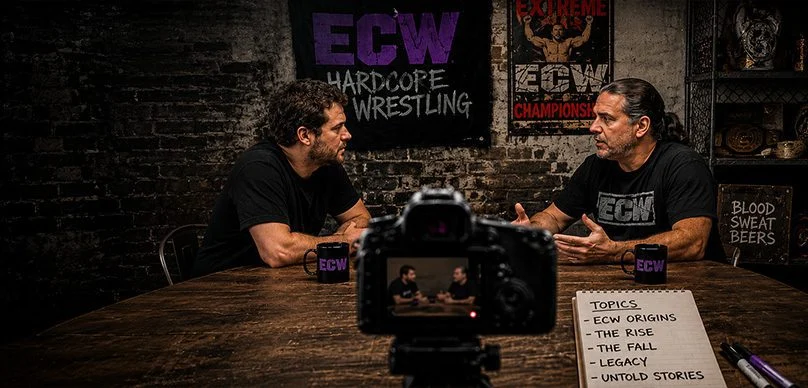
In a recent deep-dive conversation, filmmaker John Philapavage detailed the thirteen-year odyssey required to bring this project to the screen. What began as a teenager’s fan-driven curiosity morphed into a complex anthropological study, revealing not just the grit of the ring, but the human cost of a culture built on blood, spectacle, and broken promises.
The Genesis: From DIY Fandom to Anthropology
John Philapavage’s journey did not begin in a prestigious film school or on a Hollywood backlot. Like many of the most compelling independent storytellers, his craft was honed in the trenches of DIY culture. Alongside his lifelong creative partner, Kevin Kernan, Philapavage grew up in the Pennsylvania landscape, an area steeped in the specific, visceral energy of underground professional wrestling.
Equipped with VHS cameras and a penchant for comic books and experimental storytelling, the duo wasn’t just watching the matches. They were observing the ecosystem. They were fascinated by the symbiotic, often volatile relationship between the promoters, the performers, and the fan base that gave ECW its cult-like identity. Over time, their interest shifted from the spectacle of the wrestling itself to the "emotional ecosystem" that fueled it. This was no longer just fandom; it was the birth of an anthropological inquiry into a subculture that defied traditional sports-entertainment logic.
Redefining the Narrative: Truth Over Nostalgia
One of the most profound challenges Philapavage faced was shifting the audience’s expectations. When Barbed Wire City was announced, the prevailing assumption among the wrestling community was that the film would serve as a "greatest hits" compilation—a glossy, nostalgic tribute to the blood-soaked glory days of the 90s.
Philapavage, however, had no interest in producing propaganda. His goal was to document the truth, regardless of how uncomfortable it made the subjects or the viewers. To capture the reality of ECW, the film had to tackle the difficult subject matter: the systemic manipulation of talent, the physical toll of extreme violence, and the lingering psychological trauma that persisted long after the promotion folded.
The Conflict of Memory
The production was plagued by a fundamental documentary obstacle: the subjectivity of memory. In a business built on the blurring of lines between reality and scripted performance, finding a singular objective truth was nearly impossible.
"There’s your version, my version, and the truth," Philapavage noted during the interview. This became the thematic backbone of the project. Interview subjects frequently contradicted one another; some willfully distorted facts to protect their legacy, while others were so deeply enmeshed in the "work" (wrestling parlance for the con) that they could no longer distinguish between their personas and their true selves. For the filmmakers, the task was not merely to record interviews, but to act as forensic historians, untangling decades of myth-making.
The Psychology of the Interview: Earning Access
Early in the production, Philapavage hit a wall that many documentarians face: the perception of being "just a fan." When he approached wrestling icons, they initially viewed him with skepticism or condescension, which severely limited his access.
To bridge this gap, Philapavage had to undergo a personal transformation. He stopped approaching his subjects as a supplicant seeking validation and began positioning himself as an investigator. This subtle shift in professional posture was the key to unlocking the project. Trust was not built in a day; it was earned through years of persistence and a refusal to back down when access was denied. By demonstrating a genuine, non-judgmental interest in the lives of the performers, he eventually broke through the defenses of those who had been burned by the industry time and time again.
Moments of Danger: The Reality of the Field
The documentary is punctuated by moments that feel less like film production and more like survival. Philapavage recounts a chilling interview with the late wrestling legend New Jack. During the conversation, New Jack sat with a sharpened machete resting across his lap.
The tension in the room was palpable and authentic. In these moments, Philapavage discovered a cardinal rule of documentary filmmaking: the importance of remaining calm. By resisting the urge to react or retreat, he allowed the unpredictable nature of his subjects to manifest on camera. Some of the most poignant moments in Barbed Wire City were not the result of carefully crafted interview questions, but of simply holding the space long enough for the subjects to reveal their humanity—and their darkness—unfiltered.
The Economics of Independence: Lessons in Crowdfunding
Beyond the creative struggle, Barbed Wire City serves as a sobering case study in the logistics of independent filmmaking. Philapavage speaks with brutal honesty about the realities of crowdfunding, a tool that has become a double-edged sword for modern creators.
Many crowdfunding campaigns collapse not because of a lack of passion, but because of a failure to account for the "hidden taxes" of production. Philapavage outlines the critical oversights that can cripple a project:
- Logistics and Fulfillment: Underestimating the rising costs of shipping and handling rewards.
- Operational Expenses: The "hidden" drain of travel, equipment maintenance, and legal licensing fees.
- The Scalability Trap: How a campaign can successfully raise funds but fail to account for the overhead of delivering on those promises.
For any aspiring filmmaker, his advice is clear: the money raised is rarely "creative" capital. Most of it is swallowed by the machinery of production and distribution. Without a rigorous, almost ruthless approach to budgeting, even the most successful campaign can leave a filmmaker in debt.
The Endurance Test: Why the Film Matters
Ultimately, Barbed Wire City is not really about wrestling. It is not about the ECW arena, the barbed wire, or the nostalgia of a bygone era. It is a testament to the sheer endurance required to finish an independent project without the safety net of studio financing.
For thirteen years, the film was a recurring presence in Philapavage’s life—it stalled, it was revived, it evolved, and at several points, it nearly vanished into the ether. Yet, he continued to refine the story, gather footage, and hold onto the conviction that this history needed to be documented.
The Larger Implications
The success of Barbed Wire City highlights a growing trend in modern media: the move toward "long-tail" documentary work. In an era of instant content and rapid-fire streaming releases, the value of a thirteen-year project lies in its perspective. By sitting with a subject for over a decade, the filmmaker is able to see past the performance and into the long-term consequences of the lives they are chronicling.
This project serves as a bridge between the niche fandom of wrestling and the broader, more universal themes of obsession, the loss of identity, and the struggle to maintain one’s truth in a world that thrives on illusion. It stands as a reminder that the most compelling stories are rarely the ones that are easiest to tell. They are the ones that require the creator to sacrifice years of their life to ensure that the truth, however ugly or complex, is preserved for posterity.
In the end, Barbed Wire City is a masterclass in persistence. It challenges the next generation of filmmakers to look beyond the surface, to earn the trust of the "ignored," and to understand that the true story is almost always found in the silence between the questions.
