
A Final Curtain Call: André Gregory, Larry Pine, and Gerry Bamman Return to Beckett’s Endgame in One More Time
Main Facts
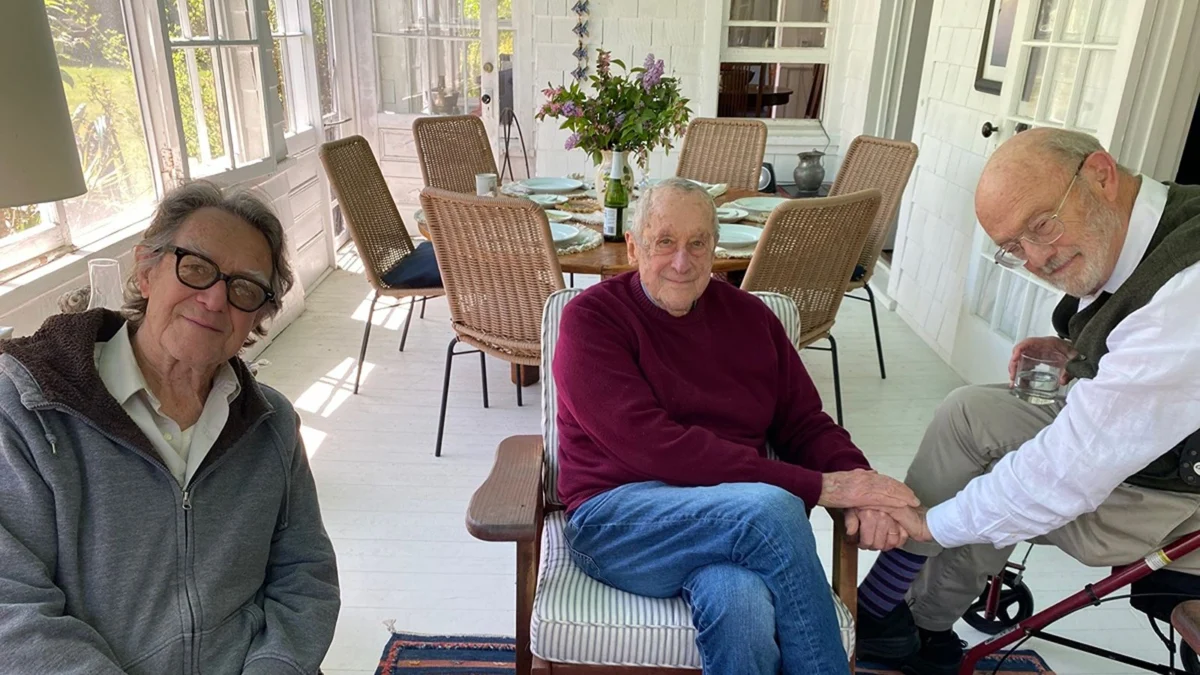
At the intersection of theatrical history, aging, and the absurd, a new documentary film titled One More Time captures an extraordinary, poignant reunion. Directed by Cindy Kleine—the longtime partner and collaborator of visionary theater impresario André Gregory—the film chronicles the late-stage artistic reunion of three towering figures of the American avant-garde: Gregory, actor Larry Pine, and actor Gerry Bamman.
Now well into their 80s and 90s, the trio has reconvened to tackle Samuel Beckett’s seminal 1957 absurdist masterpiece, Endgame. The project is not a traditional theatrical staging, but rather a deeply personal documentary record of a final, reflective run-through. Confined to Pine’s home, the veterans of the legendary 1970s theater collective known as the Manhattan Project attempt to perform excerpts of the play that defined their youth.
Against the backdrop of contemporary socio-political anxieties—specifically mapped onto the 2025 Los Angeles Eaton Fires and the dawn of Donald Trump’s second presidential term—One More Time blends the apocalyptic themes of Beckett’s script with the stark, real-world realities of the artists’ declining health, mobility struggles, and cognitive hurdles. The film, which recently screened at the 2026 New York Film Festival, serves as an intimate cinematic elegy for a bygone era of American avant-garde theater.
Chronology: From the 1970s Avant-Garde to a 2026 Film Festival Debut
The Genesis of a Lifelong Collaboration
The story of One More Time spans over half a century. In the late 1960s and early 1970s, the American theater scene was undergoing a radical transformation, fueled by countercultural energy, anti-establishment experimentation, and a rejection of traditional Broadway conventions. At the center of this movement was André Gregory, an avant-garde director who founded the Manhattan Project.
In 1973, the Manhattan Project unveiled their landmark production of Samuel Beckett’s Endgame. The staging became a legendary touchstone in theatrical history. Esteemed New York Times theater critic Clive Barnes famously hailed it as "one of the best things in the American theater." Within this crucible of artistic innovation were young actors Larry Pine and Gerry Bamman, whose careers were just beginning to take flight.
Decades of Divergent Careers
Following their formative years with the Manhattan Project, Pine and Bamman forged extensive, highly varied careers across stage, television, and film.
Larry Pine evolved into a kaleidoscopic character actor, seamlessly transitioning from soap operas to working with renowned cinematic auteurs. Gerry Bamman carved out a distinct niche as a recognizable character actor, immortalized in popular culture by audiences worldwide for playing Uncle Frank in Home Alone—the abrasive relative who memorably calls Macaulay Culkin’s character a "little jerk."
André Gregory, meanwhile, cemented his legendary status through unorthodox theatrical experiments, famously documented on film in Louis Malle’s acclaimed 1981 philosophical conversation piece, My Dinner with Andre.
The 2025 Reunion and 2026 Screening
Decades after first stepping into Beckett’s wasteland in their 20s, the trio decided to return to Endgame for what would undoubtedly be a final artistic hurrah. Filmed in 2025 at Larry Pine’s home, the project brought the octogenarians and nonagenarians back together. Armed with a battered, half-century-old edition of the script, they attempted to interpret the text under Kleine’s direction. The resulting documentary, One More Time, made its public debut at the 2026 New York Film Festival, drawing attention for its raw, unfiltered look at mortality and artistic perseverance.
Supporting Data: The Mechanics of the Project and the Realities of Aging
Navigating Text and Territory
Securing the rights to perform Beckett’s work is notoriously difficult, governed strictly by the notoriously protective Beckett estate. For One More Time, André Gregory successfully negotiated a specialized agreement allowing the production to utilize a curated selection of excerpts from Endgame. Rather than staging the full one-act play, these fragments are designed to distill the absolute essence of Beckett’s vision.
Gregory has long considered Endgame to be "the most difficult play ever written." The narrative itself centers on a blind, wheelchair-bound curmudgeon named Hamm and his long-suffering servant, Clov. The two characters are trapped together in an enclosed, gray interior, sheltered from a desolate, post-apocalyptic wasteland outside their window. Their existence is cyclical, repetitive, and defined by a morbid hesitation to reach the inevitable conclusion of their lives, as captured in Hamm’s opening declaration: "It’s time it ended and yet I hesitate to—to end."
The Physical and Mental Toll
The documentary does not shy away from the harsh physical and cognitive realities facing the performers. Decades have taken a heavy toll:
- Gerry Bamman, once kinetic and commanding on stage, now grapples with significant mobility issues that restrict his physical movement.
- Larry Pine faces the challenging progression of Alzheimer’s disease. In one of the documentary’s most striking and emotionally raw moments, Pine struggles visibly to recite a line of dialogue that had been passed along to him only moments prior, highlighting the frustrating friction between a lifetime of theatrical training and the erosion of memory.
Cinematic Form and Framing
Director Cindy Kleine frames these struggles through a distinct visual approach. The filmed rehearsals utilize alternating, sharply edited close-ups of Pine and Bamman. This directorial choice effectively silos the actors, physically separating them within the frame and occasionally breaking any cohesive illusion of a shared theatrical space. Yet, this fragmentation mirrors the thematic isolation of Hamm and Clov, bridging the gap between dramatic fiction and documentary truth.
Official Perspectives and Critical Reception
The Creators’ Vision
For André Gregory, returning to Endgame in the twilight of his life was an exercise in mapping dramatic fiction onto inescapable reality. In the documentary, Gregory draws a direct line between Beckett’s apocalyptic setting and the contemporary world of 2025, specifically invoking the devastation of the Los Angeles Eaton Fires and the political shockwaves of Donald Trump’s return to the presidency.
Trapped inside Larry Pine’s home as the world burns metaphorically and literally outside, the trio’s reenactment takes on an autobiographical urgency. Gregory notes the profound finality of their current chapter, observing with stark realism: "We don’t leave the house into a world that has 40 years in it." The repetitive, cyclical nature of Hamm and Clov’s dialogue functions as an ouroboros—a snake eating its own tail—manifested in lines like "the end is in the beginning and yet you go on."
Critical Analysis: Tributes and Accessibility
While One More Time has been celebrated as a profoundly moving historical document, critics have noted its distinct structural limitations for general audiences.
For cinephiles and theater historians intimately familiar with Gregory’s legacy, the Manhattan Project, and the towering cultural footprint of 1970s avant-garde theater, the documentary serves as a deeply affecting curtain call. It functions much like a classic rock band reuniting decades later to play their signature anthem one final time—a celebration of shared contributions and enduring creative bonds.
However, reviewers have pointed out that uninitiated viewers may find it challenging to connect with the material. The film largely omits broader biographical context regarding Pine’s diverse screen career or Bamman’s mainstream recognition. Furthermore, because the documentary prioritizes the casual, fragmented nature of the rehearsals over a polished dramatic presentation, Beckett’s original text is frequently overshadowed by the meta-narrative of the actors’ struggle to perform it.
Implications: The Legacy of Avant-Garde Theater and the Final Act
A Meditation on Artistic Mortality
One More Time transcends a standard behind-the-scenes documentary, emerging instead as a profound meditation on how artists age, how they confront the fading of their faculties, and how they utilize their lifelong craft to process their own mortality. By choosing Endgame—a play fundamentally obsessed with endings, waiting, and the bleak emptiness of the void—Gregory, Pine, and Bamman turned their final collaboration into a living mirror.
Preserving a Vanishing Era
The film also underscores a larger cultural shift. As the pioneers of the 1960s and 1970s avant-garde theater movement reach the ends of their lives, documents like One More Time become vital historical archives. They record not just the execution of a text, but the physical remnants of a theatrical philosophy that prioritized rigorous experimentation, psychological excavation, and uncompromising artistic integrity.
Ultimately, One More Time asks viewers to bear witness to the courage it takes to step back into the spotlight when the lights are dimming. As the documentary screened at the New York Film Festival, it left audiences with an enduring truth echoed by Beckett’s eternal text and embodied by Gregory, Pine, and Bamman: even when the end is undeniably in the beginning, the true artist still chooses to go on.
