
Beyond the Prompt: Autodesk Flow Studio Redefines AI Filmmaking with the 3D Editor + Canvas

Main Facts: The Intersection of Generative AI and Directable Control
For the past few years, the narrative surrounding generative artificial intelligence in media production has been dominated by a single paradigm: the prompt. Users type a text description into a black-box model, wait a few moments, and receive a 2D video clip. While the visual fidelity of these outputs has advanced at a breakneck pace, professional filmmakers have consistently encountered a fundamental limitation: you cannot direct a prompt.
Autodesk is aggressively moving to solve this industrial bottleneck. With its newly unveiled Autodesk Flow Studio, the software giant is pushing beyond prompt-driven video generation by introducing a comprehensive workflow designed to give creators precise, spatial, and directable control.
At the core of this system is the newly minted 3D Editor + Canvas architecture. Discussed in depth during a recent fxpodcast interview with Nikola Todorovic—co-founder of Wonder Dynamics and now a key technical leader at Autodesk—the platform bridges the gap between interactive 3D scene construction and the stunning visual power of generative 2D video models.
Rather than promising a utopian (or dystopian) "make a movie from a single sentence" button, Flow Studio is engineered to integrate AI seamlessly into existing professional pipelines. It caters to a wide spectrum of creators, ranging from lean, agile indie teams of three to five people all the way up to enterprise-level studio pipelines. By offering true 3D spatial management, Autodesk is providing the industry with the missing link in AI video production: granular creative direction.

Chronology: The Evolution from Wonder Dynamics to Autodesk Flow Studio
To understand the magnitude of Autodesk’s current release, it is necessary to trace the developmental lineage that brought the technology to this point.
- The Genesis of Automated Integration: Long before joining Autodesk, Nikola Todorovic and his team founded Wonder Dynamics, a company dedicated to solving one of the most tedious tasks in visual effects: character replacement and integration. The original Wonder Dynamics platform was a technical tour de force, combining roughly 25 distinct machine learning, computer vision, and generative systems to automatically place computer-generated (CG) characters into live-action footage.
- The Acquisition and Integration Phase: Recognizing the potential to scale these computer vision and AI tools for enterprise workflows, Autodesk acquired Wonder Dynamics. This integration laid the groundwork for what would evolve into Flow Studio—shifting the focus from automated character insertion to a holistic, cloud-based production ecosystem.
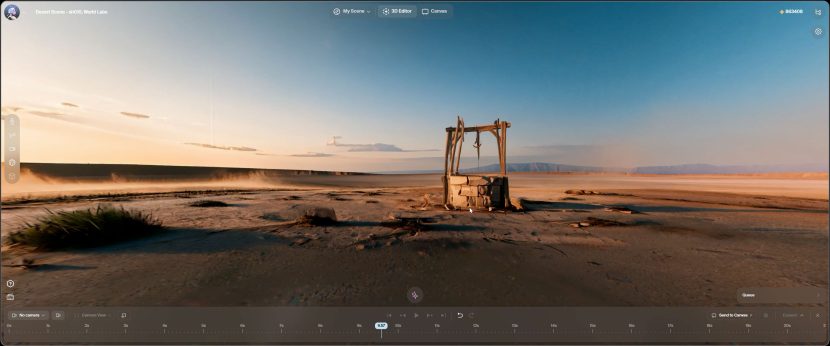
- The Integration of Spatial AI: As foundational models evolved, Autodesk incorporated cutting-edge spatial computing capabilities. This included integrating Gaussian splat-based worlds created with platforms like World Labs’ Marble, allowing creators to rapidly assemble spatially coherent environments for layout, blocking, and camera design.
- The 3D Editor + Canvas Debut: The release of the 3D Editor + Canvas workflow marks the latest milestone in this timeline. By moving past purely 2D inferences, the platform marks a pivotal transition: generative video is no longer just about generating a neat image from a text string; it is about turning that image into a fully directed, controllable cinematic shot.
Supporting Data: Under the Hood of Flow Studio
Flow Studio relies on a sophisticated cloud-based architecture designed to balance real-time interactivity with heavy generative lifting.
Performance and Pipeline Metrics
- Interactive 3D Workspace: The cloud-hosted 3D Editor is optimized for high interactivity, allowing artists to block scenes, adjust camera tracks, and manipulate character animations without frustrating latency.
- Variable Generation Times: While the 3D layout operates fluidly, generation times within the Canvas node-based environment vary depending on the chosen generative model, target resolution, and shot length. Environment generation—such as compiling Gaussian splat worlds—currently takes several minutes.
- The 80/20 Rule of AI: According to Todorovic, prompt-based AI excels at producing the initial 80 percent of an image remarkably fast. However, the real production nightmare begins in the final 20 percent—when a director requests a precise revision, such as moving an object slightly to the left, altering an actor’s micro-expression, or modifying a camera arc without breaking the rest of the shot. Flow Studio’s dual 3D/2D layout is specifically calibrated to conquer this final 20 percent.
The Technical Workflow: 3D to 2D
The operational loop of Flow Studio is built on a clear division of labor between spatial layout and generative finishing:
- 3D Direction: Filmmakers position cameras, block actors, and shape performances in a 3D environment. Character animations can be driven by motion-capture data, keyframed manually, or synthesized from reference videos.
- Spatial Environments: Creators can leverage spatially coherent environments, including Gaussian splats, to map out the geography of a scene.
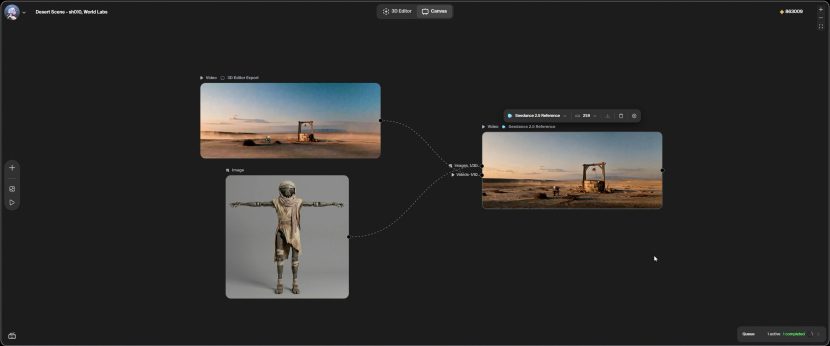
- Canvas Refinement: Once the staging, composition, and camera movement are locked in the 3D Editor, artists move into Canvas, a node-based 2D environment. Here, state-of-the-art AI video models apply their greatest strengths: seamless lighting integration, atmospheric effects, realistic physics simulations, and cinematic color grading.
Crucially, the 3D scene does not always dictate the raw final pixels; rather, it provides an unyielding architectural blueprint that guides and constrains the generative model, eliminating the chaotic "hallucinations" common in pure text-to-video systems.

Official Responses and Philosophy: Performance Before Prompting
One of the most revealing insights from the fxpodcast discussion with Nikola Todorovic centers on the industry-wide debate over how performances should be generated. While many tech companies lean heavily into audio-only prompts or text descriptions to spawn character actions, Autodesk is taking a radically different stance.
The Superiority of Human Performance
Todorovic remains unconvinced that pure text prompts or audio inputs alone can consistently produce distinctive, nuanced acting. While audio-driven animation has its place, it frequently results in generalized gestures, flat expressions, and robotic timing.
Flow Studio’s philosophy is rooted in performance before prompting:
- Actor-Centric Workflows: The preferred workflow begins with a real human performance. Video and audio recordings of an actor capture precise timing, subtle micro-expressions, and genuine emotional intent.
- Data-Driven Characters: This recorded performance is used to drive the digital character, preserving the human essence of the acting before generative models are applied to reshape the final aesthetic appearance.
- Audio Evolution: While current video models can generate sound during the finishing stages, Autodesk is actively working on pipelines that carry raw source-performance audio natively through the broader workflow, ensuring a tighter sync between actor and asset.
Solving "AI Slop" Through Direct Control
The industry has valid anxieties surrounding generic "AI slop"—homogenized, uncanny-valley content resulting from models relying on their statistically safest interpretations. Todorovic argues that the antidote to this aesthetic blandness is not better prompting, but better tools for human intervention. By allowing artists to literally reach into a 3D shot and make deliberate, spatial choices, Flow Studio restores creative specificity to the director’s chair.
Implications: The Democratization of Complex Visual Effects
The introduction of Flow Studio carries profound implications for the future of filmmaking, touching everything from traditional studio pipelines to indie creators.
Shifting the Adoption Curve
Todorovic envisions a familiar adoption curve for Flow Studio that mirrors previous technological revolutions in cinema (such as digital editing or pre-visualization):
- Experimentation & Social Content: Early adopters will test the waters using the platform for rapid social content and experimental shorts.
- Commercials & Music Videos: As workflows stabilize, high-tempo production sectors like advertising and music videos will adopt the tool to slash turnaround times.
- Independent Productions & Major Studios: Finally, indie film teams (3 to 5 people) and massive enterprise studios will integrate the system into their pipelines to handle complex background simulation and previz.
Redefining Traditional CG Overhead
In traditional computer graphics pipelines, artists are often forced to build vastly more of a digital environment than the camera will ever capture, simply because shot angles might change dynamically during editing. AI-assisted workflows like Flow Studio offer a liberating alternative: offloading technical complexities to background generation while letting artists focus entirely on what actually hits the finished frame.
This does not mean computers are replacing filmmakers. Just as directors do not need to personally write every line of physics code in a modern rendering engine, tools like Flow Studio aim to abstract the underlying mathematics of machine learning. The goal is to grant storytellers access to Hollywood-grade visual techniques without requiring them to be machine-learning engineers.
A New Era for Directors
Ultimately, Autodesk Flow Studio represents a maturing of the generative AI movement. The technology is shedding its novelty status as a party trick for generating weird, surreal loops from text prompts. Instead, it is being forged into a professional-grade instrument. By anchoring generative AI in the traditional, time-tested language of 3D space, camera blocking, and human performance, Autodesk is ensuring that the future of cinema remains firmly in the hands of directors.
