
Beyond the Tragedy: An In-Depth Look at Lee Yun Chan’s "To Be Ordinary"
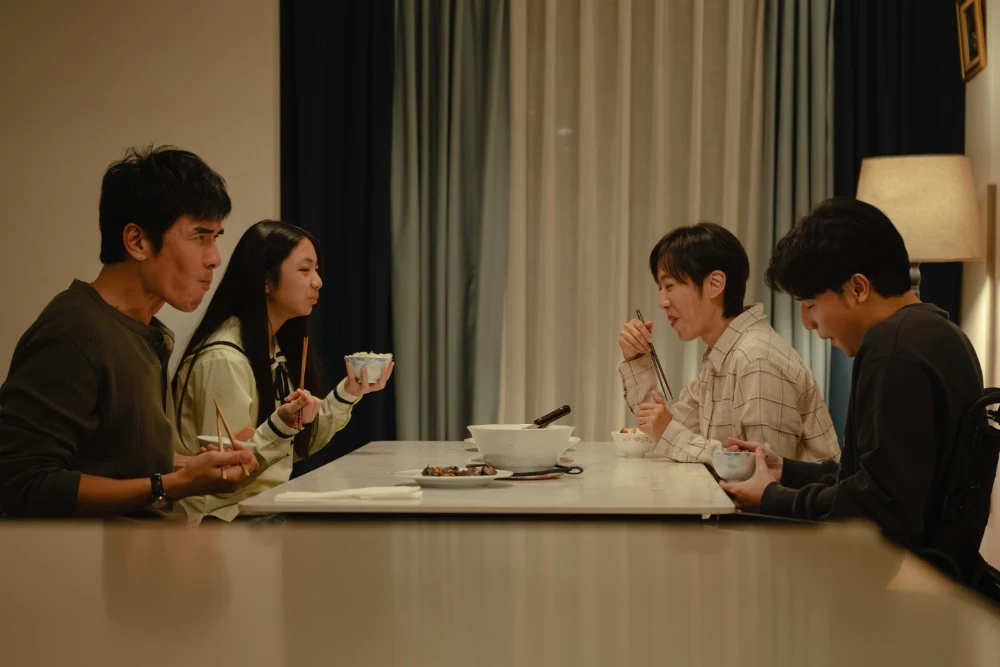
In the landscape of contemporary Taiwanese cinema, few directors possess the ability to balance the weight of human suffering with the quiet dignity of everyday existence quite like Lee Yun Chan. Her latest feature, To Be Ordinary, which recently premiered as the sole Taiwanese entry in the Busan International Film Festival’s main competition, serves as a poignant reminder of this skill. Far from being a standard “disability drama” that relies on the tired tropes of pity or miraculous recovery, To Be Ordinary is a sprawling, decade-long meditation on how a single moment of misfortune can ripple through the foundation of an entire family.
Spanning over eleven years of narrative time, the film tracks the lives of the Yu family following a life-altering traffic accident. By resisting the urge to simplify the emotional landscape, Lee has crafted a work that feels less like a scripted drama and more like a captured fragment of lived experience—one that explores marital dissolution, economic precariousness, and the painful transition from adolescence to adulthood with equal parts clinical precision and profound empathy.
The Anatomy of an Accident: A Narrative Catalyst
The film opens with a sequence that is as technically accomplished as it is emotionally deceptive. Director of Photography Ming Lee utilizes a fluid, gliding nighttime tracking shot to follow 22-year-old protagonist Yu-jie (played with remarkable, understated grace by Junior Hsieh) as he navigates the rain-slicked streets of suburban Taipei on his moped. The accompanying score, composed by Cicada, swells with a grandiose, cinematic serenity that lulls the audience into a false sense of security.
This visual and auditory reverie is shattered abruptly at a standard intersection. Yu-jie is struck by a vehicle driven by Mr. Ma (Hsiu Shen Liang), a wealthy, elderly man whose life, like Yu-jie’s, is irreversibly altered in an instant. This moment of collision serves as the narrative fulcrum of the film. While the physical trauma is immediate—Yu-jie learns in the sterile, fluorescent confines of a hospital that he will never walk again—the film’s primary focus is not on the disability itself, but on the long-term psychological and sociological fallout that ensues.
Chronology of a Decade: A Family in Flux
To Be Ordinary distinguishes itself by refusing to conclude when the dust settles. Instead, it invites the audience to bear witness to the decade that follows, a period defined by the slow, grinding erosion of the family unit.
The Initial Aftermath
In the immediate months following the accident, the film examines the divergence in coping mechanisms. Yu-jie, a burgeoning web designer with a sharp, practical mind, exhibits a stoic acceptance of his new reality. He seeks to maintain his professional trajectory and explores a fragile, burgeoning romance with his hospital physiotherapist, Yi-Han (Phoebe Chu). It is a testament to the script’s depth that it treats Yu-jie’s disability not as a tragedy to be “overcome,” but as a condition to be managed—a pivot point for his character’s development.
The Middle Years: Fracture and Erosion
As the years progress, the strain on the rest of the family becomes the film’s central friction. Yu-jie’s parents, played by Chang Shih Ying and Weber Yang, were already navigating a strained marriage prior to the accident. The added stress of his long-term care, compounded by the father’s chronic unemployment and the family’s economic fragility, acts as a solvent that dissolves the remaining glue of their relationship.
Crucially, the film also turns its lens toward Yu-jie’s younger sister, Yu-ching (Pin Hsuan Chen). As she navigates the volatile hormonal shifts of early adolescence, she finds herself effectively sidelined. She is forced to assume the role of an adult prematurely, often told by her mother that “there is enough going on at home” to warrant her own emotional needs being addressed. Chen’s performance is a standout, capturing the volatile mixture of resentment, love, and isolation that defines her character’s journey.
The Long Horizon: Consequence and Resolution
By the time the story reaches its 11th year, the film has moved through several stages of grief, anger, and eventual resignation. The presence of Mr. Ma serves as a constant, complex tether to the past. Haunted by irremediable guilt, Ma provides the family with significant financial support, including the transfer of his own home. However, as Ma himself enters the twilight of his life, his health failing and his own world shrinking, the financial assistance begins to take on a heavier, more ambiguous moral weight.
Supporting Data: The Production Context
The film marks Lee Yun Chan’s return to the big screen after a fourteen-year hiatus, her first feature since 2010’s Dancing Without You. In the interim, Lee has been a fixture of the Taiwanese television industry, most notably directing the 2022 Disney+ series Women in Taipei.
This televisual background is occasionally visible in the film’s structure—some viewers may detect a faint strain of melodrama that feels more at home on the small screen than in a theater. Yet, Lee balances this with a formal, sober restraint that elevates the material. The film was produced with an eye toward international festival play; following its Busan debut, it is slated for the Tokyo International Film Festival, with a domestic theatrical release in Taiwan scheduled for mid-November.
Industry analysts suggest that while the film’s quiet, contemplative nature may limit its reach in mainstream commercial theaters, it is perfectly positioned for the global festival circuit and, eventually, niche streaming platforms that cater to international arthouse audiences. The film’s accessibility is its greatest asset; it speaks a universal language of family obligation, which should resonate well beyond the borders of Taiwan.
Official Responses and Creative Intent
In interviews surrounding the film’s premiere, Lee has emphasized her desire to treat all characters—regardless of their moral standing or their role in the accident—with equal care. "There are no villains here," Lee noted in a recent press statement. "There is only a series of choices made by people under immense pressure."
This commitment to non-judgmental storytelling is what gives the film its “unassuming beauty.” By refusing to cast Mr. Ma as a villain or the family members as simple victims, Lee forces the audience to grapple with the complexities of culpability and gratitude. The script, co-written with Ginger Wang, deliberately avoids the "victim-villain" dichotomy, choosing instead to focus on the human capacity for endurance.
Implications: The Ethics of Care
To Be Ordinary raises profound questions about the nature of support. Does financial assistance truly alleviate suffering, or does it merely institutionalize a sense of debt? How does a family reconcile the desire to remain "ordinary" when they are constantly defined by an extraordinary trauma?
The film’s greatest triumph lies in its refusal to offer easy answers. It acknowledges the "absurdity, hilarity, and small domestic joys" that occasionally punctuate life, even when the broader narrative is one of sorrow. While the cinematography leans toward a persistently overcast, somber aesthetic, the emotional core of the film is far more vibrant.
Final Thoughts
As To Be Ordinary prepares for its wider release, it stands as a significant, if understated, contribution to contemporary Asian cinema. It is a work of patience, asking its audience to sit with its characters through the long, often tedious process of healing. By granting its subjects the space to reckon with their sorrow and find their own individual paths forward, Lee Yun Chan has created a portrait of a family that is, in every sense of the word, profoundly human.
Whether the film will find a massive global audience remains to be seen, but its value as a piece of empathetic storytelling is undeniable. It serves as a reminder that the most significant dramas are not always found in the heights of passion, but in the quiet, persistent struggle to remain ordinary in the face of the extraordinary.
