
Breaking Into the Biz: Writer, Producer, and Director Miranda Sajdak on the Chaotic, Non-Linear Reality of a Filmmaking Career
Introduction: The Great Cinematic Dilemma
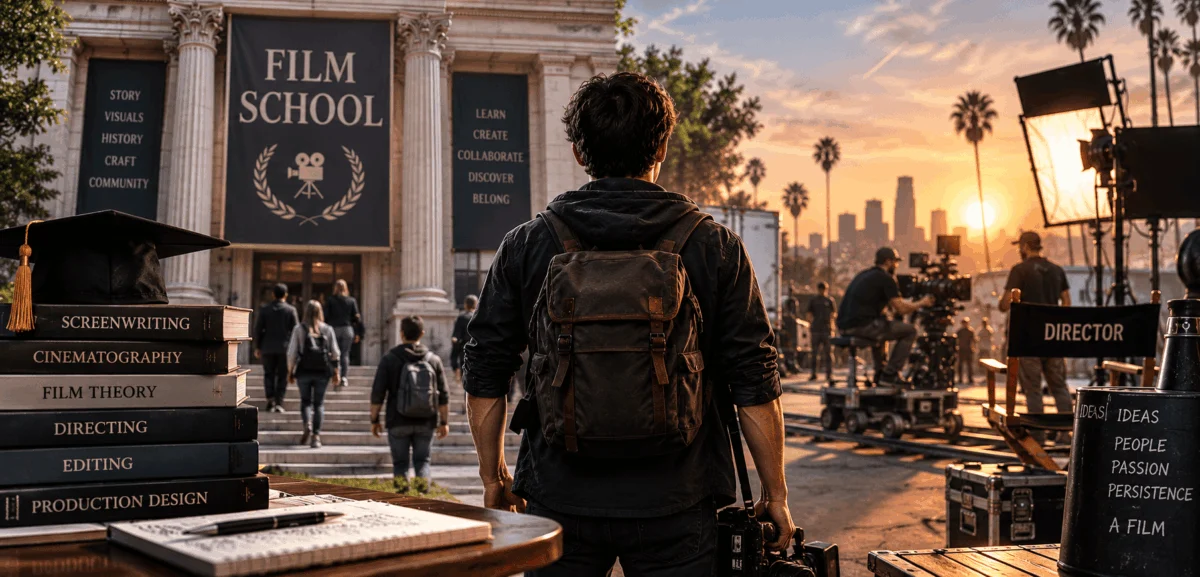
There is a question that almost every aspiring filmmaker eventually encounters, usually whispered in the dark corners of a campus screening room or debated fiercely on online forums: Do I actually need film school?
It sounds like a simple binary choice until you realize that filmmaking careers rarely follow straight, predictable lines. Some practitioners spend years dissecting European art-house cinema and mastering theoretical frameworks before ever stepping onto a professional soundstage. Others bypass academia entirely, diving straight into the beautiful, exhausting chaos of a working set—carrying heavy equipment, fetching countless cups of coffee, and learning through sheer trial by fire.
Few people understand this dichotomy better than Miranda Sajdak. A multi-hyphenate writer, producer, and director whose career spans studio blockbusters, gritty independent features, television writers’ rooms, executive development, and her own entrepreneurial creative projects, Sajdak has experienced virtually every facet of the entertainment industry. Her journey proves a vital industry truth: there is no single, correct roadmap to a career in cinema. Instead, success is forged through adaptability, relentless resourcefulness, and a willingness to embrace the unpredictable.
Chronology of a Filmmaker: From Childhood Epiphany to Columbia and Beyond
The Spark
Miranda Sajdak’s cinematic genesis began much like that of many industry veterans—with a single, transformative moviegoing experience in childhood. Her mother took her to see Penny Marshall’s sports comedy-drama A League of Their Own. For young Miranda, watching women take center stage as complex, driven athletes in a historically male-dominated sphere struck an immediate, resonant chord.
She walked out of the theater with a crystallized vision: filmmaking was not just a hobby to enjoy on weekends; it was going to be her life’s work.
The Academic Foundation
That early ambition eventually steered her toward Columbia University’s prestigious film program. For Sajdak, film school provided much more than a syllabus of textbooks and academic lectures. It acted as an incubator, granting her direct access to a community of like-minded peers, invaluable hands-on experience on graduate student productions, and a rigorous introduction to professional set etiquette. Furthermore, it introduced her to seasoned professors who helped distill the overwhelming, infinite universe of cinema history into digestible, actionable material worth studying.
Yet, Sajdak is remarkably pragmatic, careful not to romanticize her path into a universal prescription for every aspiring artist. Film school worked for her, but she readily acknowledges that it is not a mandatory prerequisite for success. Countless successful filmmakers bypass formal education entirely, teaching themselves camera mechanics, film history, theoretical foundations, and protocol independently. Others jump straight into the deep end by finding entry-level work.
Ultimately, Sajdak points out, the institutional pedigree matters far less than clarity of vision. What truly matters is understanding your ultimate destination and determining which specific path provides the skills, professional relationships, and resilience required to get there. For Sajdak, her time at Columbia served as the exact springboard she needed to land her first foundational gigs as a production assistant (PA) on major studio tentpoles, including The Bourne Ultimatum and Cloverfield.
Supporting Data & Industry Realities: The Power of Networks and Studio vs. Indie Scale
The Currency of Relationships
Stepping onto the bustling sets of high-budget studio productions quickly reinforced another foundational truth of the entertainment business: relationships are the ultimate currency.
Sajdak recalls that while one early opportunity may have materialized through a standard production-office job application, another arrived organically via a trusted referral. As the old industry adage goes, many jobs in Hollywood ultimately come down to networking and who you know.
However, Sajdak offers a crucial caveat regarding networking, stripping away the hollow imagery of handing out business cards at crowded industry mixers. True, high-value networking is rarely about superficial collection; rather, it is about reputation. The most valuable industry connections happen when colleagues observe your daily work ethic firsthand. When a crew member sees that you are reliable, calm under pressure, and unfailingly professional, your name naturally enters the conversation the moment another production is looking to fill a vacancy.
Studio Productions vs. Independent Filmmaking
Working on major studio pictures also provided Sajdak with a fascinating perspective on scale, contrasting sharply with the realities of independent filmmaking.
At their core, both environments share the exact same fundamental objective: telling a compelling story. However, the sheer scale of operations changes everything. A union studio production boasts massive departments, highly specialized crews, deep financial resources, and the luxury of time to meticulously craft individual shots.
Conversely, on an independent film, budgets are tight, crews are lean, and a director or producer might suddenly find themselves single-handedly solving logistics crises that would normally be delegated to an entire specialized department. Sajdak embraces this hands-on indie ethos, noting that the sheer pressure-cooker nature of independent cinema forces filmmakers to gain a granular, practical understanding of every single corner of physical production.
Official Responses and Tales from the Trenches: The Pregnant Horse Crisis
To illustrate the wonderfully absurd, unscripted nature of independent producing, Sajdak shares a vivid anecdote from her time producing a film in upstate New York during the dead of winter.
The script called for a high-stakes, emotional climactic scene in which a teenage girl had to assist a horse giving birth. The production had meticulously secured locations on a real horse farm populated with pregnant mares, making the logistics initially seem entirely manageable—that is, until nature refused to adhere to the call sheet.
As shooting days ticked away, it became painfully obvious that the primary horse was simply not going to foal during their strict production window. Suddenly, Sajdak was forced into an executive crisis: she had to locate another pregnant mare that bore a strong visual resemblance to the first, find a matching farm location, and coordinate a complex film crew around an biological event that fundamentally resisted precise scheduling.
In an era before smartphones and mobile high-speed internet could instantly rescue a producer via Google search, Sajdak relied on old-fashioned resourcefulness. She picked up a landline telephone, opened the Yellow Pages, and began systematically cold-calling local horse farms in the region.
Within roughly an hour of frantic networking, she had secured two viable leads. The production swiftly relocated the crew, captured the sequences successfully, and ultimately got the movie made. It stands as a wonderfully absurd, textbook example of what film producing actually entails: nobody ever hands you a comprehensive manual explaining what to do when the animal in your film’s climax refuses to cooperate. You simply assess the crisis, adapt, and solve the problem standing directly in front of you.
Implications: Television Writing, Re-writes, and the Birth of Script Chicks
Navigating the Writers’ Room
Sajdak’s subsequent foray into television writing provided an entirely different kind of education. Working as a writers’ assistant on shows such as Huge and China, IL taught her invaluable lessons not only about the craft of writing, but about the sprawling corporate ecosystem surrounding writers.
While novelists and screenwriters often create in solitary confinement, television and feature filmmaking are intensely collaborative team sports. Networks issue creative notes. Studios request structural changes. Characters are written out overnight, and entire sequences are overhauled on the fly.
A writer who treats every single sentence of their script as an untouchable, sacred artifact is bound to struggle in the professional arena. Sajdak emphasizes that humility is an absolute survival trait in Hollywood:
“There will be rewrites. There will be a lot of rewrites.”
The Entrepreneurial Pivot: Script Chicks
That pragmatic philosophy eventually inspired Sajdak to create her own career opportunities. Alongside fellow producer Sandra Leviton, Sajdak formed Script Chicks after stepping away from traditional coordinator roles to pursue independent producing full-time.
They faced a dilemma familiar to countless indie filmmakers: passion projects rarely pay monthly rent. They needed a flexible commercial venture that would simultaneously generate steady income while keeping them immersed in the writing, directing, and producing space. Drawing upon their extensive years of executive development experience, they monetized their expertise by offering professional screenplay coverage to the industry. The business served as a vital financial lifeline, keeping the lights on while fueling their broader cinematic ambitions.
Conclusion: Crafting Your Own Path in Modern Cinema
Miranda Sajdak’s career offers perhaps the most valuable meta-lesson for anyone hoping to enter the entertainment industry: a sustainable filmmaking career is rarely built by climbing a single corporate ladder until Hollywood finally notices you.
Instead, it is a mosaic. Sometimes you work as a production assistant on high-profile studio blockbusters. Sometimes you read and evaluate spec scripts in a corporate development office. Sometimes you serve as a writers’ assistant, or produce another artist’s independent film just to learn the ropes—or to finance your own projects down the line. Sometimes, you launch an entirely separate entrepreneurial business simply to gain the financial freedom required to keep creating art.
Eventually, after years spent writing, producing, and navigating the vast machinery of the industry, Sajdak experienced a moment of reckoning: she had drifted away from the primary dream that originally propelled her into a movie theater as a child. She wanted to direct.
Refusing to wait indefinitely for the stars to align or for perfect circumstances to materialize, she wrote a short screenplay, assembled a circle of trusted peer readers who weren’t afraid to brutally critique her draft, cast her actors, and launched a crowdfunding campaign for an action project. She simply started moving forward toward the work she genuinely wanted to make.
Whether your path into filmmaking begins in an elite university film school, on a grueling early-morning PA job, inside a chaotic television writers’ room, or alone with a consumer camera in a bedroom, Sajdak’s journey suggests that the specific doorway matters far less than what you choose to do after walking through it:
- Master the mechanics of how physical sets operate.
- Cultivate genuine, reputation-based professional relationships.
- Listen openly to creative notes and check your ego at the door.
- Cultivate radical resourcefulness when crises inevitably arise.
- Build sustainable financial mechanisms to support your art while you hone your craft.
And most importantly, when you inevitably realize that the daily grind has pulled you far away from the initial spark that made you fall in love with cinema in the first place, find the courage to find your way back to it.
