
From the Press Box to the Director’s Chair: How Entertainment Journalist Andrew Bloomenthal Mastered the Art of Filmmaking
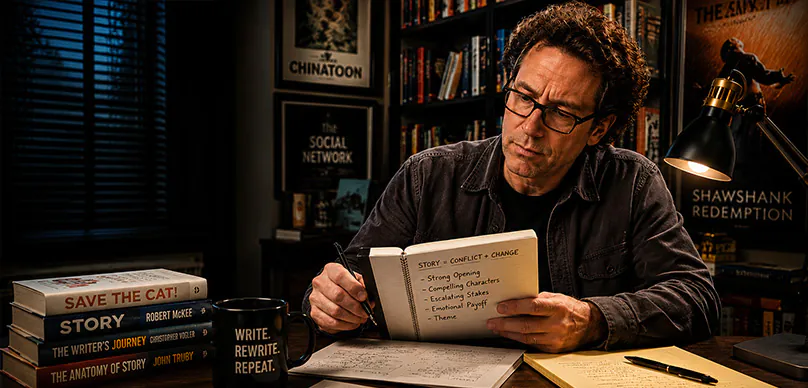
LOS ANGELES — There is a profound, often dizzying chasm between being an avid consumer of cinema and truly understanding the intricate, grueling machinery of how filmmakers actually bring stories to life. While millions of moviegoers analyze plots from the comfort of their living rooms, very few bridge the gap between critical observation and hands-on creation.
Enter Andrew Bloomenthal. Operating seamlessly across multiple disciplines as an entertainment journalist, accomplished screenwriter, and independent filmmaker, Bloomenthal has spent years exploring the cinematic universe from both sides of the table. By contributing to premier industry outlets such as Script Magazine, Creative Screenwriting Magazine, CNBC.com, and Variety, his career has afforded him a rare vantage point: he gets to study the creative psychology of master directors and legendary screenwriters while simultaneously confronting the exact same artistic and logistical trials in his own work.
Main Facts: The Dual Life of an Industry Insider
Bloomenthal’s career defies traditional career paths in Hollywood. Rather than locking himself away to write screenplays in a vacuum, or strictly interviewing those who do, he has chosen to inhabit both roles simultaneously. This dual perspective has uniquely positioned him as a student of the craft.
- The Journalist: Through deep-dive interviews with iconic filmmakers such as Oliver Stone, Michael Moore, and Ralph Fiennes, Bloomenthal has spent decades dissecting what makes great storytelling tick.
- The Filmmaker: As a screenwriter and director, he channels these analytical insights into tangible projects, moving from the theoretical world of journalism into the physical, high-stakes realm of physical production—culminating in his ambitious musical short film based on a long-cherished stage play.
- The Core Philosophy: Across all his endeavors—whether writing an assigned profile for Variety or drafting a spec script—Bloomenthal champions strict economy of words, rigorous preparation, and the unwavering belief that every creative output acts as a professional calling card.
Chronology: From Financial Newsrooms to Hollywood Sets
Bloomenthal’s journey into the heart of the entertainment industry was neither linear nor planned. Long before his bylines appeared in major entertainment publications, his professional foundation was rooted in financial journalism.
The Accidental Critic
While finance paid the bills, filmmaking and screenwriting remained his true north. For years, a close friend repeatedly urged him to merge his professional writing background with his passion for movies by interviewing screenwriters. Initially, Bloomenthal resisted the suggestion. He confesses that he wanted to be the filmmaker sitting in the hot seat, not the journalist holding the microphone.
Eventually, however, he yielded to the advice. Armed with early, self-started interviews featuring industry titans like Oliver Stone and Michael Moore, Bloomenthal built a portfolio robust enough to pitch Creative Screenwriting. Suddenly, journalism transformed from a day job into a backstage pass. Far from distracting him from his ultimate goal of filmmaking, interviewing writers allowed him to decode their struggles, working habits, and creative processes at an intimate level.
Transitioning to Production
Having spent years analyzing the mechanics of others, Bloomenthal reached a critical inflection point: moving from the observer to the creator. Transitioning from the conceptualization phase, he prepared to helm a roughly fifteen-minute musical short film adapted from a play that had captivated him for years. With a cast assembled, four original songs recorded, vocal tracks prepped for playback, and locations secured, Bloomenthal shifted his identity from a writer peering through a window to a director standing on the set.
Supporting Data and Principles of Craft
Over years of interviewing the world’s top cinematic talent and writing his own material, Bloomenthal has distilled several core philosophies that guide successful creators. These principles offer a masterclass for anyone looking to break into the entertainment industry.
1. The Power of the "Calling Card"
One of Bloomenthal’s most steadfast professional tenets is that creators must treat every assignment—regardless of its scale or budget—with absolute seriousness. Early in his entertainment-writing career, he refused to categorize assignments into "important" pieces and "insignificant" filler. Every article was approached with the rigor of a major studio feature coverage because everything published online serves as a public portfolio.
For screenwriters and independent filmmakers, the stakes are identical. That low-budget commercial, experimental short film, or obscure writing assignment may be the exact piece of work a producer uses to determine whether you are ready for a multi-million-dollar project. As Bloomenthal notes, “Every story is going to serve as a calling card.” The industry may not see the blood, sweat, and tears that went into a career, but it will judge what is ultimately put out into the world.
2. Preparation Separates the Amateur from the Professional
During his time covering press junkets, Bloomenthal grew weary of watching directors and actors field the same recycled, generic questions. Rather than asking a filmmaker what it was like working with a specific star for the hundredth time, he began meticulously studying films to uncover hyper-specific technical details.
A prime example occurred during an interview with Ralph Fiennes for The Invisible Woman. Instead of a broad inquiry, Bloomenthal asked about the technical construction of a specific musical sequence—specifically how live vocals, sound mixing, and editing were coordinated. Fiennes immediately lit up at the specificity of the question, a reaction that ultimately led to an extended, one-on-one interview opportunity.
The lesson extends far beyond journalism: whether pitching a network executive, meeting a director, or interviewing for a crew position, deep preparation demonstrates a level of respect and competence that generic compliments can never replicate.
3. Knowing When to "Zig and Zag"
Thorough preparation, however, must never morph into rigidity. Bloomenthal enters every interview with a structured list of questions, but he remains entirely willing to abandon the script when a more compelling narrative thread emerges.
He describes this adaptability as knowing how to "zig and zag." When a filmmaker answers a question in an unexpected, revealing way, chasing that conversational tangent often yields gold that a predetermined list of questions would have missed. Screenwriting operates under the exact same physics: structure and outlining provide necessary direction, but characters and stories frequently reveal organic possibilities during the writing process. True skill lies in knowing the plan well enough to recognize when breaking away from it elevates the work.
4. The Economy of Words
Drawing from his extensive print journalism background, Bloomenthal preaches the gospel of conciseness. Whether crafting an article, a feature-length script, or a short story, the material must remain tight, rhythmic, and compelling. Unnecessary words, repetitive phrasing, and cliché tropes dilute artistic impact.
For screenwriters, this principle is paramount. Screenplays represent one of the most economical storytelling mediums on earth. Space on the page is precious; dialogue must pull double duty; descriptions must evoke imagery without bogging down the reader. A screenplay does not reward a writer for demonstrating a sprawling vocabulary; it rewards them for making deliberate, high-impact choices.
5. Weaponizing Deadlines
Deadlines can terrify amateur writers, but Bloomenthal views them as essential infrastructure. Having thrived in fast-paced journalistic environments, he describes himself as practically "allergic" to missing a deadline.
While professional journalism builds in external accountability through editors and publishers, personal screenwriting projects lack a safety net. Writers working on spec scripts must act as their own taskmasters. Without an external force demanding delivery, filmmakers must manufacture internal discipline. A screenplay that remains perpetually locked in a "perfectionism loop" on a hard drive will never attract actors, directors, producers, or financiers. Eventually, creators must declare the work finished and hold themselves accountable.
Official Perspectives and Industry Insights
Reflecting on the psychological barriers that keep many aspiring filmmakers trapped in the writing phase, Bloomenthal points to a common trap: self-doubt masked as a lack of permission.
Many writers spend years wondering if they are officially "qualified" to direct a feature, produce a short, or bring their script to life. Bloomenthal’s insights suggest that the threshold between writing and directing is crossed the moment a creator stops waiting for validation.
When asked about the transition from the isolation of the keyboard to the chaotic collaboration of production, Bloomenthal highlights the kinetic energy of filmmaking. Once actors, musicians, cinematographers, and crew members enter the ecosystem, a project stops being a solitary dream and transforms into a collective reality.
Broader Implications for Modern Filmmakers
Bloomenthal’s journey serves as a blueprint for the modern, multi-hyphenate creator. In an entertainment landscape where traditional gatekeepers are shifting and independent artists must increasingly advocate for their own work, the traditional boundaries between "writer," "journalist," and "filmmaker" are dissolving.
By maintaining a foot in both journalism and production, Bloomenthal illustrates that studying the mastery of others is not a distraction from creating one’s own art—it is an accelerator. For aspiring creators navigating the precarious waters of Hollywood, his career offers a reassuring roadmap: do the prep work, honor your deadlines, trim the fat from your writing, treat every project as your ultimate calling card—and when the time comes, trust your preparation and call action.
