
Mavis Camera 8.2 Transforms the iPhone 18 Pro Into a Broadcast-Grade Production Suite
LONDON — In a major leap forward for mobile cinematography, software developer Mavis has officially released Mavis Camera 8.2 (with subsequent patch 8.2.1 already rolling out on the App Store). This landmark update transcends conventional smartphone video app upgrades, moving far beyond simple manual exposure controls or filter packs.
Instead, version 8.2 positions the iPhone and iPad as legitimate, enterprise-grade components within high-end broadcast, cinema, and live-production environments.
Targeting professional filmmakers, independent broadcast journalists, systems integrators, and multi-camera studio production teams, the new software harnesses the cutting-edge hardware capabilities of Apple’s latest hardware—specifically the iPhone 18 Pro and iPhone 18 Pro Max—while introducing workflow-altering features like direct variable aperture control, native ProRes RAW recording, low-latency professional HDMI monitoring, and a robust local-network API.
Main Facts at a Glance
- Hardware Optimization: Full, native integration for the iPhone 18 Pro and iPhone 18 Pro Max, featuring direct manipulation of physical and electronic variable aperture mechanisms.
- Cinematic Codec Support: Introduction of high-bitrate ProRes RAW recording in both 4K and Open Gate configurations, routed directly to external SSD storage media.
- Broadcast-Ready HDMI Output: Comprehensive external monitoring pipelines featuring clean or information-heavy feeds, complete professional monitoring overlays (focus peaking, zebras, false color), and synchronized frame-rate matching.
- Enterprise Integration via API: A newly minted WebSocket-based local network API enabling external hardware control surfaces, studio automation software, and custom multi-camera workflows.
- Flexible Pricing Model: The app remains free to download, with core production features integrated natively, alongside a new $29.99 annual subscription bundle or modular in-app purchasing options.
Chronology of Development: Evolving from Consumer App to Professional Standard
The trajectory of Mavis Camera has long mirrored the maturation of the iPhone as a genuine capture device. Founded on the principle that mobile hardware possesses sensor and processing capabilities that rival traditional dedicated camcorders, Mavis spent years iterating on core foundational components: fine-tuning frame-rate locking, expanding audio routing, and implementing robust manual exposure mechanics.
Phase One: Establishing Manual Dominance
In its earlier iterations, Mavis carved out a loyal niche among mobile journalists (MoJo) and indie filmmakers by granting granular control over shutter speed, ISO, focus pulls, and audio inputs. However, the software was historically bound by the inherent physical limitations of smartphone camera modules—namely, fixed apertures and closed consumer ecosystems that resisted integration into larger studio environments.
Phase Two: Embracing External Ecosystems
As Apple began outfitting its "Pro" smartphone tiers with larger sensors, ProRAW pipelines, and ProRes internal encoding, Mavis responded with targeted modular expansions, such as the Pro Pack and Film Kit, alongside Network Device Interface (NDI) streaming integration. Yet, the leap from a high-end standalone capture tool to a networked broadcast node remained incomplete.
Phase Three: The Version 8.2 Paradigm Shift
With the advent of the iPhone 18 Pro generation, hardware constraints began to dissolve. Apple introduced variable physical/electronic aperture controls to its flagship mobile lenses, and external SSD workflows matured. Recognizing this inflection point, the engineering team at Mavis spearheaded Version 8.2.
The development cycle focused heavily on bridging the gap between mobile touch-screen interfaces and traditional grip-and-rig cinema environments. By integrating native variable aperture handling, external ProRes RAW writing, hardware-level HDMI metadata monitoring, and a WebSocket API, Mavis has transformed the iPhone from an isolated pocket camera into an interoperable node suitable for high-end television and film sets.
Supporting Data and Deep-Dive Technical Specifications
To fully comprehend the magnitude of Mavis Camera 8.2, one must analyze the heavy-duty engineering specifications underpinning its marquee features.

1. Direct Variable Aperture Control on iPhone 18 Pro
Historically, mobile videographers were forced to rely exclusively on ND filters or digital shutter adjustments to control exposure in changing lighting conditions, often leading to compromised diffraction limits or unnatural motion blur.
With the iPhone 18 Pro and iPhone 18 Pro Max, Mavis Camera 8.2 introduces direct, tactile manipulation of the device’s variable aperture system. Cinematographers can adjust the aperture seamlessly while actively recording.
- Control Methods: Adjustments can be made via the hardware-mapped Camera Control Wheel or through precision onscreen thumbrails within the Mavis interface.
- Workflow Flexibility: The feature functions harmoniously under both manual exposure locking and fully automatic exposure modes. This grants directors of photography (DPs) unprecedented control over depth of field and exposure parameters on the fly, eliminating the need to cut takes or dig through deeply nested submenus.
2. Native ProRes RAW Recording to External SSDs
Data bandwidth and thermal management have traditionally been bottlenecks for high-end mobile video. Mavis Camera 8.2 tackles this head-on by unlocking ProRes RAW capture on supported iPhone configurations.
- Resolutions: Filmmakers can capture uncompressed RAW image streams in standard 4K or sweeping Open Gate formats.
- Storage Architecture: Because ProRes RAW files generate massive data rates that quickly overwhelm internal flash memory, the app routes streams directly to connected external solid-state drives (SSDs).
- Post-Production Latitude: Capturing raw sensor data preserves maximum dynamic range, enabling post-production colorists and editors to perform heavy recovery of blown-out highlights, crushed shadows, and precise white balance shifts long after principal photography has wrapped.
3. Professional HDMI Monitoring and Metadata Output
For professional video village setups, relying on a small smartphone screen is a non-starter. Mavis Camera 8.2 introduces a fully realized professional HDMI monitoring pipeline (requiring a compatible hardware adapter).
- Customizable Feeds: Operators can toggle between a pristine, clean video feed or an information-dense overlay featuring critical telemetry: exposure metrics, precise focal lengths, active recording status, SMPTE timecodes, capture codecs, multi-channel audio meters, and hardware thermal/battery health.
- Advanced Monitoring Tools: The HDMI output can pipe complex operator overlays directly to external director’s monitors, including tally lights, framing guides, custom aspect-ratio masks, hardware focus peaking, zebra striping for exposure clipping, and false color maps.
- Latency and Refresh Rate Sync: The HDMI refresh rate dynamically matches the camera’s exact capture frame rate, ensuring a fluid, predictable visual representation. Mavis’s internal benchmarks peg HDMI monitoring latency at an astonishingly low two frames at 29.97 fps, making it viable for pull-focus operators and live switchers.
4. The Mavis Camera API: Network-Centric Production
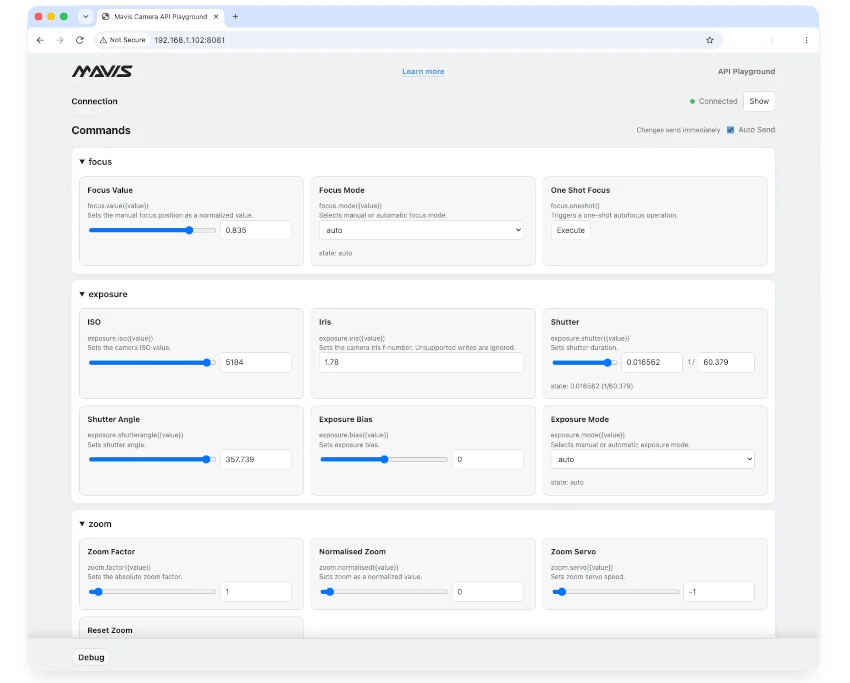
Perhaps the most disruptive inclusion in Version 8.2 is its local-network API. Built upon a responsive WebSocket communication protocol, the API allows external applications, dedicated hardware devices, and complex broadcast systems to interface directly with the mobile app.
- Remote Parameter Control: External developers and technical directors can manipulate recording states, exposure, dynamic focus racking, white balance profiles, digital zoom levels, lens switching, hardware tally states, and live color shading.
- Two-Way Telemetry: The system does not merely send commands; it receives live telemetry updates whenever camera settings or operating statuses mutate in real time.
- Developer Accessibility: Mavis has bundled a browser-based API Playground directly into the ecosystem, enabling systems integrators to test and prototype control workflows before deploying custom code.
Official Responses and Industry Context
While Mavis has not released a sweeping press conference statement, technical bulletins and developer documentation released alongside the update shed light on the company’s strategic vision.
Industry analysts and early-adopter broadcast engineers have widely praised the platform’s pivot toward open integration. For years, mobile videography lived in a walled garden where apps functioned as standalone walled gardens, isolated from the broader infrastructure of switcher decks, wireless tally systems, and professional motor-driven follow-focus units.
By opening a bidirectional WebSocket pipeline, Mavis is effectively declaring that the iPhone is no longer a toy or an emergency B-cam, but a fully functional tool capable of sitting alongside RED, ARRI, and Sony cinema lines on networked multi-camera rigs.
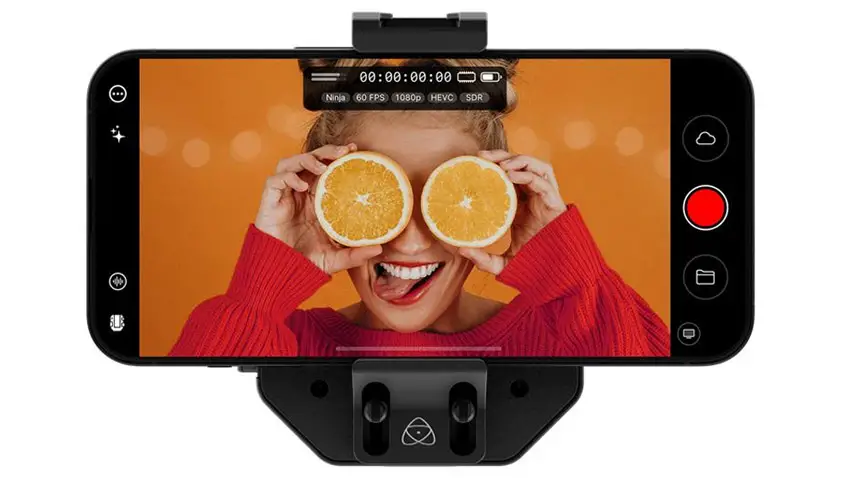
In hardware partnerships—notably highlighted by ongoing ecosystem integrations with companies like Atomos (via solutions like the NinjaPhone)—Mavis has systematically positioned its software as the brain for modular iPhone video cages. The addition of ProRes RAW and low-latency HDMI monitoring transforms a standard Apple handset into an intelligent capture head that drops effortlessly into existing grip trucks and mobile broadcast vans.
Implications for Filmmakers, Broadcasters, and Developers
The release of Mavis Camera 8.2 carries profound implications across multiple verticals of the digital media landscape:
For Independent Filmmakers and Cinematographers
Indie creators operating on lean budgets now possess a high-end cinema package that fits in their pocket. The ability to shoot Open Gate ProRes RAW to an external SSD—while dialing in physical depth of field via variable aperture controls—brings cinematic aesthetics traditionally locked behind multi-thousand-dollar cinema camera investments down to an accessible tier.
For Broadcast Journalists and Live-Streaming Crews
The integration of ultra-low latency HDMI monitoring, professional scopes (false color, zebras, focus peaking), and NDI capabilities makes the iPhone a formidable asset for live broadcast operations. Reporters in the field can pipe clean, metered feeds directly into cellular transmission packs or mobile production switchers with zero guesswork regarding audio levels or exposure clipping.
For Systems Integrators and Studio Developers
The inclusion of the WebSocket API opens the door for bespoke automation. Fixed-position studio setups (such as remote interview pods, house-of-worship multi-cam arrays, or educational lecture halls) can now deploy fleets of iPhones controlled entirely from a central switcher or custom-built hardware control surface, drastically lowering hardware expenditure without sacrificing operational control.
Pricing and Availability
Mavis Camera 8.2 (and the patch-stabilized version 8.2.1) is available immediately via the Apple App Store.
The pricing structure accommodates both casual enthusiasts and heavy enterprise users:
- Base Application: Free to download, with core foundational features and standard recording capabilities included out of the box.
- Pro Production Subscription: Available as an annual subscription priced at $29.99/year. This comprehensive bundle unlocks the full suite of advanced production features, including Pro Pack components, Film Kit utilities, NDI streaming tools, and full API access.
- Modular Add-Ons: For users who prefer a la carte purchasing, advanced capabilities like API integration are available separately as a $19.99 one-time in-app purchase.
- Legacy Compliance: Existing one-time purchasers who previously bought legacy modules remain fully grandfathered in, ensuring uninterrupted access to their purchased feature sets, subject to local App Store currency conversions.
As mobile sensor technology continues its relentless march toward parity with traditional large-format cinema glass, updates like Mavis Camera 8.2 prove that the limiting factor in modern video production is no longer the hardware in your hand—it is the intelligence of the software driving it.
