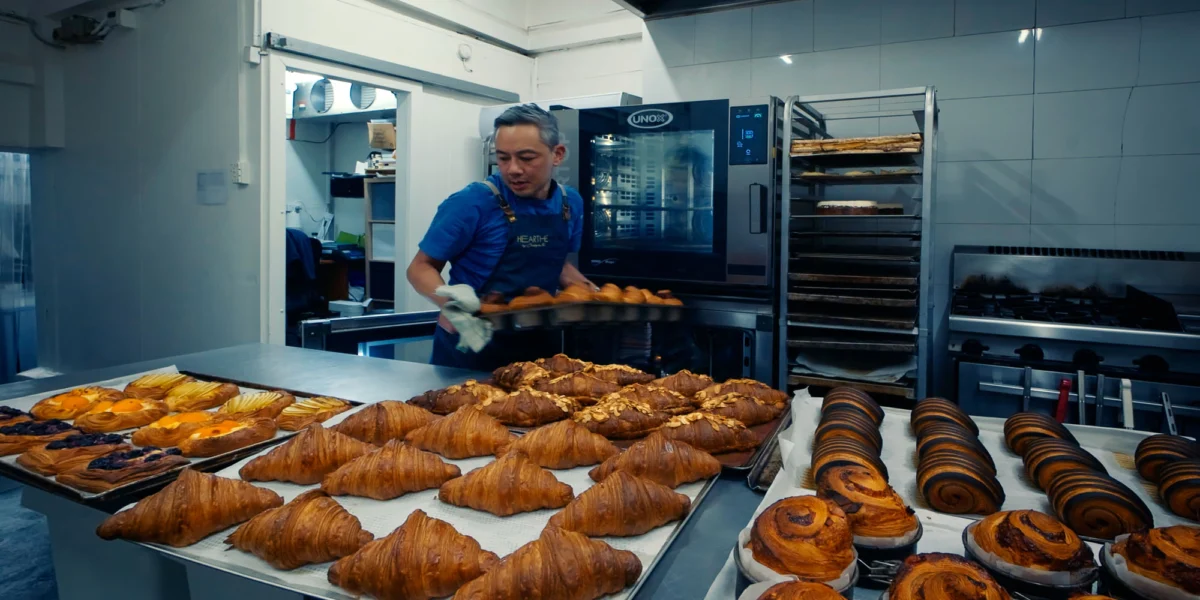
The landscape of modern cinema is constantly evolving, driven by the persistent challenge of adapting specialized footage to a sprawling array of contemporary delivery formats. Nowhere has this tension been more acute than in the realm of immersive filmmaking. Until recently, content captured for premium spatial mediums—most notably Apple Immersive Video (AIV)—remained tightly bound to head-mounted displays, locked away from traditional flat-screen distribution.
That paradigm has fundamentally shifted. More than a year after completing their pioneering immersive documentary short, Thé Fine Dining Bakery, production outfit Main CourseFilms (MCF) has successfully released what it asserts is the world’s first Apple Immersive Video film converted in its entirety for conventional, non-immersive viewing.
The newly minted version translates the original spatial documentary into a standard 4K Scope format, featuring a cinematic 2.40:1 aspect ratio paired with an immersive 7.1 surround sound mix. While the original 2025 spatial cut remains accessible to Apple Vision Pro users via streaming platforms Fovii and Theatre, this new theatrical downconversion opens the door to broader, mainstream audiences. For producers weighing the financial and creative viability of emerging spatial codecs, the ability to effortlessly pivot between platforms marks a watershed moment.
Chronology: The Road to Downconversion
The creation and subsequent reformatting of Thé Fine Dining Bakery unfolded across a meticulous, multi-phase production timeline that spanned over a year of technical and creative problem-solving.
Mid-2025: MCF completes the primary production of Thé Fine Dining Bakery, capturing pristine footage utilizing the Blackmagic URSA Cine Immersive camera. The finished spatial project is mastered and released for the Apple Vision Pro platform, utilizing Apple Immersive Video (AIV) specifications.
Late 2025 to Early 2026: MCF begins exploring the viability of downconverting the immersive master into a traditional 2D format. Initial experiments run into roadblocks regarding frame-rate compatibility, color-space management, and the massive data overhead native to uncompressed spatial capture.
Mid-2026: The creative team stabilizes a reliable workflow utilizing DaVinci Resolve Studio. By exporting Stereoscopic 3D ProRes pre-renders equipped with crucial camera metadata—such as Interaxial Lens Pitch Distance (ILPD) and Apple Immersive Motion Data—the team establishes a rock-solid foundation for remastering.
Late 2026: MCF finalizes its dual-path Fusion un-distorting process and analog-inspired audio stem routing via Fairlight. The project is locked at UHD 4K, 30 fps, within a Rec.709 color space and 2.40:1 Scope framing, resulting in the public release of the conventional 4K version.
Supporting Data & Technical Architecture
Translating an environment built entirely around viewer agency into a strictly controlled cinematic frame requires a complex alignment of hardware, software, and mathematical parameters. MCF leaned heavily on the advanced toolsets within DaVinci Resolve Studio to conquer these hurdles.
Color Management and Gamut
Both the original 2025 spatial release and the 2026 remastered 4K version were originally mastered in PQ HDR 1000 nits, tone-mapped down to 108 nits to satisfy the biological comfort thresholds of Vision Pro wearers. However, for the conventional 4K release, compatibility demanded a shift to a Rec.709 (Scene) Output Color Space.
MCF bypassed the massive data weight of ACES, opting instead for DaVinci Wide Gamut Intermediate (DWG). According to cinematographer, colorist, and sound mixer Ben Allan ACS CSI, DWG preserves the necessary bit depth without buckling under the immense file sizes typical of Apple Immersive imagery.
Frame Rates and Pacing
The original AIV master ran at a fluid 90 frames per second, providing the ultra-smooth motion characteristic of spatial video. However, because 90 fps is unusable for standard 2D distribution, and 60 fps introduces an unwanted "high frame rate" digital soap-opera look, MCF needed a cinematic frame rate. They selected 30 fps. This choice allowed for a clean, proportional 3:1 frame conversion directly from the native 90 fps source files, retaining a natural, filmic cadence.
The Fusion Un-Distortion Pipeline
To flatten the circular, fisheye-space imagery captured by the URSA Cine Immersive camera, MCF utilized DaVinci Resolve’s Fusion page. They deployed two distinct techniques:
The Technical Approach: Utilizing Fusion’s Immersive Patcher tool downstream from a Stereo Combiner node. This mathematically un-distorts the 180-degree image while offering precise pitch, yaw, and roll controls. Most shots were framed within a 65-degree to 110-degree field of view.
The Organic Approach: For extreme shots, the team employed a hybrid workflow involving a Transform node followed by one to three Lens Distortion nodes. This intentionally reintroduced subtle optical imperfections, mimicking the real-world artifacts of physical glass lenses that are otherwise perfectly neutralized by Vision Pro’s ILPD mapping.
Audio Translation via Analog Principles
Addressing the soundtrack presented an even greater conceptual hurdle. Apple Spatial Audio Format (ASAF) relies on 3D objects, ambisonics, and headlocked elements rather than fixed speaker channels. Routing an ASAF master directly to standard speaker buses collapses the mix, destroying loudness, equalization, and spatial reverb profiles.
Drawing inspiration from vintage analog radio and television workflows, Allan utilized Rogue Amoeba’s Loopback software to create virtual stereo and 7.1 outputs. By patching these virtual destinations through Fairlight’s patch bay, the team isolated dialogue, foley, sound effects, and music into distinct stereo stems. Ambient room tones were captured as 7.1 Ambisonics. This created a balanced, rich 7.1 surround mix that translated the spatial soundscape cleanly to conventional audio hardware.
Official Responses and Creative Insights
The core creative team behind Main Course Films—writer, director, and editor Clara Chong, alongside co-founder Ben Allan—provided deep insights into the philosophical and practical adjustments required to make the conversion work.
Clara Chong emphasized that the primary roadblocks were conceptual rather than purely technical:
"The challenges are more creative and conceptual than technical, although there were plenty of technical issues to solve as well! Because the way we experience AIV is on a biological level, there’s a lot of things that we had to take into account in making the film… We have been attempting to get to a down-converted version of this over the last year, but are only now at the point where we’re happy enough with the results both in terms of technical quality and conceptual approach."
On the subject of framing and viewer guidance, Ben Allan explained how spatial composition must be reinterpreted for fixed widescreen displays:
"In Apple Immersive, the pan and tilt is controlled by the viewer in real time, so the images are composed to give them the freedom to look where they want, while guiding them to notice the important things. Converting to a traditional format involves converting that pan and tilt guidance into formal framing decisions."
Rather than simply letting the camera wander statically across the 180-degree canvas, Chong addressed the pacing discrepancies by dynamically slicing single immersive takes into multiple shot sizes. By cutting between wide establishing views and tight close-ups derived from the same source clip, the team managed to replicate the narrative momentum of a conventionally edited documentary without introducing unauthorized external footage.
Implications for the Immersive Film Industry
The successful downconversion and release of Thé Fine Dining Bakery carries profound implications for the future of immersive entertainment.
Historically, spatial formats like Apple Immersive Video have faced resistance from traditional producers and distributors due to a glaring economic reality: content built exclusively for headsets suffers from a constrained addressable market. When a film’s financial return is tied strictly to a single hardware ecosystem, greenlighting high-budget spatial productions becomes a risky financial gamble.
By proving that an AIV master can be translated into a polished 4K Scope release with 7.1 surround sound—without compromising the artistic integrity of the original project—MCF has effectively unlocked a hybrid distribution model. Producers can now shoot once in ultra-high-resolution spatial formats to capture the premium headset market, subsequently recycling and reformatting that same master for theatrical screenings, television broadcasts, and traditional streaming services.
As tools within ecosystems like DaVinci Resolve and specialized hardware continue to mature, the barriers separating spatial computing from conventional cinema are rapidly dissolving. Main Course Films has not only delivered a technical milestone; they have charted a commercially viable roadmap for the next generation of filmmakers.