
Chasing the Wind: How Director Mary Mazzio Revives the Legendary Tale of ‘Mighty Mary’
Main Facts
The America’s Cup—the oldest international sporting competition in existence, predating the modern Olympic Games by decades and the FIFA World Cup by nearly a century—has always operated on a grand, almost antiquated scale of tradition. Under its storied rules, a challenging yacht club formally issues a challenge to the defending holder of the trophy, functioning much like a high-stakes maritime duel. Technically, any yacht club in the world can step forward.
Yet, for the first 140 years of its 175-year history, the grueling physical demands and elite social structures of the competition remained an almost exclusively male domain. It was not until the 1990s that women began breaking the glass ceiling to compete as core crew members in America’s Cup syndicates.
A new feature-length documentary, Mighty Mary, directed by acclaimed filmmaker Mary Mazzio, chronicles the watershed moment of 1995, when billionaire industrialist Bill Koch funded the first-ever entirely women-crewed team to enter the America’s Cup trials. Aboard the racing yacht Mighty Mary, this pioneering squad of female athletes defied the skepticism of the sailing establishment, outperforming almost everyone’s expectations—except, notably, their own.
Blending extensive archival footage, candid retrospective interviews with both the women and their male rivals, and thrilling, high-octane narrative recreations filmed 30 years later, Mighty Mary explores a historic chapter of sports history while redefining the cinematic language of the sports documentary.
Chronology: From 1990s Maritime Barriers to Modern Cinema
The 1995 America’s Cup: Breaking the Waves
The genesis of Mighty Mary lies in the high-stakes, pressure-cooker environment of San Diego during the 1995 America’s Cup cycle. For decades, female sailors had fought for recognition in the sport, occasionally serving in peripheral roles, but never mounting an independent, all-female challenge.

When Bill Koch stepped in to fund the Mighty Mary syndicate, it sent shockwaves through the yachting world. Led by original team captain Dawn Riley—who would later shatter further barriers by managing an entire America’s Cup syndicate—the crew was comprised of world-class athletes, Olympians, and collegiate standouts. They faced intense media scrutiny, local news circuses, and institutional resistance from a male-dominated sport struggling to reckon with the cultural shifts of the 1990s.
The 30-Year Reunion and Modern Recreations
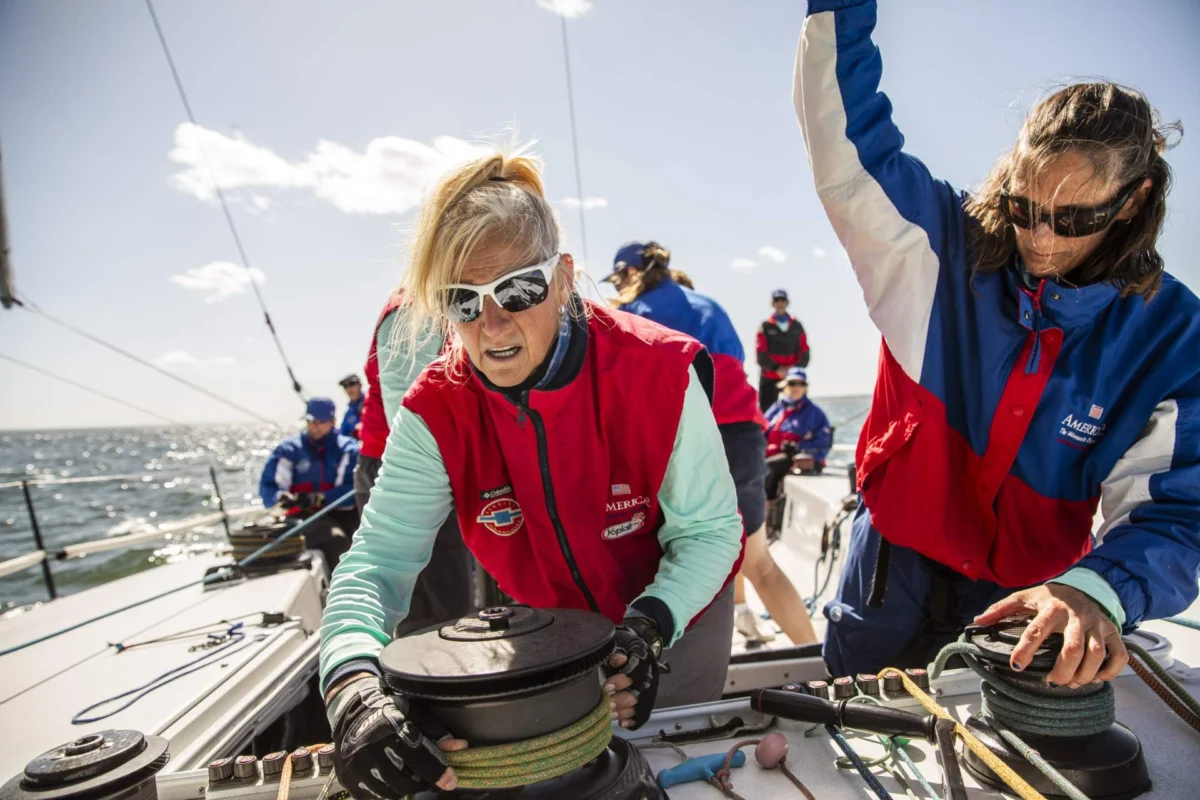
To bridge the gap between historical retrospective and visceral cinematic experience, director Mary Mazzio embarked on an ambitious production strategy nearly three decades after the initial race. She reunited the original Mighty Mary crew—now decades older, but possessing the exact same competitive fire—putting them back aboard 65-foot racing yachts in Oyster Bay.
Mazzio, working alongside co-cinematographer Peter Levy and a dedicated camera team, captured modern racing starts and intense tactical maneuvers. By intercutting split-screen visuals of pixelated 1995 archival footage with pristine, high-velocity modern shots—including Super8 footage captured from inside the boats—the film drops the viewer directly into the physical chaos of the deck.
Supporting Data and Production Insights
The production of Mighty Mary relied heavily on empirical testing and rigorous audience research, a hallmark of Mazzio’s filmmaking process. Rather than relying solely on traditional editing theories, Mazzio routinely subjects early cuts of her films to focus groups composed of teenagers and young adults, noting that high school and college students provide the most unfiltered critiques.
- The Teenage Focus Group Method: During testing, Mazzio’s team observed high school and college demographics, deliberately inviting groups that included demographics unlikely to view a traditional sports documentary—such as high school lacrosse players.
- Tracking Engagement: The editorial team meticulously tracked physical indicators of boredom, including audience coughs, knee-bouncing, and chair-shifting, to determine precisely where pacing lagged.
- Pacing Adjustments: Feedback from younger demographics directly informed the film’s rapid-cut sequences, energetic musical scoring, and structural pacing, consciously steering the project away from a slow-paced, public broadcasting aesthetic ("PBS feel").
- Technological Integration: Utilizing a mix of archival television broadcasts, digital cinematography, and intimate Super8 film rolls captured from the middle of the action, the documentary achieves a tactile sense of immersion.
Official Responses and Perspectives
Mary Mazzio on the Physicality of Elite Sport
Speaking with IndieWire, director Mary Mazzio emphasized that the primary goal of the recreations was to capture the unadulterated reality of athletic endeavor, untethered by the passage of time.

“Seeing that old muscle memory, the racing memory, was incredible,” Mazzio said. “We lined the boats up and did racing starts. People are screaming. It’s like you’re back in it. And for me, I still compete as an athlete, and maybe you don’t have the physicality anymore, but the [competitiveness] is ingrained; it’s Pavlovian. It was incredible to see how these women rallied. They came off the boat, like, ‘We can still do this.’”
Mazzio noted that the culture surrounding depictions of women in media often sanitizes the raw, gritty aspects of high-level competition.
“When you see films about women, you don’t necessarily see certain aspects. The sweat, the profanity, the sheer ‘I can’t do another deadlift’ physicality of going for it and pushing yourself and exploring the outer limits of what you can do. To me, that’s exciting territory.”
The Evolving Perspective of Male Competitors
One of the documentary’s most compelling narrative layers involves the reflections of the male sailors who competed against Mighty Mary in 1995. Looking back from a contemporary vantage point, these athletes offer a candid and surprisingly introspective look at the casual machismo that defined the sport’s culture during the mid-1990s. Their retrospective self-awareness adds analytical depth to a film that avoids simplistic heroes-and-villains framing in favor of a nuanced examination of institutional culture.
Youth Audiences and Cultural Resonance
Mazzio’s focus-group strategy yielded tangible results during test screenings, proving that historical sports documentaries can successfully capture the attention of younger generations accustomed to short-form media.

“I think about our work for the next generation. How do we get these ADHD, ‘I can only pay attention for short content’ kids to watch a film screening?” Mazzio noted. She recounted the reaction of a 16-year-old boy who approached her after a screening to declare the film "epic," validating the director’s 90-minute structure.
Implications for Documentaries and Women in Sport
Mighty Mary arrives at a critical intersection in both sports history and documentary filmmaking. By weaponizing accessible cinematic techniques to engage younger audiences, the film transcends the niche genre of sailing documentaries to deliver a universal message about endurance, grit, and ambition.
1. Challenging Representation in Sports Media
For decades, sports documentaries focusing on women have frequently prioritized inspirational narratives over raw, visceral athletic exertion. By highlighting the brutal training regimens, heavy weights, physical exhaustion, and competitive ferocity of the Mighty Mary crew, Mazzio’s film establishes a new benchmark for how female athletes are portrayed on screen—not merely as symbols of social progress, but as elite, uncompromising competitors.
2. A Blueprint for Audience Engagement in Non-Fiction Cinema
As traditional documentary distribution faces increasing competition from fast-paced digital content, Mazzio’s methodology offers a viable roadmap for filmmakers seeking to capture younger demographics. By treating audience testing as an active editorial tool rather than a final sanity check, filmmakers can successfully translate complex historical narratives into dynamic, high-retention cinematic experiences.
3. Preserving and Recontextualizing Maritime History
By placing 1995 archival footage side-by-side with modern high-definition cinematography, Mighty Mary ensures that a vital milestone in America’s Cup history is not lost to time. It cements the legacy of Dawn Riley, Bill Koch, and the entire Mighty Mary crew, demonstrating that while sailing technology and media landscapes may evolve over decades, the internal drive of an athlete remains fundamentally unchanged.

Mighty Mary is currently screening in select theaters nationwide.
