Decoding the Vaporwave Wasteland: How Julian Glander Used a MacBook and Blender to Craft the Indie Animation Marvel ‘Boys Go to Jupiter’
Main Facts
Independent animation is undergoing a quiet, decentralized revolution. While high-profile studio projects rely on massive budgets, hundreds of render farms, and teams numbering in the hundreds, a new wave of filmmakers is turning software limitations into artistic superpowers. Following the widespread critical acclaim and Academy Award success of Gints Zilbalodis’s Flow—crafted using the free-to-download 3D creation suite Blender—the animation world is waking up to what is possible on consumer-grade hardware.
Enter Boys Go to Jupiter, the startling, pastel-drenched feature-length debut from director JulianGlander. Released by Cartuna and Irony Point, the film represents the antithesis of traditional studio gloss. Set against a uniquely uncanny, sun-bleached vision of Florida, the vaporwave coming-of-age story follows an intensely sleep-deprived teenage delivery worker named Billy 5000 (voiced by Jack Corbett). As Billy hustles to raise $5,000 to secure his independence, he navigates a bizarre suburban ecosystem populated by eccentric peers, supernatural undercurrents, and an orange juice factory managed by Janeane Garofalo and Julio Torres.
Remarkably, despite carrying the visual depth of a modern 3D feature, Glander produced the entire film on a standard MacBook using Blender. The resulting aesthetic is a poignant, lo-fi, and deeply satirical critique of contemporary internet culture, corporate enshittification, and the inescapable weight of late-stage capitalism.
Chronology of Production and Aesthetic Development
The roots of Boys Go to Jupiter stretch back over a decade through Glander’s extensive background in 3D illustration and short-form internet animation. Emerging during the golden age of platforms like Tumblr, Glander honed a distinct visual language defined by smooth geometries, hyper-saturated color palettes, and deadpan absurdist humor.
The Evolution from Short-Form to Feature
Pre-Production & Visual Foundation: For years, Glander utilized Blender not merely as a tool, but as a defining constraint. Working primarily on a portable MacBook forced him to optimize every asset, favoring clean lines, simplified meshes, and calculated compositional choices over computationally heavy particle effects and hyper-realistic simulations.
World-Building the Petri Dish: Glander drew heavily on his upbringing in Florida, conceptualizing the state not just as a geographical location, but as a psychological "Petri dish" where the unchecked expansion of consumerism—symbolized by the 75-year history of Disney World and the paving over of natural swamplands—collided with modern digital alienation.
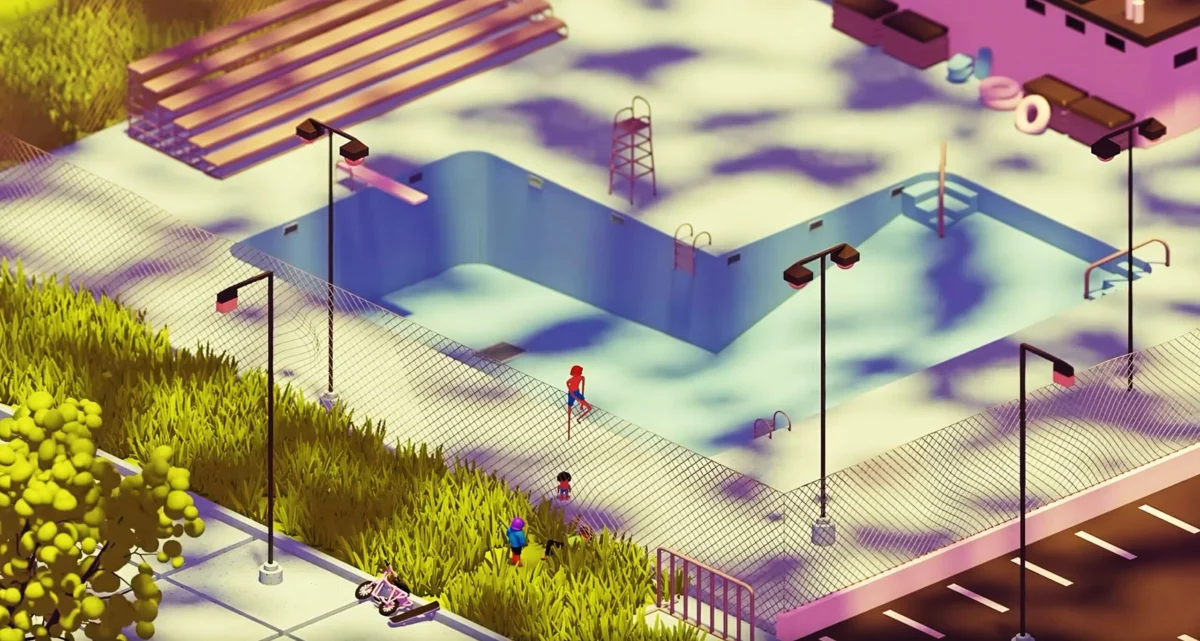
Principal Animation Phase: Using a lean independent production pipeline, Glander and his team engineered workarounds for common animation bottlenecks. To bypass the extreme rendering costs and logistical hurdles of complex character locomotion, they instituted a stylistic rule: characters rarely walk. Instead, figures are framed behind gates, stationed inside doorways, or propelled forward on wheels.
Character Conception: This technical constraint directly informed character psychology. Protagonist Billy 5000 spends the majority of the film gliding on a "swagway" (hoverboard), visually reinforcing his status as an aimless, ghost-like youth drifting through a hyper-commercialized landscape.
Festival Circuit and Distribution: Following its completion, the film captured the attention of independent distributors Cartuna and Irony Point, culminating in its theatrical and digital rollout.
Supporting Data and Technical Architecture
The production of Boys Go to Jupiter serves as a case study in resource management and technological democratization.
The Hardware Baseline: Rather than utilizing a server-class rendering rig, the core of the film was animated and compiled on a standard consumer laptop (MacBook), proving that high-concept cinematic storytelling no longer requires institutional studio backing.
Software Ecosystem: Built entirely within Blender—an open-source 3D creation suite—the film highlights the growing viability of open-access software in professional pipelines. This follows a broader industry trend validated by films like Flow, demonstrating that free tools can support diverse aesthetic styles ranging from lush, hyper-detailed naturalism to flat, vaporwave minimalism.
Economic Efficiencies in 3D Space:
Isometric and Distanced Framing: By utilizing fixed, distant, and isometric camera angles, the production reduced the need for complex, processor-heavy camera tracking and spatial mapping.
Static Locomotion Solutions: By limiting traditional bipedal walk cycles—which are notoriously labor-intensive and prone to looking uncanny if improperly executed—the animators allocated resources toward environmental texture, lighting, and comedic timing.
Voice Cast and Ensemble: The film anchors its lo-fi visuals with a sharp comedic and dramatic voice cast led by Jack Corbett, alongside notable supporting performances by cultural fixtures Janeane Garofalo and Julio Torres.
Official Responses and Creator Insights
In an exclusive interview discussing the film’s unique aesthetic and thematic underpinnings, director Julian Glander opened up about the realities of modern digital creation, the psychological landscape of growing up online, and the logistical triumphs of micro-budget animation.
On Florida as America’s Experimental Lab
Reflecting on the film’s oppressive, sun-drenched atmosphere, Glander noted the deliberate choice of setting:
"We all understand Florida as America’s hell. It’s like the Petri dish where America kind of happens. I kind of think of it as all coming out of Disney World — the invention and the construction of Disney World 75 years ago, the conquering of the swamps, and then the sort of decay of that whole magical fantasy is the world where this movie takes place."
On the Radical Promise—and Subsequent Decay—of the Internet
Glander addressed the paradox of utilizing digital tools born from internet culture during an era of widespread digital fatigue:
"Well, this is the radical promise of the Internet. We love Blender — the software of the year, the hot software of the moment. I think about 20 years ago, when I was on AOL Kids, [there was] this idea that all these tools would come to us and all this amazing creative expression would happen… We’ve almost seen a constriction of it and a re-platforming and a reorganizing of the Internet that’s very unsatisfying. I think you’d be very hard-pressed to find someone today who’s like, ‘I enjoy going online. I like the Internet.’ And that wasn’t the case 10 years ago."
On Turning Technical Limitations into Narrative Strengths
Detailing the deliberate choice to restrict character movement, Glander explained how financial and hardware boundaries shaped Billy 5000’s characterization:
"We had to find every shortcut there was, and then we also had to find a way to make that work creatively. Like, almost nobody walks in the movie, because walk cycles in animation are very time-intensive and when they look wrong, you can really tell… Billy, our main character, is on a swagway for most of the movie because it’s the easiest thing to animate, but also, I think, sells his character as an aimless young man who’s floating through life in a very ghostly way, trying to be unobserved and unnoticed."
Implications for the Future of Independent Animation
Boys Go to Jupiter arrives at a critical inflection point for the animation medium. For decades, the barrier to entry for feature-length 3D animation remained impossibly high, effectively locking out independent creators who could not secure multimillion-dollar financing packages.
The Democratization Parallel to Live-Action
Glander compares the current state of indie animation to the technological shift experienced by live-action filmmaking a decade and a half prior, when consumer-grade devices like the iPhone allowed filmmakers to bypass traditional studio gates and pioneer a new cinematic vernacular.
As educational resources for software like Blender saturate online communities, a new generation of creators is discovering that constraints—whether financial, computational, or spatial—can actively enhance artistic vision. By leaning into pastel-tinted isolation, static framing, and surreal suburban ennui, Boys Go to Jupiter proves that the future of animation belongs not just to those with the deepest pockets, but to those with the sharpest perspectives.