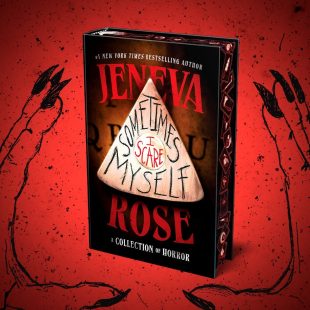
From Postpartum Anxiety to Blood-Splattered Pages: An In-Depth Interview with Author Jeneva Rose on Her Horror Debut Sometimes I Scare Myself
Main Facts
AuthorJenevaRose, widely recognized for her gripping psychological thrillers that have captivated readers around the globe, is officially shedding her purely thriller-centric skin to step boldly into the shadows of the horrorgenre. Her latest release, a chilling collection of novellas titled Sometimes I Scare Myself, marks a significant milestone in her literary career.
Far from being a sudden whim, this venture into horror serves as a long-overdue homecoming for an author whose love affair with the macabre began at the tender age of three when she first watched A Nightmare on Elm Street. The new collection was born out of a deeply personal and transformative period in Rose’s life: the arrival of her first child. Navigating the treacherous waters of sleep deprivation and postpartumanxiety, Rose found herself grappling with the terrifying "what-ifs" and intrusive thoughts that often plague new parents. Rather than letting those anxieties consume her, she channeled them into fiction, transforming her deepest fears into bloody, darkly humorous, and cathartic horror stories.
While Rose initially built her literary reputation on twisting psychological thrillers, Sometimes I Scare Myself allows her to showcase a lifelong passion that predates her career as a published author. Alongside the release of her horror debut, Rose is already looking ahead to the future, teasing her upcoming thriller Dead Girl Summer, scheduled for publication on April 27, 2027. This comprehensive interview explores the genesis of her horror writing, her lifelong obsession with the genre, invaluable advice for aspiring writers, and a sneak peek into her chilling upcoming projects.
Chronology: A Lifelong Descent into Darkness
To truly understand Sometimes I Scare Myself, one must trace Jeneva Rose’s journey through the horror landscape, a path that spans decades of consumption, creation, and professional evolution.
The Formative Years (Early Childhood to Adolescence)
Rose’s fascination with horror began extraordinarily early. At just three years old, she viewed A Nightmare on Elm Street, an experience that planted the seeds for a lifelong obsession with the uncanny and the terrifying. By the time she reached pre-teen years, her creative impulses took a hands-on approach. Armed with the family camcorder, Rose, her brother, and her cousins began shooting their own low-budget horror parodies and original features. Among their cinematic "masterpieces" were a homemade remake of Scream, as well as ambitious original concepts like The Blair Bitch Project and Wereman.
The Thriller Era
As she grew older, Rose transitioned from amateur filmmaker to novelist, eventually breaking into the publishing world through the thriller genre. Readers quickly came to know and love her for her fast-paced, suspenseful narratives and shocking twists. However, beneath the surface of her mainstream success, her devotion to horror never wavered. She continued to read voraciously within the genre, constantly consuming horror media and quietly storing away dark ideas that didn’t quite fit the thriller mold.
The Turning Point: Motherhood and Sometimes I Scare Myself
The catalyst for her official transition into horror publishing occurred following the birth of her child. Amidst the profound joy of welcoming a newborn came the heavy toll of sleep deprivation and severe postpartum anxiety. Intrusive thoughts—the terrifying, unsolicited mental flashes of harm coming to a loved one—threatened to overwhelm her. Recognizing that she needed an outlet for the immense vulnerability and fear of suddenly loving a tiny human beyond measure, Rose turned to her digital Notes app.
She noticed that her horror ideas were rapidly outnumbering her thriller concepts. While some of these dark concepts lacked the expansive framework required for a full-length novel, they were too potent to discard. A collection of novellas proved to be the ideal vessel. Sometimes I Scare Myself became the direct byproduct of this turbulent yet creatively fertile period, allowing Rose to weaponize her maternal anxieties and transform them into fiction.
Supporting Data and Genre Analysis
The publication of Sometimes I Scare Myself offers a fascinating case study in the intersection of real-world trauma and creative expression. Horror has long functioned as a safe harbor for processing societal and individual fears, but Rose’s approach highlights a particularly raw, contemporary form of psychological purgation.
The Anatomy of Postpartum Horror
Mental health professionals and literary critics alike have increasingly recognized the therapeutic value of dark fiction in processing perinatal mood disorders. Postpartum anxiety affects a staggering percentage of new mothers, often manifesting as relentless, catastrophic intrusive thoughts. By taking these terrifying mental scenarios—such as the sudden, irrational fear that catastrophe is lurking around every corner—and twisting them into fictional narratives, authors can externalize their internal distress.
In Sometimes I Scare Myself, Rose achieves a delicate balance that defines the best horror writing: the coexistence of terror and dark humor. Data from psychological studies consistently shows that dark humor acts as an effective defense mechanism, helping individuals cope with high-stress environments. By injecting moments of levity into bloody, high-stakes scenarios, Rose mirrors the absurdism of real-life anxiety, where moments of utter terror can sometimes elicit a nervous laugh.
The Appeal of the Novella Format
In a publishing market historically dominated by either short stories or full-length novels, the horror novella occupies a unique and vital niche. Rose noted that many of her horror concepts simply "didn’t have enough legs for a full novel." The novella format allows authors to maintain a relentless, high-octane pace without padding the narrative with unnecessary subplots. For readers, this translates to concentrated bursts of pure dread and suspense—a stylistic choice that aligns perfectly with the intense, hyper-focused nature of anxiety-driven thoughts.
Official Responses and Insights from the Author
In an exclusive interview discussion, Jeneva Rose opened up about the emotional weight of her new book, her philosophy on rejections, and the inner workings of her creative mind.
On Channeling Fear into Fiction
Reflecting on why horror was the only appropriate genre for her postpartum experiences, Rose explained:
"Horror gave me a place to put all that fear. I could take the things that scared me, twist them into something fictional, bloody, and occasionally funny, and put them on the page instead of carrying them around in my head."
She also emphasized that the genre serves as an acknowledgment of harsher realities, noting that the real world often eclipses the most imaginative horrors found in books or films. Despite her prior success as a thriller writer, transitioning into horror felt less like a pivot and more like shedding a disguise. "Getting to publish in the genre with Sometimes I Scare Myself feels like I’m letting readers see a side of me that’s always been there," she shared.
On Rejection and the Writer’s Mindset
For aspiring writers navigating the notoriously difficult publishing landscape, Rose offered a profound shift in perspective regarding rejection. Rather than viewing a rejection letter as a definitive failure, she treats every "no" as a temporary redirection.
"I’ve always looked at every ‘no’ as a ‘not right now.’ So much of a writing career is outside of your control. You can’t control whether an agent says yes, whether a publisher buys your book, how it sells, or how readers respond once it’s out in the world. But you can control whether you keep writing."
Rose outlined her rigorous work ethic as a shield against discouragement:
"My biggest advice is to write through the waiting. Write while you’re querying. Write while you’re on submission. Write while you’re waiting for an editor to get back to you. Write through the rejections. Every time I finished a book and sent it out, I started another one. That way, one ‘no’ never had the power to stop me because I’m already working toward the next ‘yes.’"
Looking Forward: Dead Girl Summer (2027)
While currently celebrating the launch of her horror collection, Rose is already building anticipation for her next major thriller release. Titled Dead Girl Summer, the novel is set to hit shelves on April 27, 2027, and promises to deliver the intricate plotting and suspense her fanbase adores.
Set in Tomahawk, Wisconsin—a picturesque, postcard-worthy lake town—the story centers around a chilling local phenomenon. Over the course of two consecutive summers, three young women have died under mysterious circumstances. Although official reports ruled their deaths as tragic accidents, the locals have grimly dubbed the cluster of tragedies "Dead Girl Summer."
The narrative ignites when a disgraced true-crime podcaster arrives in town, recognizing the string of deaths as the definitive investigative piece capable of resurrecting her floundering career. Standing in her way is the town’s acting sheriff, who has a vested, desperate interest in maintaining the official narrative that the deaths were mere accidents. The delicate status quo shatters entirely when a fourth body is discovered in the lake, plunging the community into a frantic race for the truth.
Implications of the Genre Shift
Jeneva Rose’s successful foray into horror carries several notable implications for both her career and the broader contemporary publishing ecosystem.
1. Expanding the Brand of the Modern Thriller Author
In contemporary publishing, authors are frequently nudged to remain within established genre boundaries to maximize marketing efficiency. A recognizable "brand" helps retailers and algorithms categorize books neatly. However, Rose’s move proves that cross-genre experimentation—when rooted in genuine passion and personal experience—can expand an author’s audience rather than alienating them. Thriller fans drawn to her razor-sharp pacing will find those same mechanics amplified in her horror work, while dedicated horror enthusiasts gain a talented new voice with a mainstream platform.
2. Destigmatizing Maternal Mental Health Through Art
By speaking candidly about postpartum anxiety as the driving force behind Sometimes I Scare Myself, Rose contributes to a vital cultural conversation. Postpartum mental health struggles are frequently sanitized or whispered about in hushed tones. By weaponizing her experiences and rendering them as visceral, bloody fiction, Rose helps dismantle the shame surrounding intrusive thoughts. She validates the reality that motherhood and intense fear can coexist, offering a powerful reminder that creative output can serve as a lifeline during life’s most disorienting chapters.
3. A Blueprint for Resilience in Publishing
Rose’s practical philosophy on the publishing industry offers a much-needed antidote to the pervasive burnout affecting many modern creators. By emphasizing continuous creation over passive waiting, she provides a sustainable mental framework for surviving the endless cycle of queries, submissions, and editorial feedback. Her insistence that "a ‘no’ only becomes the end of the story if you stop writing" serves as an inspiring rallying cry for a new generation of novelists.
Conclusion
With Sometimes I Scare Myself, Jeneva Rose has successfully proven that her literary talents extend far beyond the confines of the psychological thriller. By turning her most agonizing personal fears into brilliantly crafted, blood-soaked horror novellas, she has delivered a collection that is as emotionally resonant as it is terrifying. As she continues to bridge the gap between horror and suspense—with her sights firmly set on the 2027 release of Dead Girl Summer—Rose solidifies her status as one of the most versatile and resilient voices in modern genre fiction. Whether she is dissecting the dark corners of a picturesque Wisconsin lake town or mining the terrifying depths of postpartum anxiety, Jeneva Rose proves time and again that she knows precisely how to keep her readers turning pages late into the night.