
Fur, Class, and Absurdity: How Uruguayan Director Federico Borgia Turns a Canine Inheritance Into a Cinematic Battle Royale
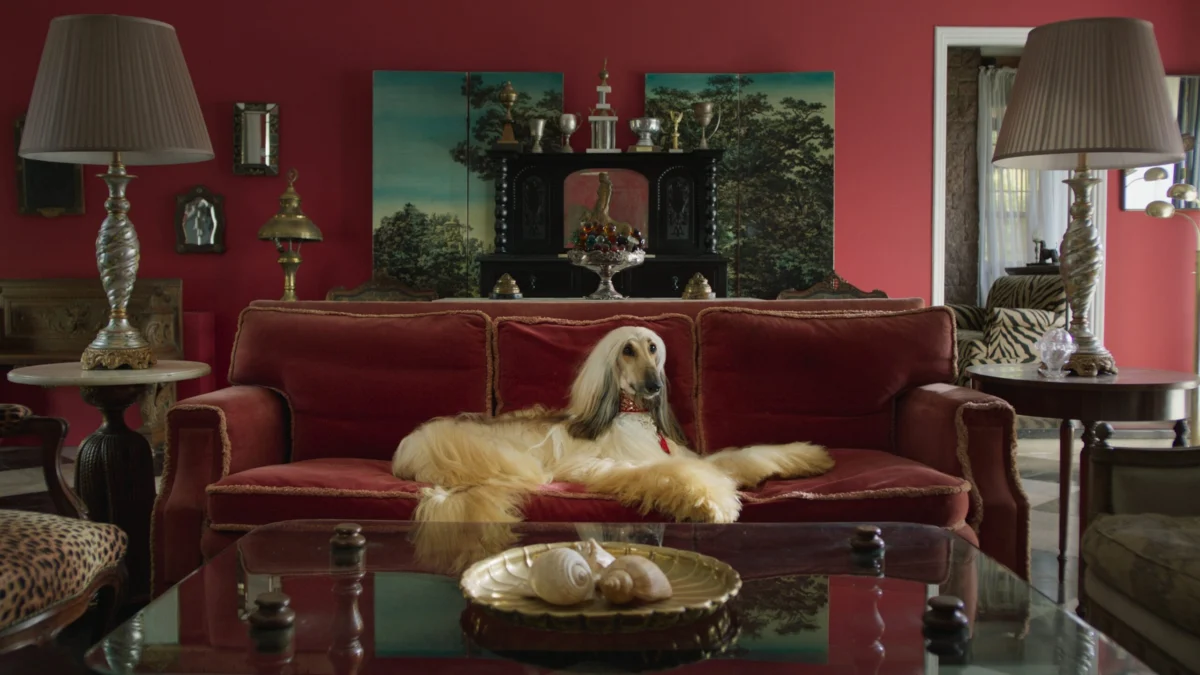
LONDON — Prince is accustomed to the finer things in life: pampered grooming sessions, sweeping coastal views, and an environment where his every whim is catered to. But in Prince, the darkly comedic solo feature debut from Uruguayan writer-director Federico Borgia, this award-winning Afghan hound becomes the unwitting catalyst for a high-stakes, cinematic battle royal. Steeped in black humor and absurdist tension, the film uses a canine inheritance dispute to lay bare the precarious fault lines of class, wealth, and human avarice.
As the film prepares for its world premiere at the 70th edition of the BFI London Film Festival (LFF) on Thursday, October 8, international sales agent Alpha Violet is steering its festival and market rollout. Starring an acclaimed cross-border cast that features Roberto Suárez (The Saint), Maitina De Marco (27 Nights), and Esteban Bigliardi (27 Nights), Prince positions itself as one of the most distinctive Latin American festival entries of the year—a stylistic tightrope walk between kitsch comedy and psychological claustrophobia.
Main Facts: The Setup of an Absurdist Inheritance
At its core, Prince explores the friction that occurs when dying wealth meets working-class survival. Set against the fading, melancholic glamour of Punta del Este—a coastal resort town where hyper-wealth rubs shoulders with the service economy—the narrative kicks off with a bizarre yet binding legal condition.
The story centers on Jaime (played by Suárez), a former romantic partner who has spent two decades living as a live-in butler to Isabel (De Marco), an affluent Argentine woman residing in an expansive seaside villa. Their unconventional domestic rhythm orbits entirely around Prince, Isabel’s prized Afghan hound.
When Isabel dies unexpectedly in her swimming pool, her will reveals a shock provision: her entire luxury estate is left directly to Prince, with Jaime appointed as the dog’s legal guardian. The catch? Isabel’s estranged human relatives cannot touch the property until the dog passes away.
This sets the stage for a ruthless custody battle. When Isabel’s estranged son and granddaughter move into the villa with the explicit intent of ousting the dog, Jaime is forced to protect Prince while simultaneously confronting Diego, his own estranged son. The resulting domestic warfare transforms the once-grand coastal estate into a claustrophobic pressure cooker, exposing a tangled web of resentment, greed, and suppressed history.
Chronology: From Childhood Observations to the Big Screen
The journey to Prince spans decades of observation for Borgia, who previously co-directed Clever (2015) and The Champion of the World (2019) alongside Guillermo Madeiro. The seeds of the film were planted during two distinct phases of the filmmaker’s life: his childhood and his eventual relocation to Punta del Este.
- Childhood Influences: Long before he stepped behind a camera, a young Borgia was given a dog at age ten. Accompanied by his mother to a local groomer, the young boy observed pictures of elite dog shows featuring handlers in sharp suits. "They looked like lawyers, but with a dog," Borgia recalls.
- Geographic Shift: Years later, moving from Montevideo to Punta del Este crystallized his artistic vision. Immersed in a resort town where socioeconomic classes violently collide—where a wealthy elite pays for services rendered by a struggling working class—Borgia began observing the local dynamics.
- The Creative Synthesis: Surrounded by this juxtaposition of modern glamour and decaying luxury, Borgia started taking notes on everyday people, letting his imagination run wild about what secrets lay behind closed doors. Eventually, these real-life observations merged with the classic cinematic trope of an eccentric inheritance.
- Festival Debut: Following years of development, writing, and production, the Uruguayan-Argentine co-production is slated for its world premiere at the BFI London Film Festival on October 8.
Supporting Data & Production Insights: Working With the "Un-trainable" Star
Making a film driven by a high-maintenance dog comes with unique hurdles, particularly when the breed in question has a reputation for stubbornness.

According to dog training literature on the internet, the Afghan hound sits comfortably near the bottom of the canine trainability index, far out-ranked by border collies and German shepherds. However, Borgia’s aesthetic choice—prioritizing the striking, sweeping silhouette of the breed over obedience metrics—paid off thanks to a serendipitous encounter.
The Canine Talent
During pre-production, the creative team met an owner who lived with eight Afghan hounds. While most were notoriously difficult, one young dog defied the breed’s reputation.
"He said he is like a Labrador in the body of an Afghan," Borgia notes. "He was really social and really calm."
On set, the star performer was remarkably cooperative. Borgia reports that the canine actor caused zero major disruptions throughout the shoot—with just one watery exception.
"The dog was always perfect," the director says. "We never had a problem with the dog. Except for that one time when things got hairy… just one time, he fell into the pool, and we had to dry his hair for two or three hours."
Assembling the Cast
For the human cast, Borgia balanced performers he had long idolized with fresh faces discovered through targeted casting calls across Uruguay and Argentina.
Securing Roberto Suárez for the complex role of Jaime was a priority. "Roberto Suárez… is someone I have wanted to work with for a long time, and he accepted really fast," Borgia says. "I really admire him, not only as an actor, but also as a great theater creator. He was reading different versions of the script and throwing out ideas, and they were always brilliant ideas."
Official Responses & Director’s Perspective
Speaking with industry press, Borgia has been candid about the socio-political underpinnings and character dynamics that define Prince. Rather than relying strictly on genre conventions, the director sought to ground the absurd premise in authentic emotional ambiguity.

Discussing Jaime’s peculiar position within the household, Borgia highlights the blurred lines of modern labor and intimacy:
"He’s a worker who met this lady in some kind of service relationship, and then he became her lover, and that started this undefined point between being a lover, partner, butler. It’s really undefined as you start discovering, and then all the other relationships and bonds and all the problems that come with them and family come into the film."
Despite the distinctively South American coastal setting—marked by the specific architectural and social decay of Punta del Este—Borgia firmly believes the film’s themes will resonate globally.
"The story itself is universal," the director explains, "but the most important thing for me was the characters and their relationship, and the tone of the film. I felt I could make it different. The original thing is how an author can make the premise of a film different."
When asked what lies ahead after the film’s high-profile London premiere, Borgia admits to the cyclical anxiety common among independent filmmakers. "I want to talk about it, but I have no clue," he laughs. "Every time I finish a film, I really don’t know if I’m going to make another one… But I know I will because it’s like an addiction. You know you’re going to fall into it again."
Implications: A New Wave for Latin American Dark Comedy
The world premiere of Prince at the BFI London Film Festival marks a significant milestone for Uruguayan cinema, highlighting the region’s growing capacity to produce internationally competitive, high-concept dark comedies.
By framing class warfare through the lens of a kitsch custody battle over an Afghan hound, Borgia avoids heavy-handed moralizing, opting instead for a satirical lens that exposes the absurd lengths to which families will go for capital. As Alpha Violet introduces the film to international buyers and festival programmers in London, Prince is poised to establish Borgia as a major voice in contemporary Latin American auteur cinema—proving that sometimes, the best way to examine human greed is to hand the keys of the kingdom to a very glamorous, unfazed dog.
