How Titmouse Brought 1990s Anime Grit to the Live-Action ‘Street Fighter’ Adaptation
Main Facts: A Bold Hybrid Approach to Video Game Adaptation
In the modern cinematic landscape, the influence of anime is inescapable. From the kinetic, multi-dimensional framing of Spider-Man: Across the Spider-Verse to the deeply ingrained, pugilistic poetry of Creed III—which draws a straight, unapologetic line back to classic shonen staples like Naruto and Hajime no Ippo—live-action and animated media have increasingly traded DNA. Yet, despite this aesthetic cross-pollination, it remains exceedingly rare for a live-action feature film to anchor its core emotional narrative in hand-drawn, anime-style sequences.
Director Kitao Sakurai’s live-action StreetFighter feature film, based on Capcom’s legendary and massively influential video game franchise, avoids this limitation entirely. Rather than relying on standard CGI spectacle or disconnected video game cutscenes to nod to its source material, the film takes a daring narrative swing. It embeds an entire chronological storyline within its runtime using traditional, 2D animation.
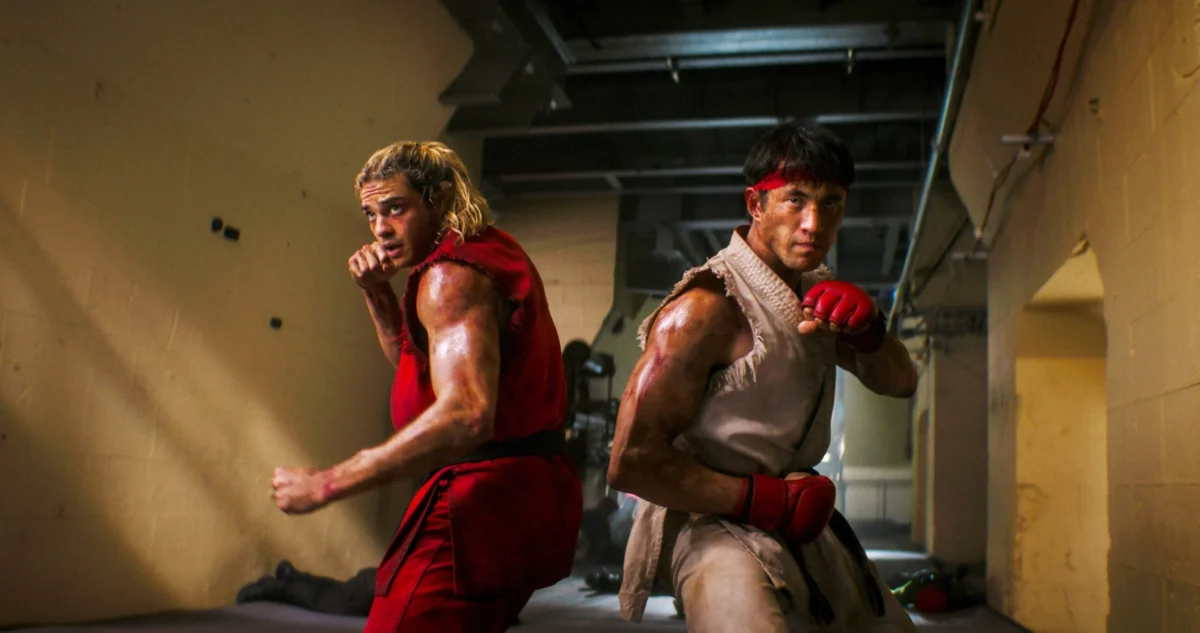
Produced by the acclaimed studio Titmouse, these sequences do not play as fleeting Easter eggs or stylized commercials. Instead, they function as an integral dramatic spine for the film. Through gritty, hyper-violent, hand-drawn flashbacks evoking the golden era of 1990s OAV (Original Animation Video) classics like Angel Cop and Ninja Scroll, the movie details the formative years of Ryu (Andrew Koji) and Ken Masters (Noah Centineo). It charts their brotherhood, their rigorous training under Gouken, and their tragic fallout after Ryu accidentally unleashes the demonic entity known as Akuma.
Chronology: From a Single Pitch to the Emotional Core of the Film
The integration of 2D animation into a live-action blockbuster was not always the master plan. According to Titmouse co-founder Chris Prynoski, the project’s scope evolved organically through creative collaboration.
The Initial Concept
Initially, the production team envisioned a single, isolated animated sequence—a brief stylistic flourish to bridge a narrative gap or showcase a legendary move. However, that trajectory shifted during early pitch meetings when animation supervisor Young Heller presented a series of striking storyboards.
The Evolution on Set
According to Prynoski, those initial storyboards served as a turning point. It was the first time director Kitao Sakurai fully visualized the potential of what hand-drawn sequences could achieve within the broader cinematic universe of the film. As production progressed, Sakurai began requesting more and more animated material. What started as a minor stylistic nod steadily expanded into a recurring, structural presence throughout the film’s runtime.
Production and Execution
With art director Khang Le stationed on the ground alongside animation supervisor Young Heller, Titmouse worked closely with Sakurai to ensure the animation seamlessly mirrored the camera movements, blocking, and directorial rhythm of the live-action photography. The result is a series of flashbacks that culminate in crucial narrative beats, such as Ryu’s first deployment of the iconic Hadouken and his harrowing bout against Sagat during the inaugural World Warrior tournament. These animated interludes build inexorably toward the live-action climax: the inevitable, emotionally fraught confrontation between Ryu and Ken.
Supporting Data: Behind the Scenes at Titmouse
While Titmouse is internationally renowned for steering powerhouse television animation—including critical and commercial smashes like The Legend of Vox Machina and Star Trek: Lower Decks—feature film production offers a distinct set of operational and artistic challenges.
Although the studio previously contributed a 2D animated sequence to M3GAN 2.0, the scale of Street Fighter represents a massive leap forward. Feature films require a level of visual fidelity, character consistency, and production polish that differs fundamentally from the constraints of weekly television pipelines.
Technical and Artistic Choices
Visual Reference: The artistic direction consciously bypassed the uncanny valley of hyper-realistic Western character models. Instead, it targeted the nostalgic, sharp-lined aesthetic of 1990s Japanese animation.
Studio Scale: Unlike television projects that must adhere strictly to tight broadcast budgets and rapid turnaround times, the production provided Titmouse with the necessary resources.
Resource Allocation: Ample time and financial support enabled the artists to experiment with complex action choreography, detailed ink-and-paint aesthetics, and heavy shadow work characteristic of vintage martial arts anime.
Official Responses: Creators on Balancing Styles
Bridging the gap between a live-action Hollywood feature and a distinct sub-genre of hand-drawn Japanese animation required delicate coordination between the live-action director and the animation house.
Chris Prynoski emphasized in an interview with IndieWire that the primary objective was to maintain structural and aesthetic continuity with Sakurai’s live-action vision while granting the animators creative autonomy.
"There was an attempt to hit the likeness, but not so hard like you do in a western style where it looks too realistic and almost uncanny," Prynoski explained. "It was definitely the overriding principle of the concept to really make it feel like ’90s anime and be inspired by the original games."
Prynoski credited art director Khang Le and animation supervisor Young Heller for maintaining close communication with Sakurai on set. This ensured that the animation’s framing, pacing, and kinetic energy reflected the tone of the live-action scenes. At the same time, the studio retained the creative freedom required to make the animated sequences feel authentic to the medium.
"We got a lot of agency in making the scenes as authentic as possible in the medium of animation," Prynoski added. "They gave us enough time and enough budget to really execute and make something that we’re really proud of, and hopefully something we’ll do more of."
Implications: A New Blueprint for Video Game Adaptations
The integration of 2D animation into live-action Street Fighter carries significant implications for future video game adaptations and Hollywood blockbuster production models.
1. Elevating Video Game Adaptations Beyond Nostalgia Bait
For decades, video game adaptations struggled with an identity crisis, frequently caught between alienating hardcore fans with loose cinematic retellings or alienating general audiences with slavish recreations of video game lore. By utilizing traditional anime sequences to handle complex backstory—such as the inner turmoil of Ryu, the tragic awakening of Akuma, and the bond with Ken—the film bypasses clunky exposition dumps. It proves that animation can serve as a sophisticated storytelling tool within a live-action framework.
2. A Showcase for Western Animation Studios
For studios like Titmouse, Street Fighter acts as a high-profile calling card. It demonstrates that television-bred animation powerhouses can successfully scale up to deliver feature-film-quality sequences that hold their own alongside live-action cinematography. The critical reception of these sequences highlights a growing appetite among audiences for mixed-media storytelling in mainstream cinema.
3. Setting a New Industry Standard
As studios continue to mine video game intellectual properties for cinematic universes, the success of the animated flashbacks in Street Fighter offers a compelling template. It demonstrates that honoring source material does not require a choice between live-action realism and full animation. Instead, a hybrid approach—when backed by adequate time, budget, and creative synergy—can yield a richer, more emotionally resonant cinematic experience.
“Street Fighter” is now playing in theaters nationwide.