
Illuminating the Frame: The Revolution of Affordable, Portable LED Lighting
The landscape of professional video production has undergone a seismic shift over the last decade. A decade ago, achieving cinematic lighting required bulky, heat-intensive tungsten arrays, fragile glass panels, and the logistics of a power-hungry generator or heavy-duty extension cables. Today, the technological trajectory of Light Emitting Diodes (LEDs) has democratized high-end production values. What was once the exclusive domain of major studios is now available to independent creators, documentarians, and solo operators, thanks to a new wave of compact, affordable, and incredibly powerful handheld lighting solutions.
As LEDs have cemented themselves as the industry standard, manufacturers have turned their attention to miniaturization. The ability to carry a professional lighting kit in a backpack—rather than a dedicated lighting truck—has fundamentally changed how we approach cinematography. Whether you are aiming for a subtle eye light to bring life to a subject’s gaze, a vibrant background wash, or a practical light hidden within a scene, there has never been a better time to invest in your toolkit without exhausting your budget.
The Technological Evolution: From Bulky to Portable
To understand the current market, one must look at the chronology of lighting technology. The transition from traditional incandescent bulbs to LEDs was initially met with skepticism regarding color accuracy and flicker. However, through the mid-2010s, improvements in Color Rendering Index (CRI) and Television Lighting Consistency Index (TLCI) ratings brought LEDs up to par with traditional sources.
As the underlying LED tech matured, the focus shifted to form factor. The emergence of lithium-ion battery technology allowed these lights to become untethered from AC power. Simultaneously, the integration of wireless control protocols—such as Bluetooth-enabled apps—meant that gaffers and solo operators could manipulate lighting parameters from across a room. This combination of portability, color precision, and app-based control has created a "golden age" for the independent creator.
Top-Tier Handheld Options: A Curated Review
The following selections represent the current benchmark for price-to-performance ratios in the portable lighting space.
1. Aputure MC: The Industry Standard
The Aputure MC is widely considered the gold standard for compact, "credit-card" sized lights. Its versatility is unmatched; it provides a bi-color range from 3200K to 6500K, alongside full RGB capability and 100 levels of saturation adjustment.
- Key Features: Integrated magnetic back, high-quality diffusion case, and seamless integration with the Sidus Link app.
- Implications: The magnetic mount is a game-changer, allowing users to attach the light to metal surfaces like door frames or desk legs, effectively replacing the need for bulky C-stands in tight spaces. Its reliability in wireless connectivity ensures it remains a staple in any professional Pelican case.
2. Lume Cube RGB Panel Pro: The Event Workhorse
Designed with the event videographer in mind, the Lume Cube RGB Panel Pro offers a robust output of 1000 Lumens from 263 LEDs. It is the ideal companion for those shooting weddings or corporate events where mobility is critical.
- Supporting Data: The battery life is its standout feature, capable of running for 4 hours at 50% brightness or 2.5 hours at full intensity.
- Usage Context: Its slim profile allows it to be mounted directly onto a camera cage without compromising the center of gravity, making it a perfect tool for run-and-gun vlogging or adding dynamic color splashes to a background.
3. Nanlite LumiPad 11: Sleek and Efficient
Nanlite has rapidly ascended as a major competitor to established brands by focusing on reliability and consistent innovation. The LumiPad 11, at just 1.4 inches thick and weighing under 0.6 lbs, is a marvel of efficiency.
- Professional Perspective: While it isn’t intended to replace a main key light for large-scale cinema, it excels as a fill or backlight. Its low weight means it can be safely mounted using lightweight gaffer tape or small articulating arms, making it the perfect "emergency" light for quick setups.
4. Aputure MT Pro: The Hidden Accent
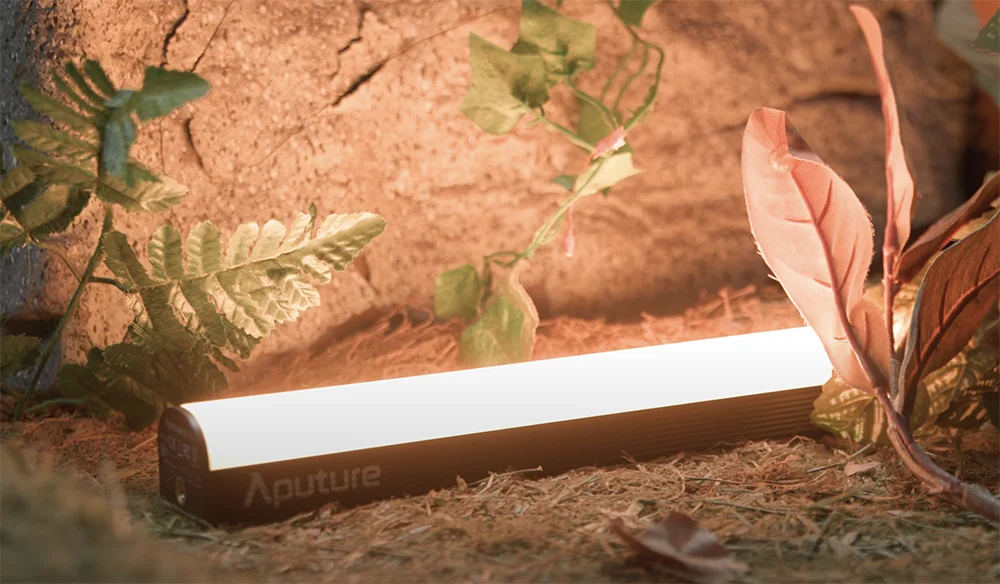
The mini LED tube light represents a shift toward "practical" lighting—lights that are designed to be seen or hidden within the frame.
- The "Flare" Factor: These lights are intended for creative placement—tucked behind bookshelves, hidden under kitchen counters, or concealed within foliage. They provide the necessary "pop" in an interview set that elevates a flat, boring background into a layered, professional composition.
5. Nanlite PavoTube II 6C: Speed and Precision
For documentary filmmakers, setup time is the enemy. The PavoTube II 6C is a masterclass in rapid deployment.
- Technical Specifications: Featuring a CRI of 98 and a color temperature range of 2700K–7500K, it provides professional-grade light quality.
- Built-in Effects: The inclusion of programmable cinematic effects—such as lightning, police sirens, or flickering fires—allows creators to simulate complex lighting scenarios without the need for additional DMX consoles or software.
6. Amaran AL-MX: The "Brick"
Often referred to as "the brick," the Amaran AL-MX is a bi-color powerhouse. It is a more rugged, heavier option that prioritizes raw output over extreme miniaturization.
- Performance: Capable of 1100 lux at 0.5m in Boost Mode, it is essentially a handheld sun. It serves dual purposes: as a reliable key light for close-ups and as a utilitarian tool for illuminating dark locations during equipment teardowns.
Implications for Modern Production
The widespread availability of these tools has significant implications for the industry. First, the "barrier to entry" for high-production value has been obliterated. A project that previously required a $5,000 lighting rental can now be achieved with $500 worth of pocket-sized LEDs.
However, this ease of use brings a responsibility. As lighting becomes more accessible, the art of "lighting with intent" becomes more important. Having a pocket-sized RGB light is useless if the operator doesn’t understand the principles of contrast, color theory, and shadow management.
Official Industry Stance
Manufacturers like Aputure and Nanlite have noted that the feedback from the independent community drives their R&D departments. By listening to the specific pain points of creators—such as the need for better battery management and more intuitive app interfaces—these companies are effectively crowdsourcing the future of lighting. The focus has moved from "how many lumens can we put in a box" to "how can we make this light disappear into a scene while providing maximum control."
Conclusion: The Future is Bright
As we look toward the next decade, we can expect further integration of AI-assisted lighting adjustments, where lights might automatically adjust their color temperature to match ambient room conditions. Yet, the current crop of handheld LEDs is already more than capable of handling professional workflows.
For the modern filmmaker, the message is clear: stop relying on massive, immovable lighting rigs for every scenario. Invest in a kit that prioritizes portability, color accuracy, and wireless control. Whether you are a wedding photographer needing a quick fill light or a narrative filmmaker looking for the perfect practical, these handheld LEDs offer the flexibility to adapt to any environment at a moment’s notice. The tools are no longer the bottleneck—your creativity is.
Disclaimer: All mentioned products were evaluated based on market availability, user-reported reliability, and technical output specifications.
