
Ingenuity in Exile: Examining The Professor’s Five Most Realistic Inventions on Gilligan’s Island

Main Facts
For three seasons, Gilligan’s Island captivated millions of television viewers with its high-concept premise: a diverse group of seven castaways stranded on an uncharted Pacific atoll following a “three-hour tour” gone wrong. While the sitcom relied heavily on physical comedy, repetitive gags, and far-fetched plots, it also featured one of television’s most enduringly resourceful characters: the Professor, played by the late Russell Johnson.
Though Johnson famously harbored mixed feelings about the typecasting and lifelong fame brought by the role, his character served as the undeniable intellectual anchor of the series. Equipped with an endless array of academic degrees and an apparently bottomless knowledge of applied sciences, the Professor routinely transformed bamboo, vines, coconuts, and debris from their wrecked ship, the S.S. Minnow, into functional machinery.
While many of his creations stretched the boundaries of believability—such as a Lie Detector constructed from a ship’s horn or a full-scale hot air balloon fabricated from raincoats—a select few of his inventions stood out for their surprising technical accuracy. Examining these specific devices reveals that, under the right conditions, the Professor’s mechanical engineering was grounded in genuine scientific principles.

Chronology: The Evolution of Survival Engineering
The ingenuity displayed on the island was not a static element of the show; rather, it evolved alongside the castaways’ desperation and familiarity with their tropical environment.
Season 1: Establishing the Baseline (1964–1965)
In the early episodes of the series, the Professor’s inventions were primarily focused on basic survival, sanitation, and creature comforts. As the castaways realized they would be stranded for the foreseeable future, the necessity for organized domestic infrastructure arose. This era of survival engineering birthed human-powered mechanics designed to reduce physical labor, laying the groundwork for more complex apparatuses later on.
Season 2: Scientific Expansion and Complex Problem-Solving (1965–1966)
By Season 2, the scope of the Professor’s inventions expanded dramatically. No longer content with merely washing clothes or listening to music, the Professor began tackling advanced geological monitoring, emergency communication hurdles, and even food preparation. This season featured the peak of his engineering output, balancing whimsical plot devices with surprising nods to historical technology.

Supporting Data: The Professor’s Top 5 Realistic Inventions
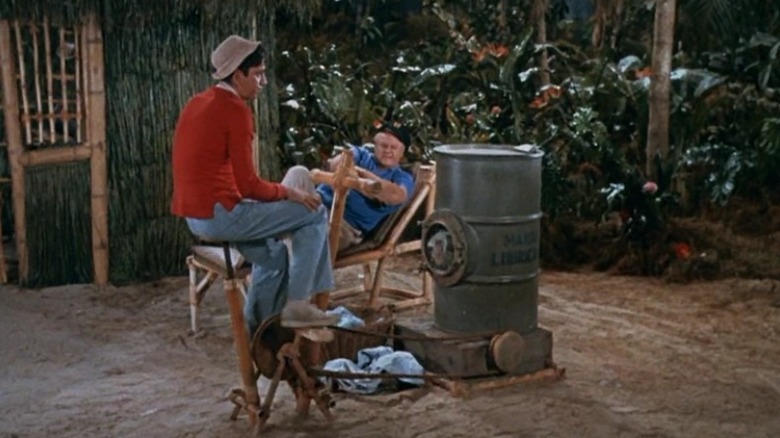
1. The Pedal-Powered Washing Machine
- Episode Reference: Season 1, Episode 19, "Gilligan Meets Jungle Boy"
- Materials Used: A discarded marine lubricant metal drum, a porthole window, bamboo, and a bicycle-style crank.
- Mechanism: Operating entirely on human-generated mechanical energy, this device allowed the castaways to maintain hygiene without electricity. The user sat on a bamboo seat, pedaling a crank that rotated the inner drum through soapy water.
Scientific Merit: The physics behind this invention are entirely sound. Human-powered washing machines are not merely a sitcom trope; they have historical precedents in rural communities lacking electrical grids. By utilizing a sealed metal drum for agitation and a manual crank to achieve torque, the design successfully replicates the mechanical action of early twentieth-century non-electric agitator washers.
2. The Bamboo Seismometer
- Episode Reference: Season 2, Episode 25, "Operation: Steam Heat"
- Materials Used: Bamboo, a roll of paper salvaged from the shipwreck, a fixed pen, and a weighted bag.
- Mechanism: Triggered by fears of a volcanic eruption following the discovery of a hot spring, the Professor engineered a crude recording seismograph. A weighted bag attached to a paper strip registered ground motion, while a fixed pen traced the magnitude of tremors onto the moving paper.
Scientific Merit: This device mirrors the ancient history of seismology. Long before electronic sensors, early mechanical seismoscopes (such as those invented in ancient China) relied on inertia to record ground movement. Because the heavy weighted bag remained relatively still while the earth and the frame moved beneath it, the pen successfully graphed seismic activity. The design is historically accurate and physically plausible.
3. The Pedal-Powered Hacksaw (and Its Realistic Failure)
- Episode Reference: Season 2, Episode 17, "You’ve Been Disconnected"
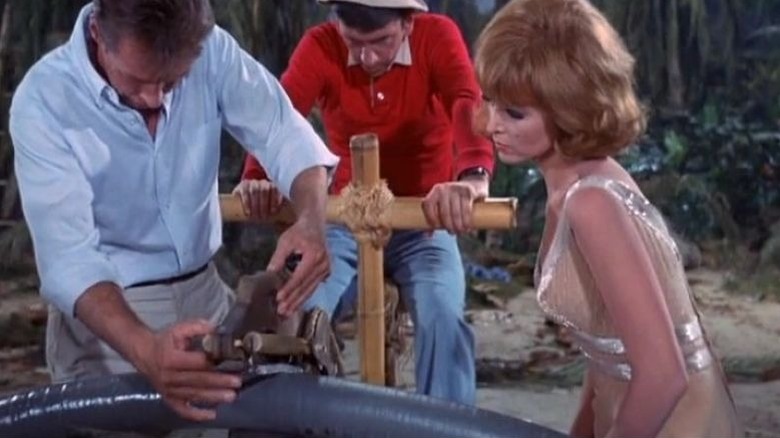
- Materials Used: A bamboo seat, a wooden bike crank, a vine belt, and a diamond necklace belonging to Eunice Howell (Natalie Schafer).
- Mechanism: After a severe storm washed a heavy-duty phone cable onto the beach, standard hand tools failed to cut through it. The Professor rigged a pedal-driven mechanism to slide Mrs. Howell’s diamond necklace back and forth across the cable at high speed.
Scientific Merit: Ironically, the most realistic aspect of this invention was its failure. While the mechanical transfer of rotational pedal energy into linear sawing motion is entirely viable, cutting thick undersea or armored communication lines requires sustained, high-friction cutting power or specialized thermal tools. Gilligan’s inability to generate enough friction to sever the cable highlights a rare commitment to physical realism in the show’s writing.
4. The Coconut Guillotine
- Episode Reference: Season 2, Episode 16, "Not Guilty"
- Materials Used: A metal sheet for the blade, bamboo framing, and a wooden base.
- Mechanism: Designed specifically to split coconuts in half, this miniature execution device utilized gravity to drop a sharpened metal blade cleanly down a bamboo track.
Scientific Merit: While employing a French instrument of execution for kitchen prep is undeniably macabre, the mechanics are foolproof. A weighted, vertically guided blade drops with maximum force along a fixed axis, making it an efficient tool for cleaving hard-shelled fruits. It requires no complex moving parts, relying solely on gravitational potential energy converted into kinetic cutting force.
5. The Hand-Cranked Record Player
- Episode Reference: Season 2, Episode 30, "The Producer" (widely regarded as one of the series’ best episodes)
- Materials Used: The steering wheel of the S.S. Minnow, a makeshift needle, and a megaphone functioning as an acoustic amplifier.
- Mechanism: Operating identically to a vintage phonograph, the turntable was manually spun via the ship’s steering wheel. A stylus tracked the grooves of a vinyl record, and the sound was amplified acoustically through a megaphone.
Scientific Merit: This is arguably the most scientifically authentic invention on the show. Early gramophones did not require electricity; they operated entirely on spring-wound motors or manual rotation combined with acoustic horn amplification. By substituting a ship’s steering wheel for a traditional crank and a megaphone for an internal horn, the Professor successfully replicated the exact acoustic engineering principles established by Thomas Edison.
Official Responses and Cast Perspectives
While audiences marveled at the Professor’s weekly feats of engineering, the actors behind the scenes had a more lighthearted view of the show’s scientific liberties.

Russell Johnson frequently noted in interviews that while he appreciated the character’s popularity, the technical jargon he was forced to deliver often bordered on the absurd. In later reflections on his career, Johnson recounted how fans would frequently approach him to ask how a man capable of building a functioning nuclear reactor or radio out of coconuts could not manage to patch a hole in a boat.
Cast member Bob Denver (Gilligan) often joked that the Professor’s workshop was the true star of the show, possessing an infinite supply of raw materials that conveniently appeared whenever a script demanded a new contraption. Despite the comedic impossibility of certain gadgets, the writers maintained a strict formula: the Professor’s inventions always looked like they could work if assembled by a genius in desperate circumstances.
Implications: The Cultural Legacy of the Professor’s Craft
The enduring fascination with the Professor’s inventions points to a broader cultural appreciation for survivalist ingenuity and the "do-it-yourself" ethos. Long before modern survival reality television dominated the airwaves, Gilligan’s Island introduced generations of viewers to basic concepts of mechanical advantage, recycling, and applied physics.
Furthermore, the character of the Professor challenged mid-century television stereotypes by positioning an intellectual as a central, heroic figure. By demonstrating that education and scientific literacy could be just as valuable as physical strength or social charm, the show left an indelible mark on popular culture. Whether viewers were evaluating the plausibility of a bamboo seismometer or laughing at a coconut-cleaving guillotine, the Professor’s workshop remains a beloved monument to mid-century television creativity—proving that even on a desert island, science always finds a way.
