
Inside the Belly of the Beast: How the Production Team Behind ‘Whalefall’ Engineered Cinema’s Most Ambitious Practical-Digital Nightmare
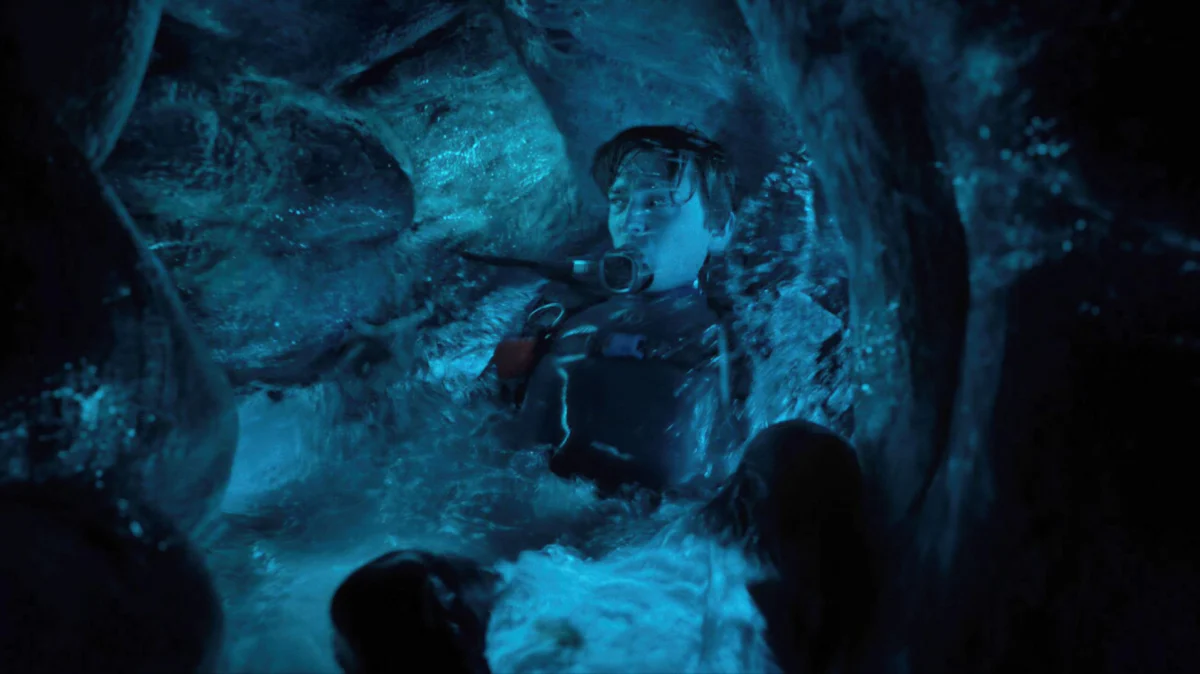
When a project’s script demands an intimate, agonizing, and ultimately transformative sequence set entirely inside the digestive tract of a rogue sperm whale, filmmakers usually reach for the digital toolset. But for Whalefall—the gripping survival drama directed by Brian Duffield and starring Austin Abrams as grieving diver Jay Gardiner, alongside Josh Brolin as his late father, Mitt—the creative team decided to do things the hard way. They went inside.
Long before Abrams found himself swallowed whole by a leviathan in the waters off Northern California, the film’s first true "victim" was production designer Ramsey Avery. Tasked with turning an impossible script note (INT. Whale.) into a tangible, functioning reality, Avery embarked on a journey that combined marine biology, industrial engineering, silicone manufacturing, and pioneering computer vision.
The result is a masterclass in modern filmmaking: a seamless, harrowing hybrid of physical sets and cutting-edge visual effects that redefines what is possible when Hollywood craftsmanship meets untamed imagination.
Main Facts: Deconstructing the Anatomy of Whalefall
At its core, Whalefall is a deeply psychological and spiritual journey disguised as a high-concept survival thriller. Following diver Jay Gardiner as he searches the Pacific depths for his father’s remains, the narrative takes a terrifying turn when Jay is accidentally engulfed by a sperm whale.
To bring this claustrophobic ordeal to life, Avery and his collaborators—including director of photography Aaron Morton, VFX supervisor Guillaume Rocheron, and the legendary creature-builders at Weta Workshop—had to construct an entire internal ecosystem from scratch.

The production ultimately fabricated:
- Five distinct stomach sets, engineered with varying dimensions, flexibilities, and mechanics.
- A fully articulated whale mouth and esophagus, designed to simulate the violent descent of a swallowed human.
- A hyper-detailed giant squid puppet, adding a layer of primeval dread to the oceanic depths.
- Custom camera-tracking technology, invented specifically to map the erratic, fluid movements of the shifting organic sets in real-time.
Chronology: From Gross Anatomy to Cinematic Triumph
Phase 1: Research and the Anatomy of the Grotesque
The journey of Whalefall began in the realm of morbid curiosity. Avery admits that his initial research phase felt like a fever dream. Long before any lumber was cut or silicone was poured, the production designer spent weeks poring over unsettling reference material.
"I was really worried because here I am clicking through images of the insides of grotesque stomachs and being like, ‘They’re never gonna make this movie,’" Avery recalled.
The team analyzed tripe samples, studied anatomical explorations of beached whales, and reviewed orthoscopic medical footage showing cameras thrust down the throats of orcas, dolphins, horses, and cows. No amount of viscera, however, could deter the crew. Four rigorous camera tests were conducted to scale up and calibrate the physical environments, ensuring that the sets would be expansive enough for actors and cameras, yet intimate enough to convey claustrophobia.
Phase 2: Building the Belly
Once the dimensions were locked down, Weta Workshop in New Zealand went to work, crafting stomach interiors out of silicone, latex, and heavy-duty upholstery. These components were shipped across the Pacific Ocean to shooting tanks in Los Angeles, where they were mounted onto elaborate mechanical rigs.

To give the whale’s stomach a lifelike, dynamic presence, the engineering team devised multiple motion systems:
- Gimbal Rigs: Large-scale hydraulic platforms capable of executing the heavy, rolling swings of a massive marine mammal rising or diving through the water column.
- Washing Machine Rigs: Axis-spinning setups designed to disorient both the actor and the audience.
- Micro-Movement Rigs: Precision-calibrated systems built to create subtle, organic shivers and shudders for close-up shots.
Some stomach sets were even built to be struck from the outside—either violently by grips throwing their weight against the walls, or delicately via jury-rigged tools fashioned from plywood and pool noodles.
Phase 3: The Technological Breakthrough
The greatest hurdle facing the production wasn’t just building a moving stomach; it was filming inside it. Traditional visual effects pipelines rely on static laser scans of a set after filming wraps. However, because Whalefall’s sets were constantly flexing, shifting, and rolling, standard scanning methods were useless.
Production VFX supervisor Guillaume Rocheron stepped in to solve the crisis. During a grueling four-to-five-week development period, Rocheron invented a specialized infrared binocular camera system designed to mount directly onto the production cameras.
"He invented the camera, he wrote the code, and figured out a way to capture that constant motion," Avery explained. This breakthrough allowed the team to generate a moving, real-time 3D scan of the set that matched every single frame of footage. As a result, Austin Abrams’ face was illuminated by the correct ambient light while interacting physically with a set that perpetually morphed in size, shape, and color.

Supporting Data and Technical Innovation
The fusion of practical grit and digital enhancement extended far down into the microscopic details of the whale’s interior biology. To achieve an authentic "bioluminescent" quality inside the stomach—giving the tissue an eerie, living pulse—Rocheron and his digital artists turned to household beverages.
By painting physical set swatches with ginger ale or seltzer water and illuminating them under black light, the team captured natural, organic bioluminescent drips. These real-world chemical reactions were digitized and fed into Weta’s pipeline, allowing artists to scatter glowing, falling bioluminescence across the digital whale walls without relying entirely on computer-generated imagery.
Furthermore, the physical space within the stomach sets was intensely cramped. Crew members had to choreograph shots knowing that at any given moment, the tight interior would house:
- The lead actor (Austin Abrams)
- Two operating film cameras
- A microphone boom operator
- A grid of internal LED lighting strings
"I was the first guinea pig and the Weta guys were all in there, too, figuring out the action and pushing and pulling [the stomach]," Avery noted. "We all worked together as a team."
Official Responses and Creative Collaboration
The consensus among the cast and crew is that Whalefall succeeded precisely because of the collective psychological toll it exacted on its makers.

"You don’t get challenges like this. And so it just was a tremendous thing. I mean, pretty much everybody came at it with a sense of, ‘Oh, this is gonna kill us, but we’re gonna have fun while we’re doing it anyway,’" Avery shared with IndieWire.
Director Brian Duffield and director of photography Aaron Morton fostered an environment of fearless experimentation. By refusing to rely entirely on green screens, the production ensured that Abrams’ performance remained grounded in genuine physical discomfort and environmental resistance. The stomach wasn’t just a backdrop; under the guidance of Weta artist Ben Milson, the mechanical motion of the internal walls was choreographed to mirror the emotional beats of Jay’s grief and spiritual awakening.
Implications for Modern Filmmaking
The production model established by Whalefall offers a vital roadmap for an industry increasingly reliant on virtual production and volume stages. While LED walls and digital environments have their place, proven tactile immersion—exemplified by the multi-continental collaboration between Los Angeles soundstages and New Zealand workshops—proves that audiences can subconsciously detect the difference between pure pixels and hybridized reality.
By empowering technicians to invent new hardware on the fly (such as Rocheron’s motion-tracking infrared camera), Whalefall demonstrates that technical constraints often breed the most enduring cinematic innovations. The film breaks new ground in creature features, shifting the focus from external monster battles to an internal, visceral exploration of survival, closure, and grief.
“Whalefall” is now playing in theaters nationwide.
