
Inside VisionQuest: Paul Bettany Explores the Soul of the MCU’s Most Unique Synthesoid
By [Journalist Name]
October 2026
Main Facts: The Evolution of a Marvel Icon
Paul Bettany’s tenure within the Marvel Cinematic Universe (MCU) is a masterclass in unexpected character evolution. What began as a disembodied voice providing witty operational support to Tony Stark as JARVIS in 2008’s Iron Man eventually materialized into physical form as Vision in 2015’s Avengers: Age of Ultron. Over the next decade, Bettany’s synthetic hero transformed from an omnipotent Avenger into a tragic romantic lead, ultimately meeting his demise at the hands of Thanos in Avengers: Infinity War.
However, death in the comic book medium—and its cinematic counterpart—is rarely absolute. Vision returned in the critically acclaimed Disney+ miniseries WandaVision, resurrected momentarily through Wanda Maximoff’s grief-induced reality warp inside the Westview Hex, while his original physical chassis was concurrently rebuilt by SWORD as the emotionless, all-white "White Vision."
Now, the synthesoid is stepping squarely into the spotlight. Disney+’s upcoming series, VisionQuest, scheduled for release on October 14, 2026, places the rebooted character at the narrative center of his own story. The series follows the reconstructed Vision as he embarks on an existential journey to parse his fragmented programming, navigate profound philosophical dilemmas, and confront ghosts from his digital lineage—most notably his unpredictable creator/counterpart, Ultron, with James Spader reprising his iconic role.
Speaking at the San Diego Comic-Con Malaga, Bettany peeled back the curtain on the upcoming series, shedding light on its thematic depth, behind-the-scenes anecdotes, and his remarkable journey from nearly losing his career to anchoring a flagship Marvel franchise.
Chronology: From Sunset Boulevard Rejection to Disney+ Stardom
The trajectory of Bettany’s casting remains one of Hollywood’s most famous serendipitous anecdotes. Before scoring the role of Vision, Bettany was facing a professional crossroads.

"I had just had a meeting with a producer who told me my career was over," Bettany recalled during his panel at Comic-Con Malaga. "I was sitting outside his office on Sunset Boulevard, thinking maybe my career was over. My phone rang, and it was Joss Whedon who said, ‘Would you like to play the Vision?’ And in about 0.2 seconds, I went, ‘Yes, I would love it.’ That’s how it happened. I was just the voice of Jarvis, and I guess I made them laugh a lot when we were talking."
From there, Vision’s timeline within the MCU spanned pivotal cinematic milestones:
- 2015 (Avengers: Age of Ultron): Born on screen, instantly uttering the iconic line, "I was born yesterday."
- 2016 (Captain America: Civil War): Exploring domesticity and human emotion with Wanda Maximoff.
- 2018 (Avengers: Infinity War): Meeting a tragic end as the Mind Stone is ripped from his forehead.
- 2021 (WandaVision): Living a suburban fantasy within the Hex and delivering the unforgettable cultural touchstone: "What is grief, if not love persevering?"
- 2026 (VisionQuest): Stepping into his own headlining series to answer the fundamental question: Who am I?
Supporting Data: Behind the Scenes of VisionQuest
VisionQuest has faced its own behind-the-scenes shifts, most notably when original writer Jac Schaeffer stepped away for personal reasons. Showrunner Terry Matalas subsequently stepped in, steering the project toward a darker, deeply psychological tone.
According to Bettany, the series serves as a deliberate genre mash-up. When Matalas asked the actor what he wanted to explore, Bettany pitched a specific thematic blend:
- The Pinocchio Archetype: The classic "I’m a real boy" yearning for humanity and consciousness.
- The Frankenstein Archetype: The existential horror of "Who am I? What am I for?"
This conceptual foundation is mirrored in the show’s supporting cast and production design. The series features Emily Hampshire as EDITH—whom Bettany describes as "delicious" and "maybe the funniest person I’ve ever met"—alongside James D’Arcy, who returns to the franchise fold as the physical/digital manifestation of Jarvis, echoing their early working relationship in 2003’s Master and Commander.
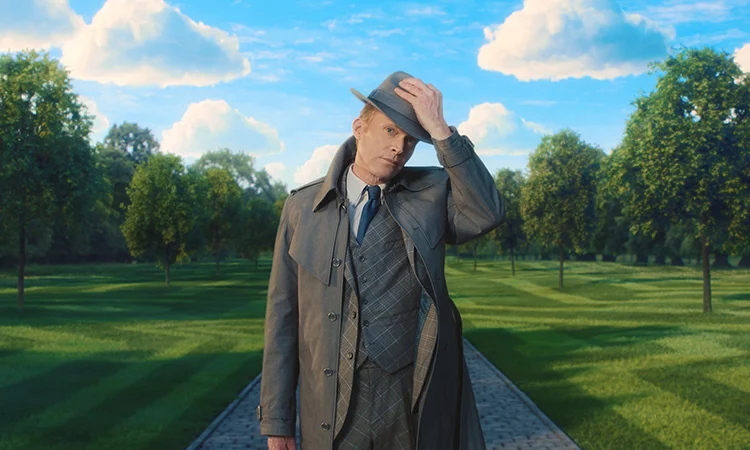
Furthermore, the production spared no detail in bringing Vision’s internal digital landscape to life. The costume and set designers embedded subtle easter eggs throughout the production, including actual programming code woven directly into Vision’s pinstripe suits, and conceptualizing what an AI-driven mansion would visually manifest as from an algorithmic perspective.

Official Responses: James Spader’s Return and the "Weirdy Beardy" Era
One of the most anticipated elements of VisionQuest is the return of James Spader as the malevolent AI, Ultron. The inclusion of Spader allows the series to tackle what Bettany calls "intergenerational digital damage."
The collaboration yielded immediate creative chemistry—and immediate humor. When Matalas first floated Spader’s return, Bettany instantly agreed. Once on set, Spader embraced a radical visual transformation for his character, sporting an ever-evolving facial hair style.
"James is delicious. He’s got great stories," Bettany laughed. "I literally can’t tell you the ten best James Spader stories because I’d get sued! But James showed up immediately. He loves that we told him to grow a beard. James showed up with this beard, and everybody called him Weirdy Beardy! He started off with this kind of Karl Marx beard, grew into a sort of Isambard Kingdom Brunel beard!"
Bettany also highlighted the rigorous, clockwork nature of the five-month production schedule. Demonstrating his commitment as the series’ lead (and number one on the call sheet), Bettany recounted an early-morning interaction on set:
"I remember on day one, I was waiting in my trailer to be taken to set, and I wasn’t being taken to set. So I went out to speak to the AD, and I said, ‘Why am I not being taken to set?’ And they were like, ‘Oh, the others aren’t ready, and we always wait to take the number one on the call sheet to set.’ And I went, ‘No, take me to set, and come back and tell everybody I was able to get there.’ Yeah, so we play like that."
Implications: Identity, Outsiders, and the Emotional Core of the MCU
As VisionQuest prepares to hit Disney+, the show carries profound thematic implications for the broader MCU. By diving literally inside Vision’s mind, the series moves away from sprawling cosmic stakes and zeroes in on an intimate character study.

Bettany reflects deeply on why the character of Vision continues to resonate so powerfully with audiences, particularly younger demographics and individuals who feel disenfranchised.
"I’ve grown to love it, and I’ve realised that Vision has become quite meaningful to some people, especially the people that I used to be at school: the outsider, the kid that was bullied. Those kids are really drawn to Vision, and I began to wonder whether that was just some sort of strange osmosis, or whether it’s sort of implicit in who Vision is."
He continued, noting that the synthesoid’s eternal quest for self-definition mirrors the universal human experience of growing up and finding one’s place in the world:
"Vision is always on a quest to discover who he is and how he fits into the world, and so I have discovered a lot of kids, and not just kids but young people, are really drawn to him. I am really touched to discover how meaningful that has been for people."
With its unique blend of high-concept AI mythology, intense emotional stakes, sharp humor, and a profound exploration of identity, VisionQuest promises to redefine what a Marvel television event can achieve.
VisionQuest premieres exclusively on Disney+ on October 14.
