
Into the Event Horizon: An Exclusive Deep Dive into Eternity’s Tomb, the High-Stakes Sci-Fi Heist Set to Redefine the Genre
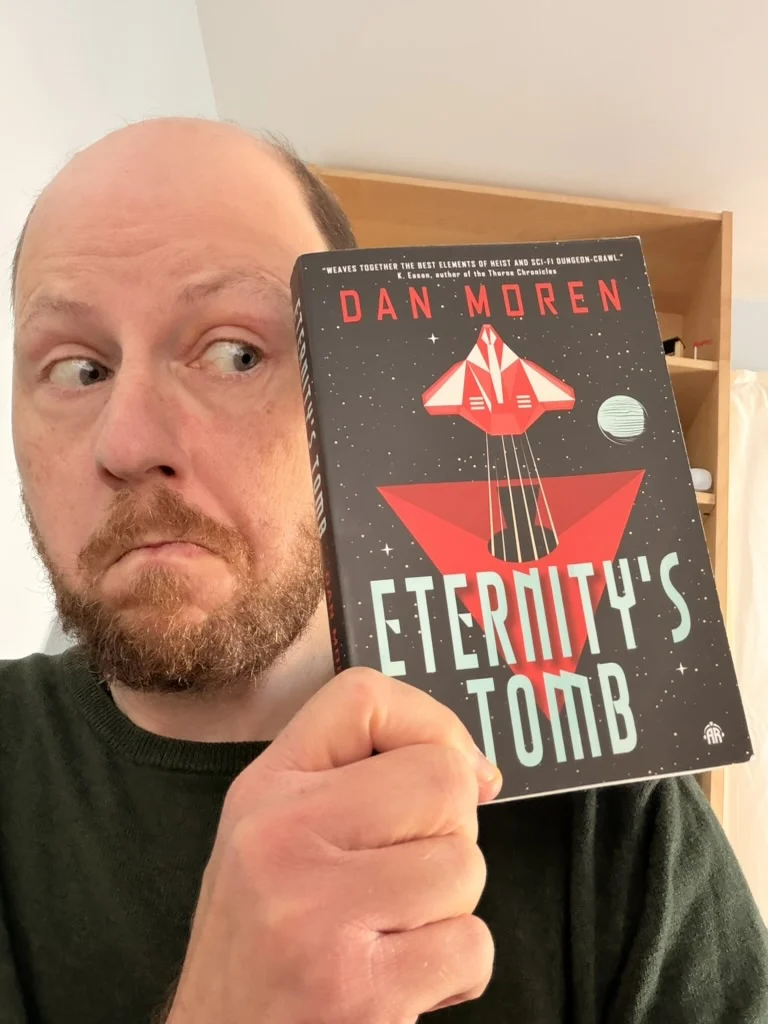
Main Facts: The Anatomy of a Cosmic Caper
With five acclaimed science-fiction novels already gracing bookshelves worldwide, an author might be forgiven for leaning back on established formulas, trusting the well-worn grooves of past successes to carry them through. Yet, complacency is the ultimate enemy of artistic evolution. For this veteran speculative fiction creator, the release of their sixth novel, Eternity’s Tomb, represents not a victory lap, but a deliberate, white-knuckle leap into uncharted literary territory.
Due for a major paperback release on November 23, 2026, via Angry Robot Books, Eternity’s Tomb is pitched as a high-octane, breakneck heist thriller. The premise is as audaciously cinematic as it is mechanically demanding: a motley, dysfunctional band of interstellar outcasts attempts to pull off the ultimate robbery inside an ancient tomb floating aimlessly in the cold expanse of deep space. To complicate matters exponentially, this architectural relic of a forgotten era is caught in a gravitational death spiral, hurtling inexorably toward a supermassive black hole.
The logistical parameters of the job are deceptively simple: get in, secure the payload, get out, and—crucially—avoid being compressed into a singularity along the way. However, the true friction of the narrative lies not merely in the ticking-clock mechanics of an astrophysical crisis, but in the author’s deliberate choice to stretch their own technical boundaries. Shifting to a rigorous first-person perspective, tightening the narrative plotting, and maintaining an unrelenting, breathless pace turned the writing process into its own high-stakes endurance test.
Beyond the narrative mechanics, Eternity’s Tomb marks a significant expansion of the author’s universe-building repertoire. Set millennia in the future, the novel introduces readers to a sprawling galactic community where humanity—now referred to exclusively as "exanths"—has been reduced to just one species among thousands. Earth itself has transcended geopolitical reality, fading into the nebulous realm of ancient myth and legend.
Chronology: The Evolution of a Sci-Fi Universe
To understand how Eternity’s Tomb came to fruition, one must trace the trajectory of the author’s career through its distinct phases of world-building and stylistic maturation.
Phase One: Establishing the Baseline (Books 1–3)
In the early stages of their bibliography, the focus rested primarily on grounding readers in familiar narrative paradigms—exploring human-centric space operas, traditional frontier colonies, and standard genre tropes. These formative works allowed the author to hone their dialogue, establish a reliable sense of pacing, and build a loyal readership.
Phase Two: Expanding the Horizon (Books 4–5)
As confidence grew, the scope widened. The middle books of the bibliography began to toy with larger sociopolitical structures, introducing interstellar factions and exploring the complexities of multi-species diplomacy. However, these works still relied heavily on familiar third-person omniscient or limited perspectives, keeping the narrative distance comfortable for both writer and reader.
Phase Three: The Great Leap (Book 6: Eternity’s Tomb)
The conceptualization of Eternity’s Tomb began several years ago with a singular, striking image: a vault of unimaginable wealth suspended on the precipice of an event horizon. Recognizing that a standard narrative approach would fail to capture the claustrophobic panic of the setting, the author made the pivotal decision to adopt a first-person perspective through the eyes of the protagonist, Z.
Following years of outlining, meticulous pacing adjustments, and the invention of an entirely new lexicon of alien biology and political structures, the manuscript was finalized. The upcoming November 2026 paperback launch by Angry Robot Books marks the culmination of this multi-year creative evolution, positioning the novel as a milestone in the author’s publishing journey.
Supporting Data: Meet the Crew and the Hegemony
The richness of Eternity’s Tomb is found in its meticulous sociological and biological world-building. The novel populates its cosmic stage with imaginative life forms and complex geopolitical frameworks designed to challenge standard science-fiction tropes.
The Crew: Misfits on the Edge
At the heart of the novel is a ragtag assembly of operatives, each bringing distinct biological and psychological advantages—and liabilities—to the heist:
- Z (The Exanth): The human protagonist and first-person narrator. Operating under the futuristic moniker for humanity, Z navigates the complexities of a galaxy where their ancestral home planet is treated as a fairy tale.
- The Trelaxi: A fascinating study in biological evolution, this species has discarded traditional corporeal forms entirely, existing now as hyper-intelligent brains suspended in specialized life-support jars.
- The Kalendar: Part lumbering ursine giant, part lovable teddy bear, and part terrifying physical threat. The kalendars combine immense physical strength with surprising cultural depths.
- The Genetically Engineered Avian Assassin: Known casually—and accepted with mild amusement—as a "murderbird." This lethal operative provides both tactical superiority and deadpan comedic relief.
The Sociopolitical Backdrop: The Thousand Stars
While many space operas rely on a cut-and-dried dichotomy between absolute good and textbook evil empires, Eternity’s Tomb introduces a more nuanced, insidious antagonist: The Thousand Stars.
This immense galactic hegemony is neither monstrously tyrannical nor benevolently utopian. Instead, it operates on a philosophy of "benign pragmatism." The system offers a reliable social safety net:
- Guaranteed housing for all citizens.
- Comprehensive medical care.
- Reliable food distribution and basic necessities.
The catch? Order must be maintained. As long as citizens follow the established rules, perform their designated societal functions, and pay their taxes on time, the Thousand Stars exercises absolute indifference toward their personal lives. However, for independent spirits like Z and their crew—individuals who prioritize personal autonomy, the freedom to self-determine, and the right to make their own mistakes—the omnipresent, bureaucratic comfort of the Thousand Stars feels suffocatingly oppressive.
Official Responses and Creative Philosophy
Reflecting on the psychological and artistic demands of bringing Eternity’s Tomb to life, the author offered deep insights into their creative philosophy during recent promotional reflections.
"With five science-fiction books under my belt, it’s tempting to think that I’ve got this whole writing thing down," the author notes. "But every book is its own challenge, and as a writer, you need to embrace that challenge, because if you’re not pushing yourself, what’s the point?"
This philosophy of constant self-disruption directly informed the stylistic choices of the novel. Transitioning to a first-person narrative required shedding the narrative safety nets of previous works. "That kind of story means a lot of pressure—and not just for our characters," the author explains. "For me, it meant stretching myself in everything from writing from a first-person perspective to careful plotting to really nailing the pace."
Yet, the author emphasizes that creative friction is inextricably linked to liberation. "Pushing yourself to new places comes with freedom too. In this book, I’ve gotten to unlock a new worldbuilding achievement: inventing some fun aliens."
Crucially, beneath the high-concept physics of black holes and the exotic biology of jar-bound brains and murderbirds, the author insists that the core of the story remains deeply human. "As much as I’ve delved into the new with this novel, some things don’t change. At its root, Eternity’s Tomb is ultimately about fun and adventure—and, most importantly, about our characters’ relationships with one another."
"Our patchwork crew might be scoundrels and sneaks, but that doesn’t stop them from working together and becoming something more—in the course of their thievery, naturally," the author concludes. "As different and strange as these aliens and this world might be, at the end of the day, it’s still a story about people. No matter the trappings of the universe, that’s always the constant of the stories I like telling the best."
Implications: What Eternity’s Tomb Means for Modern Sci-Fi
The release of Eternity’s Tomb arrives at a fascinating juncture for the science-fiction genre. In recent years, readers have increasingly gravitated away from exhaustive multi-volume space operas bogged down by encyclopedic lore, seeking instead high-velocity, character-driven narratives that combine clever world-building with visceral thrills.
By framing a classic heist narrative against the unforgiving backdrop of astrophysical mechanics—specifically an impending encounter with a black hole—the novel bridges the gap between hard science-fiction concepts and accessible, pulse-pounding entertainment. Furthermore, the critique of the Thousand Stars hegemony offers subtle commentary on modern bureaucratic complacency, safety versus freedom, and the systemic alienation of those who refuse to conform to standardized societal expectations.
As independent and mid-list authors continue to push the boundaries of speculative fiction through innovative micro-settings and diverse character ensembles, Eternity’s Tomb stands poised to serve as a masterclass in how to expand a fictional universe without losing sight of the intimate interpersonal dynamics that anchor a story in the reader’s heart.
Publication Details
- Eternity’s Tomb
- Publisher: Angry Robot Books
- Format: Paperback
- Release Date: November 23, 2026
- Availability: Pre-orders and retail links available via Angry Robot Books and major literary outlets.
