
Kevin Smith Slams Disney’s AI Trajectory and Studio Layoffs, Defends Ben Affleck’s Multi-Million Dollar Tech Venture
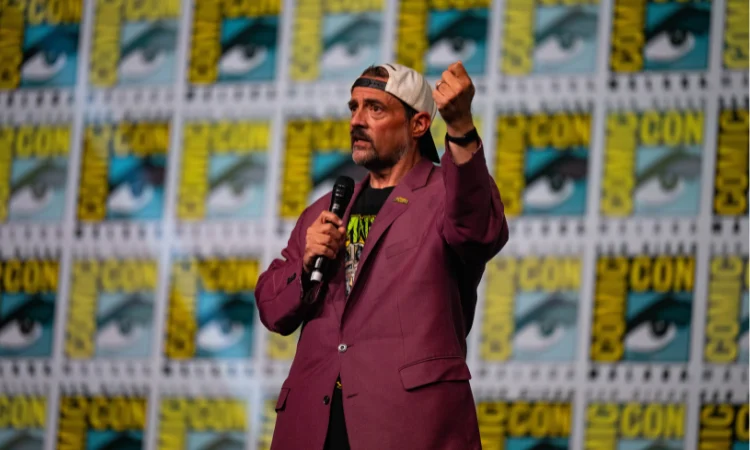
MALAGA, SPAIN — Famed filmmaker, comic book aficionado, and outspoken pop culture commentator Kevin Smith pulled no punches during a recent appearance at San Diego Comic-Con Málaga. While the Clerks director has never hidden his lifelong adoration for the comic book medium and cinematic universes, he used his platform in Hall M to deliver a searing critique of Hollywood’s growing reliance on artificial intelligence, targeting studio restructuring, the displacement of traditional artists, and corporate motivations.
Speaking candidly to a packed room of fans, Smith addressed the seismic shifts currently reshaping both the film and comic book industries, offering a stark warning about the commodification of artistry at the expense of human labor.
Main Facts: The Core Controversy at Comic-Con
The focal point of Smith’s panel discussion centered on the rapid integration of generative artificial intelligence into mainstream Hollywood workflows and the human cost associated with these technological transitions.
During the fan-driven Q&A session, Smith specifically highlighted the plight of veteran concept artists and visual effects professionals, pointing directly to high-profile industry exits at Marvel Studios. He singled out Andy Park, Marvel’s long-serving director of visual development, whose breathtaking concepts shaped the aesthetic of the Marvel Cinematic Universe (MCU) for over a decade and a half.
According to Smith, the shifting corporate tide—characterized by studios leaning into AI and automated workflows—represents a profound betrayal of the artisans who built modern blockbuster cinema.
"Andy Park is a great fucking artist over at Marvel," Smith told the audience, praising his foundational designs that frequently made it straight from the drawing board to the silver screen. "And they just got rid of him and the whole effects team a couple months ago."
Smith explicitly claimed that Disney had signaled an intention to lean more heavily on AI tools moving forward, a prospect he characterized as "disappointing as fuck because it took a bunch of people, it took jobs away from a bunch of people, true artists who made magic that we grew up watching."
Chronology: The Timeline of Industry Shifts and Layoffs
To understand the weight of Smith’s comments, it is necessary to examine the timeline of recent structural changes within Marvel Studios and the broader entertainment landscape:
- April 2026: Industry publication Variety reported that Andy Park had officially parted ways with Marvel Studios after an illustrious 16-year tenure as the director of visual development. Park’s departure occurred amid a broader wave of Disney layoffs, which studio insiders attributed to a strategic corporate mandate focused on cost-cutting and a streamlined, paired-down content slate.
- March 2026: In a parallel technological development, Netflix acquired InterPositive, an artificial intelligence firm founded by Ben Affleck’s production company, Artists Equity. Subsequent financial filings pegged the acquisition deal at approximately $587 million.
- October 1–4, 2026: San Diego Comic-Con Málaga convened in Spain, serving as the international stage where Kevin Smith delivered his extensive remarks on AI, cinematic craftsmanship, and corporate ethics in the film industry.
- Present: Smith’s next directorial venture, Jay and Silent Bob: Store Wars, is currently in active development, with the filmmaker promising that the movie will actively satirize the absurdity of the modern AI boom.
(Note: While industry reports tied Park’s departure and concurrent visual development cuts to budgetary restructuring and slate reduction, independent investigations and official studio filings have not explicitly confirmed that AI tools directly replaced Park or his team on day-to-day assignments.)
Supporting Data: Craftsmanship vs. Automation
To illustrate the irreplaceable value of human artistry, Smith invited the audience to look backward at the architectural peaks of the MCU, specifically pointing to Avengers: Endgame.
He reminded the audience of the monumental climax where dozens of heroes converge on Thanos, a sequence requiring massive, synchronized feats of digital design, choreography, and compositing.
"That took like hundreds of digital artists to create that, along with the footage that they shot on the soundstage," Smith reflected. "That’s craftsmanship. That’s beautiful. That’s artistry. And now all those people have had their work fed into a fucking computer."
The director emphasized that the financial windfalls of automation are entirely one-sided. "It’s a shame," he added. "That’s a bunch of jobs that just went up in smoke."
When analyzing who stands to gain from the widespread adoption of generative AI in Hollywood, Smith stripped away the corporate spin. "It’s going to be cheaper to make movies, but who benefits from that? Me, you, the audience? No. Fucking studios benefit from that. That’s it."
Official Responses and Nuanced Distinctions: The Ben Affleck Exception
Interestingly, Smith’s hardline stance against corporate AI does not extend universally to all applications of the technology. During the panel, the director carved out a distinct exception for a familiar face: his longtime friend and collaborator, Ben Affleck.
Smith shed light on a closed-loop AI model developed under Affleck’s production umbrella, Artists Equity. Unlike publicly scraped large language and generative models that ingest vast, uncredited swathes of copyrighted material from the open internet, Affleck’s proprietary system—housed within the firm InterPositive—was trained exclusively on footage produced internally by the company.
"It doesn’t steal from the internet," Smith explained to the Comic-Con audience. "I like what he’s doing because it doesn’t steal from everybody else. It’s only trained on what they feed it from what they shoot."
This distinction—between extractive AI models that harvest public intellectual property without compensation and ethically isolated, proprietary tools—represents a growing point of debate among creators navigating the digital age.
Netflix’s subsequent multi-million-dollar acquisition of InterPositive demonstrates that major distributors are aggressively investing in closed-loop systems designed to mitigate legal risks while capitalizing on production efficiencies.
Despite acknowledging the technical sophistication behind certain AI outputs—such as a viral, surreal generative video depicting a fictional, extended dinner scene with Darth Vader behind the closed doors of Cloud City in The Empire Strikes Back—Smith remains fundamentally unimpressed by the aesthetic results.
"It was like five minutes of Darth Vader eating dinner with other people and talking," Smith recalled. "It was so fucked up."
He noted that human audiences retain a natural radar for artificial creations. "There’s just something that’s off about it," he observed, pointing directly to the inescapable persistence of the uncanny valley.
Implications: The Future of Filmmaking and Independent Cinema
Smith’s remarks at San Diego Comic-Con Málaga underscore a widening ideological chasm within the entertainment industry. On one side, multinational conglomerates are pressured by shareholders to explore automated workflows, reduced headcounts, and algorithmic content generation to protect profit margins in an increasingly saturated streaming economy. On the other side, creators, actors, visual effects artists, and writers view these technologies as an existential threat to creative integrity and labor sustainability.
For his own part, Smith made it abundantly clear that artificial intelligence holds no place in his personal creative process.
"I don’t have anything against it, but I’ll never have use for it, to be honest with you," Smith asserted. "I like making small movies where people talk to each other."
Rather than embracing automated tools for his dialogue-driven indie features, Smith is choosing to weaponize his comedy against the trend. His upcoming film, Jay and Silent Bob: Store Wars, will directly satirize the current cultural obsession with generative tech.
"They do a lot of talking about AI, but we would never use AI and stuff," Smith concluded. "We just make fun of it."
As Hollywood continues to grapple with the legal, ethical, and economic fallout of the generative AI revolution, voices like Kevin Smith’s serve as a reminder of the human heartbeat underpinning true cinematic artistry—a heartbeat that algorithms, no matter how advanced, cannot replicate.
