
Navigating the Crucible: Animation and VFX Leaders Confront AI, Pipeline Evolution, and Artist Livelihoods at View Conference 2026
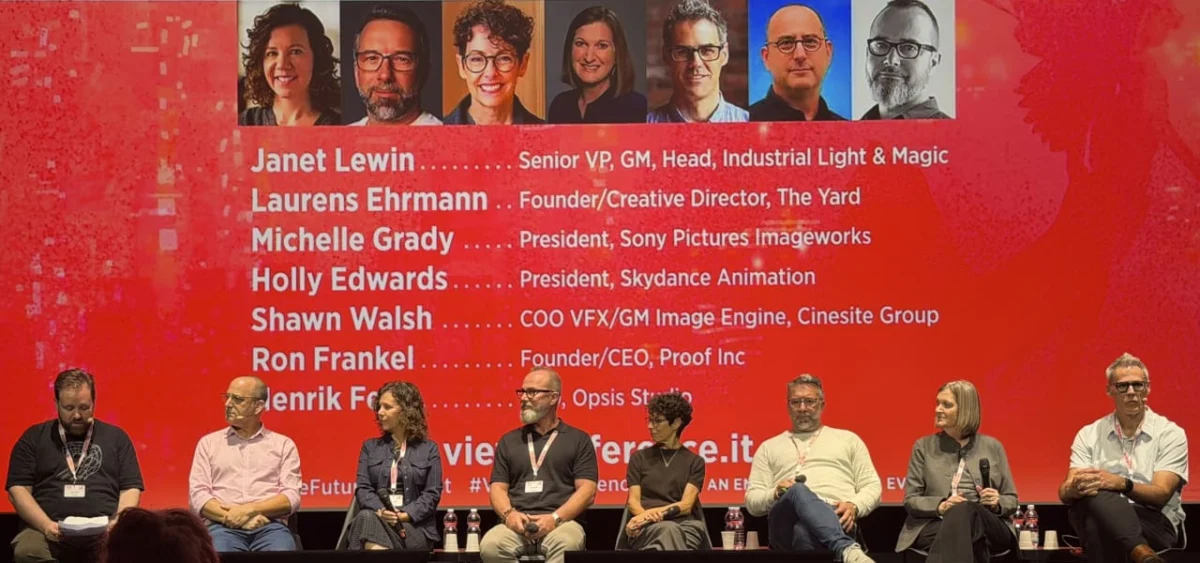
TURIN, Italy — As the global entertainment industry wrestles with a compounding wave of technological disruption and economic realignment, seven of the world’s most prominent animation, visual effects (VFX), and pre-visualization executives gathered on Wednesday evening at Italy’s prestigious View Conference. Moderated by befores & afters editor Ian Failes, the high-stakes panel took a hard look at an industry in transition, evaluating how sweeping operational changes will impact not just the bottom line, but the human talent whose labor and ingenuity form the bedrock of the medium.
The distinguished panel featured a powerhouse lineup of industry leadership: Michelle Grady, President of Sony Pictures Imageworks; Janet Lewin, Senior Vice President and General Manager of Industrial Light & Magic (ILM); Holly Edwards, President of Skydance Animation; Ron Frankel, Founder and CEO of Proof; Laurens Ehrmann, Founder and Creative Director of The Yard; Henrik Fett, CEO of Opsis Studio; and Shawn Walsh, Chief Operating Officer of VFX for Cinesite Group and General Manager of Image Engine.
Over the course of a wide-ranging discussion, these leaders unpacked the realities of generative artificial intelligence (genAI), shifting production pipelines, alternative distribution avenues beyond traditional cinema, and the existential anxiety facing artists trying to chart a course through an increasingly volatile job market.
Main Facts: The State of the Industry in 2026
The convergence of economic pressures—including post-strike corrections, corporate consolidation, studio contraction, and rapid advancements in software tools—has placed the entertainment workforce under unprecedented strain. While executive suites champion the potential of generative AI and real-time game engines to streamline workflows, the grassroots reality for artists remains characterized by rolling layoffs, shrinking employment windows, and acute uncertainty.
Key takeaways from the Turin panel included:
- The AI Paradox: Executives widely agreed that while generative AI and machine learning tools will compress execution times and accelerate creative iteration, they cannot replicate human taste, judgment, or intent.
- Pipeline Revolution: Real-time software like Unreal Engine is fundamentally altering how major studios construct animated features, moving away from rigid, linear pipelines toward fluid, multi-departmental collaboration that keeps creative decisions open late into production.
- Diversification of Revenue: Legacy visual effects houses are aggressively expanding beyond traditional feature films. For ILM, traditional feature work now accounts for only 40% of its portfolio, with the remaining 60% dedicated to location-based entertainment, immersive cinema, and interactive experiences.
- The Labor Dilemma: Despite optimistic projections regarding technological innovation, executives offered few concrete guarantees on how they intend to safeguard artist livelihoods amidst corporate cost-cutting and mounting financial pressures.
Chronology of the Discussion: From Silicon to Strategy
The evening progressed logically from macro-level technological changes down to the micro-level realities of artist employment, geographical studio ecosystems, and future-proofing the next generation.
1. The Reality Check on Generative AI
Unsurprisingly, generative AI dominated the early segments of the conversation. Rather than painting a picture of immediate, wholesale replacement, the panel framed AI as an evolving toolset that demands rigorous oversight.
Shawn Walsh of Cinesite cautioned against hasty adoption. “Dumping one entire process for something else that has an unknown end is not something that’s easy to adopt,” Walsh noted, arguing for a measured transition that respects filmmaker intent. “I think ultimately visual effects artists are going to be needed for the foreseeable future to manage this transition to whatever we’re transitioning to.”
Laurens Ehrmann of The Yard highlighted the distinction between speed and quality. While AI can drastically reduce rendering and execution times, “it cannot compress taste,” he said. “So, we really need our new generation of artists to understand how to judge an image, how to improve it.”
Echoing these sentiments, Ron Frankel of Proof emphasized the collaborative speed enabled by advanced visualization tools. “To be able to have a creative conversation at the speed of ideas is an incredibly powerful thing,” he observed, while acknowledging that the industry has not yet fully realized that potential. Janet Lewin of ILM warned against buying into the hype of a “magic bullet,” urging an open-minded yet pragmatic approach to machine learning integration.
2. Reinventing the Production Pipeline
Moving beyond AI, the conversation shifted to how real-time rendering engines are rewriting the rules of animation production. Michelle Grady of Sony Pictures Imageworks detailed how her studio has leaned heavily into Unreal Engine. Initially tested on KPop Demon Hunters, expanded for Goat, and now pushed to its absolute limits on the highly anticipated Spider-Man: Beyond the Spider-Verse, these tools are redefining workflows.
“It’s wildly different than what we’ve done before,” Grady explained. Because the directors of the Spider-Verse franchise prefer to keep creative choices fluid right up to the deadline—treating the process like a jazz performance—Imageworks had to build a brand-new pipeline. This system prioritizes “story camera, story performance, and story lighting” simultaneously, pulling artists into the creative process much earlier in the cycle.
Meanwhile, Holly Edwards emphasized that Skydance Animation remains resolutely focused on pushing the artistic boundaries of traditional CG filmmaking rather than chasing unrelated business models, aiming to extract maximum emotional and visual impact from core animation techniques.
3. Expanding Beyond the Silver Screen
Facing a contracting market for traditional feature-film VFX and streaming series, studios are diversifying into non-traditional sectors. Lewin revealed a stark metric for ILM: traditional feature film visual effects now make up a minority 40% of the company’s business. The remaining 60% spans location-based entertainment, immersive Meta partnerships, and digital avatar projects for the music industry.
Henrik Fett shared that Opsis Studio is diving into large-format traveling concert installations. These interactive, live environments “speak differently to the audience than the passive mediums do,” offering alternative revenue streams and creative challenges. Edwards similarly floated the idea that the industry is ripe for a brand-new medium or platform akin to the cultural disruption once caused by Adult Swim, signaling a desperate need for fresh distribution avenues.
Supporting Data and Industry Metrics
To contextualize the panel’s discussion, one must look at the broader economic landscape of the global VFX and animation sectors:
- Market Contraction: According to industry tracking, major Hollywood studios have cut thousands of visual effects and animation jobs globally over the past 24 months, driven by a post-streaming-boom correction and reduced overall output.
- The Shift to Real-Time: Utilization of real-time engines (such as Unreal Engine and Unity) in feature animation has grown by an estimated 35% year-over-year since 2023, drastically reducing iteration cycles but requiring retraining for legacy animators.
- Geographic Disparities: Regional tax incentives continue to dictate where studio hubs operate. While remote studios like Opsis leverage global senior talent pools, major vendors remain anchored to government-subsidized jurisdictions, creating stark imbalances for local artists—particularly in regions with weaker state support, such as Italy.
Official Responses: Executives on Artist Livelihoods
The most tense and vital moment of the evening arrived during the open audience Q&A. Confronted by students, aspiring professionals, and veteran artists worried about job security in the face of widespread layoffs and technological displacement, the panel was asked how executives balance corporate operational pressures with their moral responsibility to protect human talent.
Michelle Grady did not mince words. “We don’t exist without artists, full stop,” she stated. “The concern of disappearing is very real for us as organizations. If we don’t figure this out, if we don’t figure out how to use the technology in a way that creates great images using great artists, then we’ve completely failed.” While admitting that the ongoing transition will cause friction, Grady expressed hope that efficiency would eventually unlock new opportunities, adding, “We want to hold on to our people. We want to hold on to our companies. We need taste. We need talent. There’s no other way to do it.”
Janet Lewin addressed the uncomfortable corporate realities beyond local studio control. “Many of us are part of a parent company that makes decisions that we can’t control,” she explained. “Additionally, we can’t control what projects get greenlit and when and how much visual effects is going to be required and what the budgets are.” Lewin emphasized that studio leaders must prioritize transparency and retraining, though she admitted that certain industry-wide shifts remain immovable.
Henrik Fett brought a deeply personal perspective as an independent studio owner. For Fett, artist welfare is not a corporate footnote: “The well-being of our artist pool […] is paramount. That’s what I go to bed with, and that’s what I get up in the morning with.”
Implications: Navigating an Uncertain Horizon
The View Conference panel painted a dual-sided picture of the future of animation and VFX. On one hand, the creative and technical horizons have never looked more expansive. Real-time pipelines, immersive platforms, and generative tools promise an explosion of novel storytelling forms reminiscent of the artistic movements that followed the invention of photography.
Yet, a glaring disconnect persists between executive optimism and worker precarity. As studios lean into automated efficiency and navigate the labyrinth of global tax incentives—ranging from Fett’s remote-first, borderless staffing model to Frankel’s mushroom-like expansion into subsidized jurisdictions—the traditional studio artist is caught in the crossfire.
For the next generation of creatives, the advice from the panel was unanimous: avoid hyper-specialization, master your foundational craft, and cultivate adaptability.
However, as the conference crowd filed out into the Turin evening, a lingering question remained unanswered. While technology will undoubtedly continue to evolve and executives will find new markets to conquer, the industry’s ultimate test will not be how efficiently it can generate pixels, but whether it can sustain the human artists required to give those pixels a soul.
