
The Blood & Ink Horror Script Contest Kicks Off: A Deep-Dive Review of Eric Levin’s Killer-Mold Comedy, The Mold
Main Facts: The Launch of a Unique Screenplay Competition
The competitive landscape of screenwriting contests has welcomed a distinct new entry with the official launch of the Blood & Ink Horror Script Contest. Spearheaded by industry commentators and script analysts, this unique competition departed from traditional open-submission models. Rather than operating on an open-door policy where anyone with an entry fee could submit, the Blood & Ink contest required writers to earn their spot by pitching a compelling concept.
Out of a competitive pool, just under 100 concepts were accepted. The selected writers were then given a rigorous six-month window to flesh out, structure, and draft their full-length screenplays. Now, the heavy lifting of evaluation has begun.
Organizers have outlined the roadmap for the judging phase: all accepted scripts will be read, culminating in a detailed two-week rollout reviewing the Top 10 scripts, counting down from 10 to 1. While this official countdown is projected to launch in one to two months, intermittent reviews of standout entries may drop early on the platform.
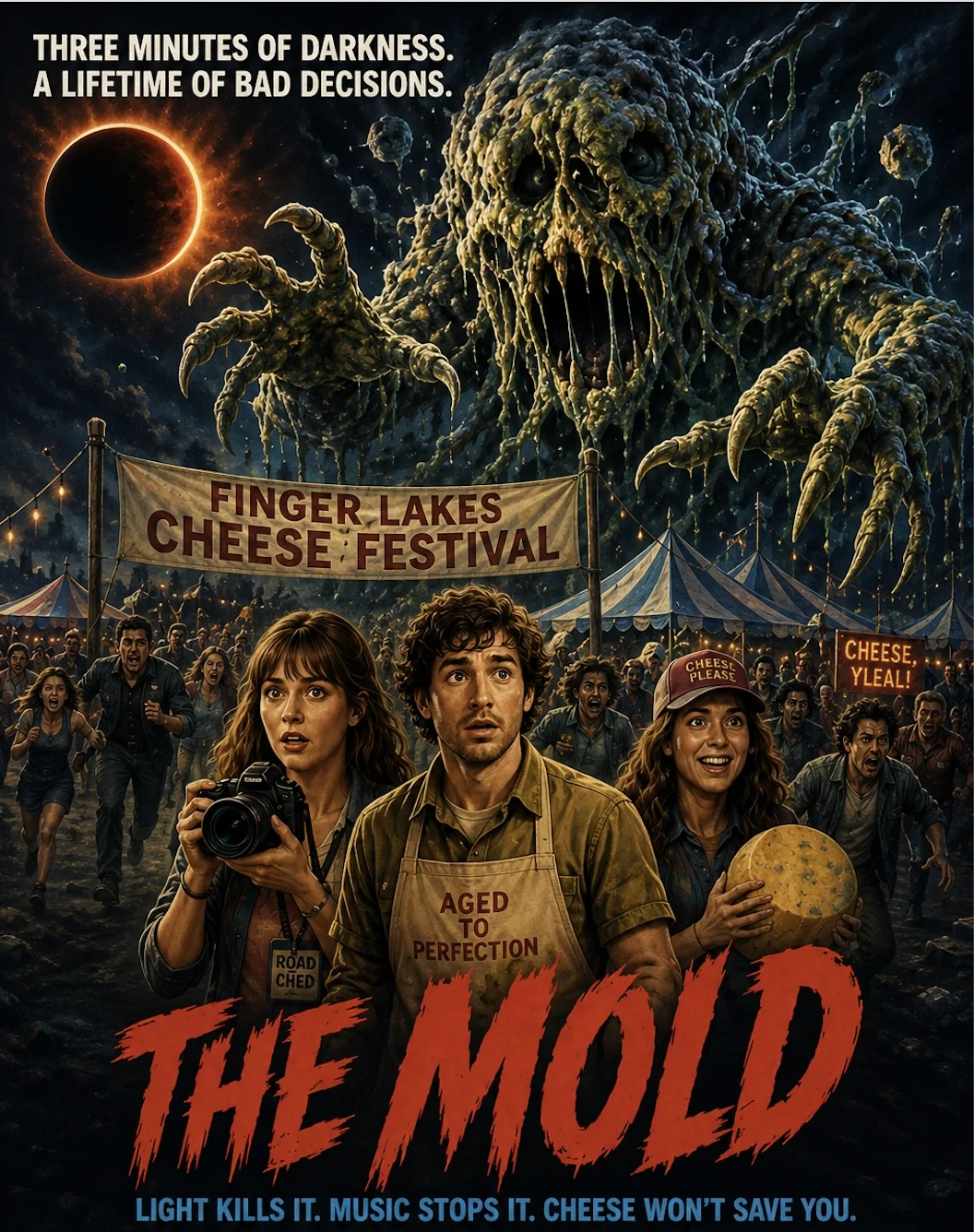
To inaugurate the competition reviews, analysts selected The Mold, an 85-page horror-comedy written by Eric Levin. Boasting a high-concept premise—a killer space mold terrorizes an upstate New York community during a local cheese festival, threatening a food journalism intern and her cheesemonger-in-training ex-boyfriend—The Mold serves as an ideal baseline for evaluating the strengths and pitfalls common to first-act-heavy genre screenplays.
Chronology: From Meteorite Crash to Alien Abduction
The narrative structure of The Mold follows a classic creature-feature escalation, blending artisanal dairy culture with extraterrestrial terror.
Act I: The Finger Lakes Cheese Festival
The story centers on Bri, a twenty-something aspiring food journalist, and Mac, her ex-boyfriend and a cheesemonger apprentice. Seeking to secure a permanent promotion at her publication, Bri travels to upstate New York to cover the annual Finger Lakes Cheese Festival. Needing an expert guide through the complex world of dairy production, she brings along Mac.
Upon arrival, the pair visit a local cheese farm, where they meet Lyla, a welcoming local youth thrilled by the presence of big-city journalists. The atmosphere is light, rich with educational exposition regarding cheese production, and colored by the unexpected appearance of Jason, Bri’s toxic ex-boyfriend.
Act II: The Eclipse and the Outbreak
Unbeknownst to the festivalgoers, a meteorite has crashed nearby, unleashing an aggressive, light-sensitive alien mold. The outbreak coincides precisely with a total lunar eclipse, granting the organism a critical three-minute window of darkness to wreak havoc. The mold surges through the crowd, consuming a dozen victims before Bri and Mac manage to retreat to safety.
As the night deepens, the mold evolves, coalescing into a sentient humanoid alien creature. Survival tactics take a bizarre turn: Mac discovers that singing directly to the mold monster temporarily pacifies it, allowing him to evade fatal strikes. Meanwhile, Bri experiences an abrupt narrative shift—she is beamed aboard an orbiting alien spaceship, where the piloting extraterrestrial casually reveals a cosmic hobby of visiting planets to destroy them with pet mold.
Act III: The Race Against Sunrise
Trapped in an alien vessel while Mac remains ensnared in a web down on Earth, Bri faces a desperate race against time. With Mac’s musical stalling tactics wearing thin and the sun hours away from rising, the climax hinges on high-stakes rescue mechanics and extraterrestrial survival.
Supporting Data: Strengths, Weaknesses, and Genre Mechanics
The Mold received a nuanced critical evaluation, earning a "wasn’t for me" rating on the traditional review scale, yet providing invaluable educational takeaways for genre writers.
What Worked: Old-School Setup and "Doggy Bag" Details
- The Premise: The script capitalizes on an enduring, high-concept horror-comedy framework reminiscent of classic B-movies, offering a distinctly original sub-genre flavor.
- Educational World-Building: The script excels in employing what screenwriting theorists call "doggy bag" moments—elements that allow audiences to absorb fascinating, real-world knowledge (in this case, artisan cheesemaking) to take home intellectually.
- Showing, Not Telling: Levin successfully demonstrates the rules of his antagonist visually rather than through clunky exposition. When the mold spreads through shade and instantly disintegrates upon hitting a patch of sunlight, the audience absorbs the creature’s fatal weakness instantly and organically.
- Atmospheric Setup: The initial buildup mirrors the tone of indie travel-comedy films like Sideways, substituting wine country for dairy farms and establishing high curiosity for the festival events.
Where It Stumbled: Narrative Derailment and Missed Opportunities
- Loss of Specificity: Once the alien mold takes center stage, the rich cultural specificity of the cheese festival vanishes, reducing the narrative to a standard "people run away from monster" dynamic without sufficient dramatic elevation.
- Lack of Kill Variety: The monster’s attacks lack imagination. Nearly every fatality follows the exact same formula: mold approaches, victim attempts flight, victim fails, mold overtakes them.
- Character Flaws and Dynamics: Core character flaws, such as Bri’s tendency to abandon situations when times get tough, are communicated via dialogue ("told") rather than dramatized ("shown"). The romantic triangle between Bri, Mac, and Lyla represents a major missed opportunity; rather than playing on jealousy as Mac and Lyla bond, the narrative introduces Jason, whose backstory is murky, confusing, and largely unjustified.
- Tonally Inconsistent Climax: The second half suffers a sharp decline in quality. The alien pilot introduced in the final act feels uncalibrated, wacky, and tonally disconnected from the grounded terror established earlier. Furthermore, the extensive early focus on cheese is entirely abandoned, failing to pay off as a thematic or literal weapon against the mold.
Official Responses and Industry Insights
Reflecting on the challenges observed in The Mold, contest organizers emphasized universal lessons applicable to screenwriters across all genres.
A primary critique focused on the structural imbalance common in spec scripts: writers frequently invest heavily in perfecting their first acts while rushing through the development of the second and third acts.
Furthermore, analysts highlighted the importance of maximizing emotional resonance in character deaths. Citing a scene where an unsympathetic grocery store customer pushes past a barricade and is killed ten seconds later, reviewers noted:
"If you’re going to kill a bad person, get the most out of it by setting up that they’re a bad person! That’s half the fun! … You could’ve spent a page building this character up as an asshole. … NOW when that guy gets killed, we’re going to FEEL SOMETHING. That’s what you’re trying to do in scripts. Is make people feel something."
Organizers also underscored that foundational character work must precede plot mechanics. By refining character flaws, tightening relationship dynamics, and maintaining the thematic motifs introduced in Act I (such as utilizing cheese as a tactical weapon), scripts like The Mold can elevate themselves from standard genre exercises to genuinely impressive cinematic contenders.
Implications: The Road Ahead for Blood & Ink Entrants
The launch of the Blood & Ink Horror Script Contest and the early review of The Mold signal a rigorous evaluation standard for participating writers. As the contest administration works through the logistics of tracking accepted concepts and preparing for the upcoming Top 10 countdown, the broader screenwriting community is receiving a masterclass in script analysis.
For Eric Levin and his fellow contestants, the feedback serves as both a diagnostic tool and a roadmap for future revisions. As the competition progresses over the next two months, writers will be watching closely to see which concepts successfully survive the narrative gauntlet, proving that horror-comedy execution requires as much precision in the final act as it does in the pitch.
Contest Trivia Notice
As part of the contest rollout, organizers issued a trivia challenge for the writing community: What is the most famous spec script ever sold that had a strong focus on cheese? The first participant to email the correct answer to the designated address would secure heavily discounted script notes. Comment sections were temporarily restricted to preserve the integrity of the trivia event.
