
The Dutton Dilemma: Can ‘Marshals’ Finally Deliver a Meaningful Arc for Tate?
The Yellowstone universe, masterminded by Taylor Sheridan, has never been a stranger to the heavy toll of generational trauma. From the sweeping vistas of the Montana ranch to the complex political machinations of the spinoffs, the series is built on the foundation of the "Dutton way." Yet, as the spinoff series Marshals moves into its second season, a glaring narrative inconsistency has emerged: the underutilization of Tate Dutton. Played by Brecken Merrill, Tate represents the future of the bloodline, yet his character has frequently been relegated to the sidelines. As Marshals enters its sophomore season, the creative team faces a critical juncture: will they finally grant Tate the substantive development he deserves, or will he remain a perennial footnote in his own family’s saga?
The Foundation of a Disjointed Narrative
To understand the frustration surrounding Tate’s character, one must first look at the structural hurdles Marshals faced during its inaugural season. The series debuted with the ambitious task of balancing the high-stakes, procedural "case-of-the-week" format with the sprawling, character-driven baggage inherent to the Yellowstone brand.
In Season 1, this fusion proved problematic. The show often struggled to find its identity, frequently oscillating between gritty police procedural and high-octane Western drama. By attempting to serve both masters, the writers often found themselves stretched too thin. Characters that required deep, introspective exploration—most notably Tate Dutton—were frequently sidelined to make room for episodic mysteries that, while functional, lacked the emotional resonance of the main Yellowstone series.
The tragic off-screen passing of Monica Dutton, Tate’s mother, due to land-polluting mining operations, should have served as the emotional bedrock of the show. It was a catalyst for trauma, grief, and the harsh realities of the Dutton existence. Instead, the narrative momentum surrounding this event was dissipated, leaving fans to wonder why the show bothered to establish such a heavy premise only to let it drift into the background.
Chronology of a Traumatized Scion
Tate Dutton’s life has been, by any measure, a series of catastrophic events. Even before his transition into Marshals, his childhood was defined by the violence of the Dutton ranch. However, the move to Marshals presented an opportunity to shift the focus from the victimhood of his youth to the hardening of his adolescence.
The Season 1 Climax
The first season concluded with a high-stakes cliffhanger: Tate was kidnapped by the antagonist Tom Weaver, a rancher whose malice served as a dark mirror to the cutthroat tactics of the Dutton family. For a moment, it seemed the writers were pivoting to make Tate the focal point of the series’ central conflict. Yet, when the resolution came, it felt rushed. The trauma of the abduction was touched upon, but the show quickly moved on to its next procedural beat, effectively silencing the psychological repercussions of the event.
The Season 2 Pivot
The premiere of Season 2, "End of Watch," saw Kayce Dutton (Luke Grimes) rescue his son from Weaver’s clutches. While the action was intense, it was the aftermath—specifically in the second episode—that provided a glimmer of hope for character development. Kayce, in his protective desperation, reinforces the security of their home, a physical manifestation of his fear for his son’s safety.
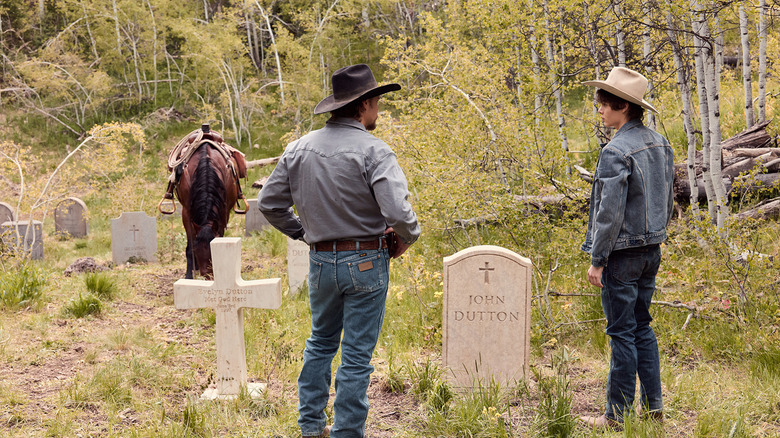
When Kayce discovers Tate at the grave of John Dutton, the narrative finally pauses to breathe. The exchange between father and son is arguably the most poignant moment in the series thus far. Tate’s admission that he once admired Weaver—before realizing his true nature—and his stoic embrace of the "Dutton way" suggest a shift in his psyche. He is no longer just a child being protected; he is a young man attempting to reconcile his family’s violent legacy with his own survival.
Supporting Data: The "Dutton Way" and Emotional Toll
The strength of the Yellowstone franchise lies in its willingness to lean into the toxicity of its protagonists. The conversation at the gravesite is a vital data point in understanding the show’s potential trajectory. When Kayce tells his son, "Our family legacy was never about land; it was about always having to fight," he is confirming the central thesis of the entire franchise.
For Tate, this realization is transformative. His response—"Good thing I’m strong… you and grandpa raised me to be"—is chilling. It signifies that Tate is not just a victim of the Dutton legacy; he is an active participant in it. This creates a fascinating tension: Kayce, who has spent years trying to distance himself from the brutality of his father, now sees that very brutality reflected in his son’s resolve.
The show has the tools to explore this. We know through recurring mentions—such as when Andrea Cruz (Ash Santos) references Tate’s previous kidnappings—that his history is not forgotten by the characters. The question is whether the writers are willing to trade the procedural "sniper-of-the-week" stories for a sustained psychological study of a boy who has grown up in the crosshairs of constant danger.
Implications for the Series’ Future
The risk for Marshals is clear: if it continues to treat Tate as a prop rather than a person, it risks alienating the core Yellowstone audience. Fans of the franchise are invested in the intergenerational conflict that has defined the Duttons since the days of 1883.
The Procedural vs. Serialized Conflict
The inherent tension between the network procedural format and the serialized drama of the Yellowstone universe is the show’s greatest liability. A case-of-the-week format requires a "reset" at the end of every hour, which is antithetical to the slow-burn, long-form storytelling that made Yellowstone a cultural phenomenon.
To rectify this, Marshals must integrate the procedural elements into the character arcs. If a weekly case involves a father-son dynamic, it should be used to mirror Kayce and Tate’s relationship, not just provide a temporary distraction. The writers have an opportunity to make the "Dutton way" the lens through which every case is viewed.
The "Carter" Precedent
Comparisons to the character of Carter (Finn Little) in the Dutton Ranch segments of the franchise are inevitable. Carter was given the space to grow, falter, and eventually find his place within the ranch’s hierarchy. If Marshals can grant Tate a similar trajectory—allowing him to be flawed, angry, and deeply conflicted about his inheritance—it could elevate the show from a mediocre spinoff to a essential piece of the Yellowstone mythos.
Conclusion: A Turning Point for the Dutton Scion
As the season progresses, the stakes for Tate Dutton have never been higher. He is at an age where the influence of his father and the ghost of his grandfather will either forge him into a formidable, albeit damaged, leader, or break him entirely.
The inclusion of the grave-side conversation suggests that the writers are aware of the missed opportunities of Season 1. By acknowledging the "heavy toll" of the family name, they have opened a door to a more nuanced exploration of what it means to be a Dutton in the modern era. However, intent must be matched by execution.
If Marshals chooses to prioritize the human drama over the procedural filler, it will succeed in giving Tate the storyline he has long been denied. If, however, it retreats into the comfort of formulaic storytelling, it will lose the chance to tell one of the most compelling stories in the Yellowstone universe: the story of a boy who is trying to survive the weight of his own name. For now, the audience remains watching, waiting to see if the "Dutton way" will be the making of Tate, or his undoing.
