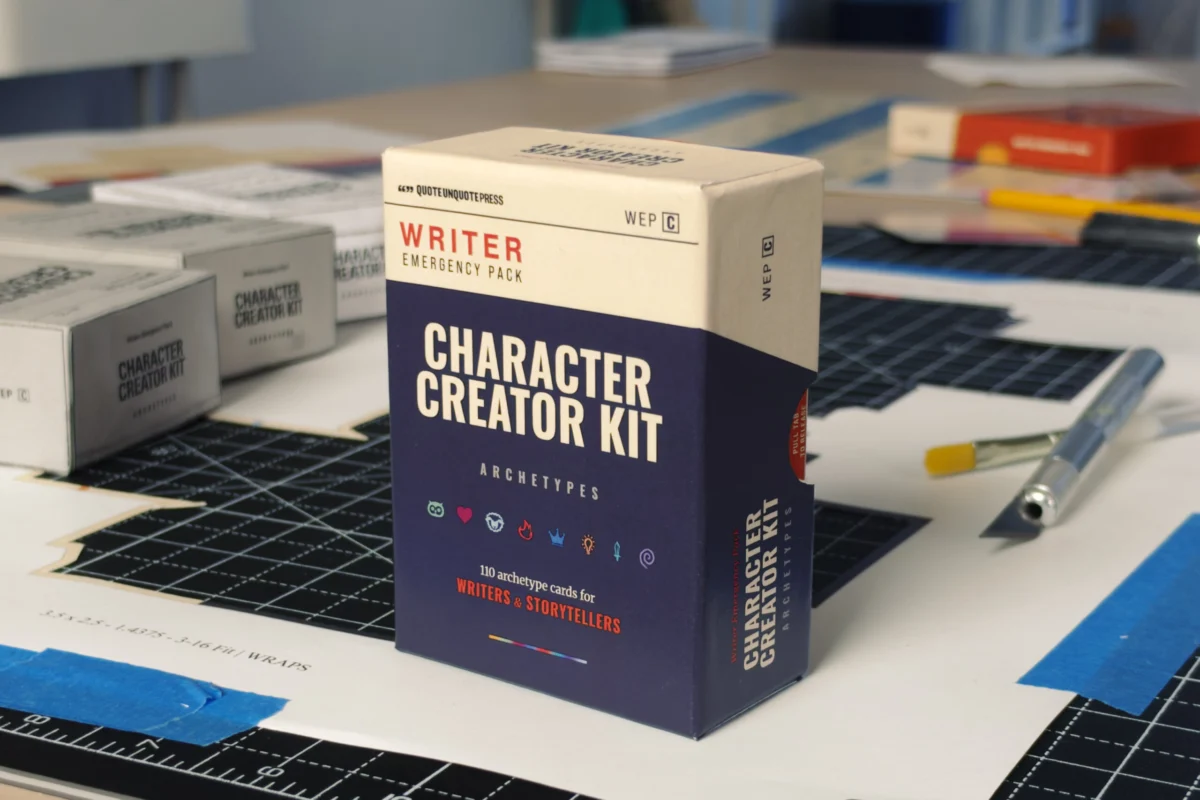
The Evolution of Writer’s Blockbusters: John August and the Quote-Unquote Team Launch Kickstarter for the "Character Creator Kit"
LOS ANGELES — A decade after redefining how screenwriters brainstorm plot holes and narrative friction, the creators behind the iconic Writer Emergency Pack are returning to their crowdfunding roots. Screenwriter JohnAugust (known for Big Fish, Charlie and the Chocolate Factory, and Aladdin) alongside the Quote-Unquoteteam, has officially launched a Kickstarter campaign for their latest physical writing aid: the CharacterCreator Kit.
The new deck expands upon the beloved Writer Emergency Pack franchise, which debuted on Kickstarter in 2014 and briefly reigned as the highest-grossing card project on the platform. Designed to help authors, screenwriters, and storytellers unearth hidden dimensions in their protagonists and antagonists, the Character Creator Kit aims to bridge the gap between abstract character conception and tangible, dramatic execution.
Yet, beyond the launch of a new product for creatives, this Kickstarter marks a significant internal milestone for Quote-Unquote: a passing of the torch. While August remains involved as an editorial guide, the development and execution of this new kit were spearheaded by former Scriptnotes intern Sam Shapson and collaborator Daniel Sauvé-Rogan, signaling a new chapter for the company.
Main Facts: What is the Character Creator Kit?
At its core, the Character Creator Kit is a physical deck of cards meticulously engineered to assist writers during the often-daunting phase of character development. Unlike automated writing software or rigid formulas that attempt to dictate character arcs, this kit functions as a practical, tactile catalyst for imagination.
The Philosophy: The deck is explicitly framed not as a "magic wand" that writes the story for you, nor as a cage that forces characters into pre-existing tropes. Instead, it acts as an exploratory tool designed to prompt questions, reveal blind spots, and present unexpected narrative possibilities.
The Origin: The kit is the brainchild of Sam Shapson, who originally brought a primitive, early-stage version of the deck to John August roughly a year prior to launch.
Leadership and Execution: While the broader brand benefits from August’s industry clout, the heavy lifting of production, design, and campaign planning was led by Shapson and Daniel Sauvé-Rogan.
Availability and Fulfillment: The Character Creator Kit is currently available exclusively through its Kickstarter campaign. To satisfy early backers, the team has promised that the first 1,000 decks will be manufactured, packed, and shipped out in time for Christmas.
Chronology: From Scriptnotes Internships to Crowdfunding Success
To understand the cultural and commercial weight of the Character Creator Kit, it is necessary to trace the timeline of the ecosystem that produced it.
2014: The Birth of the Writer Emergency Pack
Long before the Character Creator Kit was conceived, John August identified a distinct gap in the toolkit available to working screenwriters. While numerous textbooks dissected screen structure, screenwriters frequently hit walls when trying to diagnose scene-level problems.
August turned to Kickstarter to fund the Writer Emergency Pack—a deck of cards designed to look like a first-aid kit, containing prompts to fix stalled scenes. The campaign went viral within the screenwriting community. For a brief, dizzying period, it held the title of the highest-grossing card project on Kickstarter, establishing August not just as a Hollywood screenwriter, but as an innovative producer of physical writing tools.
2023–2024: The Incubation Phase
Behind the scenes of the Scriptnotes podcast ecosystem—which August co-hosts with Craig Mazin—young creatives often develop auxiliary projects. Sam Shapson, working at the time as an intern for Scriptnotes, began tinkering with a new problem set: character creation.
While the original emergency pack dealt with plot and scene mechanics, Shapson recognized that many stories stall not because the plot is weak, but because the characters lack psychological depth, internal contradictions, or compelling motivations. Shapson assembled a rough, primitive prototype of a character-focused deck and brought it to August for review. Recognizing its potential, August encouraged further development, though he consciously stepped back to let the younger creators shape the product’s identity.
Fall 2026: The Hand-Off and Kickstarter Launch
Over the course of the following year, Shapson and Daniel Sauvé-Rogan refined the prompts, streamlined the design, and tested the deck with various writers. By October 2026, the project reached maturity.
In October 2026, the Kickstarter campaign officially went live. Returning to the platform where it all began, the campaign quickly drew attention from the loyal fanbase that had supported the original Writer Emergency Pack twelve years prior.
Supporting Data: The Business and Logistics of Indie Writing Tools
The landscape of writing aids has shifted dramatically over the past decade. While digital applications, AI-assisted generation tools, and screenwriting software dominate the modern workflow, the enduring appeal of tactile, analog tools like the Character Creator Kit points to a broader psychological need for creators to disconnect from glowing screens during the brainstorming phase.
The Kickstarter Ecosystem: Crowdfunding for physical card decks and board games has evolved into a multi-million-dollar industry. Projects that rely on nostalgia, community trust, and proven utility—such as a follow-up to a historically successful campaign like the 2014 Writer Emergency Pack—frequently outperform baseline funding goals within hours of going live.
Fulfillment Realities: One of the most common pitfalls of Kickstarter campaigns is delayed manufacturing and fulfillment. By strategically limiting the holiday delivery tier to the first 1,000 decks, the Quote-Unquote team has established a disciplined logistical boundary, mitigating supply-chain risks while offering an attractive incentive for early adopters.
Team Scaling: Quote-Unquote has transitioned from a solitary vanity enterprise into a micro-publishing house of sorts. The shift from August being the sole creative engine to delegating full project leadership to Shapson and Sauvé-Rogan demonstrates a sustainable business model capable of generating intellectual property independent of its founder’s direct daily labor.
Official Responses and Perspectives
The transition from a top-down creator model to a collaborative, decentralized team is a point of immense pride for John August. In reflections shared surrounding the launch, August emphasized his satisfaction with taking a backseat:
"This project was led by Sam [Shapson] and Daniel [Sauvé-Rogan]," August noted. "I was much more hands-off than with any of our previous launches. Beyond my editorial guidance and some sign-offs, it’s their baby. It’s exciting to see the Quote-Unquote team planning and delivering projects on their own. Of all the things I’ve built, this little company is one of my favorites."
The sentiment underscores a mentorship-driven culture within August’s production companies and media projects. For Shapson—moving from an intern position on Scriptnotes to leading a flagship product launch for the company—the journey represents a textbook example of industry upward mobility fostered through creative collaboration.
Furthermore, speaking on the design philosophy of the deck itself, the team has repeatedly stressed its non-prescriptive nature. In an industry increasingly saturated with automated writing generators that promise to "write your script for you," the Character Creator Kit champions human agency. It does not dictate who a character should be; instead, it asks the uncomfortable questions screenwriters and novelists often avoid, forcing creators to dig deeper into their character’s psychology, background, and choices.
Implications: What the Character Creator Kit Means for the Future of Writing
The launch of the Character Creator Kit carries several broader implications for independent creators, the writing accessory market, and the Quote-Unquote brand.
1. The Value of Analog Tools in a Digital Age
As generative artificial intelligence tools flood the market—promising instant character bios, automated plot outlines, and algorithmic script generation—the demand for human-centric, analog brainstorming tools has taken on a new urgency. Writers are actively seeking ways to protect their creative sovereignty. A deck of cards like the Character Creator Kit offers a physical, screen-free way to stimulate imagination without outsourcing the actual thinking process to an algorithm. It keeps the writer’s hands on the wheel.
2. The Maturation of Creator-Led Brands
For independent creators looking to build sustainable businesses, the hardest step is often moving past founder dependency. Many successful podcasts, newsletters, and indie product lines wither because the audience is solely attached to a single personality. By handing the reins of the Character Creator Kit over to Shapson and Sauvé-Rogan, John August has proven that the Quote-Unquote brand can successfully incubate new talent, expand its product catalog organically, and endure across generations of creators.
3. Strengthening the Screenwriting Community
Crowdfunding campaigns like this do more than simply finance the printing of cardboard boxes; they foster a sense of shared community among isolated creators. Writing is famously a solitary profession. By rallying thousands of backers around a physical product designed to solve common creative missteps, campaigns like the Character Creator Kit rebuild a sense of camaraderie. When backers receive their decks by Christmas, they will not merely be opening a tool; they will be engaging in a shared ritual of storytelling practiced by writers all over the world.
Looking Ahead
As the Kickstarter campaign continues to gain momentum, all eyes are on the fulfillment of those first 1,000 holiday shipments. If the success of the 2014 Writer Emergency Pack is any indicator, the Character Creator Kit is poised to become a staple on writing desks, in writer’s rooms, and within university screenwriting programs for years to come. More importantly, it marks the successful dawn of a new generation of leadership for Quote-Unquote—proving that when it comes to great storytelling, the right prompt can change everything.