
The Making of a Hero: Aaron Pierre’s Journey to Defining John Stewart in HBO’s ‘Lanterns’

In the expansive and often contentious landscape of modern comic book adaptations, few characters carry the weight of legacy quite like John Stewart. As one of DC Comics’ most iconic Green Lanterns, Stewart is defined by his stoicism, military discipline, and unwavering moral compass. When HBO and DC Studios announced that British actor Aaron Pierre would take on the mantle for the hit series Lanterns, expectations were sky-high. However, the production has faced significant scrutiny from fans and critics alike—not least of which involved the star himself.
In a recent virtual press conference following the conclusion of Lanterns Season 1, Aaron Pierre revealed a fascinating behind-the-scenes truth: he initially found himself in total agreement with the fan criticism regarding the portrayal of his character in the show’s early episodes.
The Weight of Expectation and the Reality of Adaptation
Lanterns has undeniably been a commercial and critical success for HBO, but it has not been immune to the polarized nature of modern fandom. Much of the discourse surrounding the show has centered on the creative team’s decision to "ret-con" established Green Lantern lore. For many purists, the treatment of Hal Jordan—portrayed by Kyle Chandler—was particularly jarring. Throughout the first season, the legendary hero was depicted as a man besieged: imprisoned, abandoned by his allies, shunned by the Corps, and ultimately meeting a fate that left many long-time comic readers reeling.
James Gunn and the production team have defended these radical shifts as necessary for the narrative trajectory of the new DC Universe (DCU). Yet, for an actor like Pierre, who is a self-professed fan of the source material, navigating these creative departures while staying true to the essence of John Stewart proved to be an exercise in patience and perspective.
A Chronology of Character: From Burdened Prodigy to Independent Sentinel
To understand the friction Pierre felt, one must look at the structural design of the first season. The writers approached John Stewart not as the seasoned, battle-hardened veteran familiar to fans of the Justice League animated series, but as a man molded by immense external pressure.

The Formative Phase (Episodes 1–4)
In the early chapters of Lanterns, Stewart is presented as a "superhero child prodigy." The narrative establishes that his father was overlooked for the role of Earth’s first Green Lantern, a failure that seemingly haunted the family. Consequently, John was raised under the iron gaze of parents who groomed him for a destiny he did not necessarily choose. He was conditioned to be fearless, assertive, and tactical, but his personality was, for all intents and purposes, a construct of his upbringing.
When Pierre first read these scripts, his reaction was visceral. "As a John Stewart fan myself, I’m going, ‘Ah, John wouldn’t have that,’" Pierre admitted during the press conference. "I’m like, ‘I don’t think John would let that slide.’" For the actor, the early episodes felt like a betrayal of the character’s core identity—the very traits that made him a fan favorite in the comics.
The Emergence of the Man (Episodes 5–8)
The turning point for the audience, and for Pierre himself, arrived in the fifth episode. This installment featured a radical pivot: Stewart chooses to reject the power ring and turn his back on the Green Lantern Corps, effectively stripping away the identity that had been forced upon him.
"Episodes 1 to 4, we set the stage, and episodes 5 to 8, it’s like the game really begins," Pierre explained. It was in these later episodes that the actor finally felt he was playing the John Stewart he knew and loved. The transition from the "boy" being sculpted by his parents to the "man" carving out his own moral agency provided the narrative bridge that Pierre needed to reconcile his performance with his personal expectations.
Reverse-Engineering a Legend
The process of portraying a character who is actively evolving into their iconic self required Pierre to engage in what he described as "reverse-engineering." He had to work backward from the stoic, independent leader seen in the season finale to find the frightened, pressured boy he started as in Episode 1.

The Methodology of Evolution
Pierre’s approach was grounded in the realization that the show was not a static retelling of a hero’s greatest hits, but a character study on the cost of heroism. He had to lean into the discomfort of the early scripts, viewing them not as "out of character" moments, but as the necessary crucible of youth.
"I had to remember that’s the boy," Pierre noted. "That’s not the man yet. And I had to really lean into that truth and that reality." By accepting that the John Stewart of the first four episodes was a work-in-progress, Pierre was able to justify the character’s perceived weaknesses. He framed the performance as an arc of maturation—learning the true weight of "the business of saving lives."
By the time the audience reaches the 2026-set timeline in the latter half of the season, Pierre argues that Stewart has "earned those moments of confidence." His assertiveness and his willingness to take educated, often dangerous risks are no longer the result of parental conditioning, but the product of hard-won experience.
Implications for the DC Universe
The impact of this performance extends far beyond the conclusion of the Lanterns finale. The season ends with a powerful image: Stewart charging Hal Jordan’s power ring, effectively declaring his intent to stand as an independent protector of Earth. This sequence has been widely interpreted as a passing of the torch, signaling that John Stewart is now the primary Green Lantern of the DCU.
The "Man of Tomorrow" Connection
The narrative threads established in Lanterns are set to continue in the highly anticipated Superman sequel, Man of Tomorrow. By establishing a version of John Stewart that is independent, seasoned, and deeply rooted in his own moral code, the creators have ensured that the character is ready for the high-stakes environment of the broader DC cinematic slate.
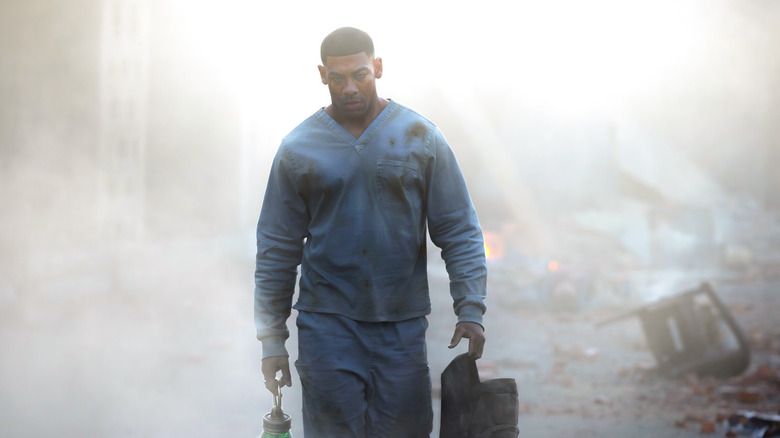
For fans, the transition is crucial. By allowing the character to struggle through an identity crisis in Lanterns, the writers have arguably created a more three-dimensional figure. While the initial backlash was intense, the consensus is shifting toward appreciation for the "long game" the production team was playing.
Conclusion: A Worthy Steward
Aaron Pierre’s journey with Lanterns is a testament to the complex relationship between actors, source material, and fan expectations. By openly acknowledging his initial disagreements with the script, Pierre has fostered a level of transparency that is rare in the high-stakes world of comic book adaptations.
He did not merely play a hero; he dissected the concept of a hero. In doing so, he has bridged the gap between the character’s origins and his future, proving that even a character as stalwart as John Stewart can benefit from a little bit of growing pains. As the DCU expands, one thing remains certain: the mantle of the Green Lantern is in the hands of an actor who is not just committed to the role, but who deeply respects the man behind the ring.
As the credits roll on Season 1, fans are left with a version of John Stewart who is ready for the future—a future where the boy has finally, decisively, become the man.
