
The Prism of Memory: Remembering Nicolas Roeg, Cinema’s Master of Time, Fear, and Desire
Main Facts: The Legacy of a Visionary
In the lexicon of modern cinema, few directors possessed a visual signature as instantly intoxicating, psychologically labyrinthine, and profoundly influential as Nicolas Roeg. When the acclaimed British filmmaker passed away at the age of 90, the global film community lost not just a director, but a pioneer who radically reshaped how movies handle time, memory, and spatial reality.
Roeg was a cinematic architect who treated a narrative not as a straight road, but as a shattered mirror. Whether depicting the haunting, watery decay of Venice, the sun-scorched emptiness of the Australian Outback, or the glittering, melancholic alienation of an alien stranded in corporate America, Roeg infused every frame with a palpable, hallucinatory voltage.
Though his most fertile creative period spanned a relatively brief decade—from 1970 to 1980—his footprint on visual storytelling remains indelible. Directors from Steven Soderbergh to Christopher Nolan have cited his dizzying experiments with nonlinear editing as foundational to their own understanding of cinematic pacing. Roeg did not merely direct films; he orchestrated sensory dreams, forcing audiences to experience the vertigo of human desire, grief, and existential dread from the inside out.
Chronology: From Master Cinematographer to Auteur
The Apprenticeship of Light and Shadow (Pre-1968)
Roeg’s journey to the director’s chair was long and deliberate. Born in London, he spent more than two decades immersed in the mechanics of the British film industry, working his way up through the camera department. This foundational training as a cinematographer gave him a rare, deeply technical mastery over light, shadow, and lens choice.
His early career behind the camera included monumental projects, such as serving as a cinematographer on David Lean’s epic Lawrence of Arabia. However, artistic friction marked his stint on Doctor Zhivago, pushing Roeg toward projects that allowed for greater visual poetry. His work on John Schlesinger’s Far from the Madding Crowd (1967) showcased a Thomas Hardy-on-sedatives visual aesthetic, while Richard Lester’s Petulia (1968) blended Godard-esque structural fragmentation with a slick, fashion-forward Carnaby Street ethos.
The Explosion of Performance (1968–1970)
Roeg finally stepped into the co-director’s chair alongside Donald Cammell for Performance (completed in 1968, but delayed by a nervous Warner Bros. until 1970). A psychodrama blending London gangster tropes with counterculture rock-and-roll decadence, the film paired the elegant, straitlaced James Fox with the feral, lurid charisma of Mick Jagger.
The studio famously panicked over the film’s ominous, elliptical nature and forced edits, yet the resulting movie stands as an underworld masterpiece. It reached its hypnotic zenith when Jagger performed "Memo from Turner," a sequence dripping with a sordid, foreboding atmosphere that anticipated the kinetic neon dread of Stanley Kubrick’s A Clockwork Orange.
The Triumvirate of Masterpieces (1971–1976)
Following Performance, Roeg embarked on a staggering run of solo-directed films that cemented his status as a major cinematic artist:
- Walkabout (1971): A minimalist yet resonant survival tale set in the Australian Outback, following two stranded siblings (featuring Roeg’s son, Luc Roeg, and Jenny Agutter) and an Aboriginal youth on his walkabout (David Gulpilil). The film used landscape to mirror internal isolation.
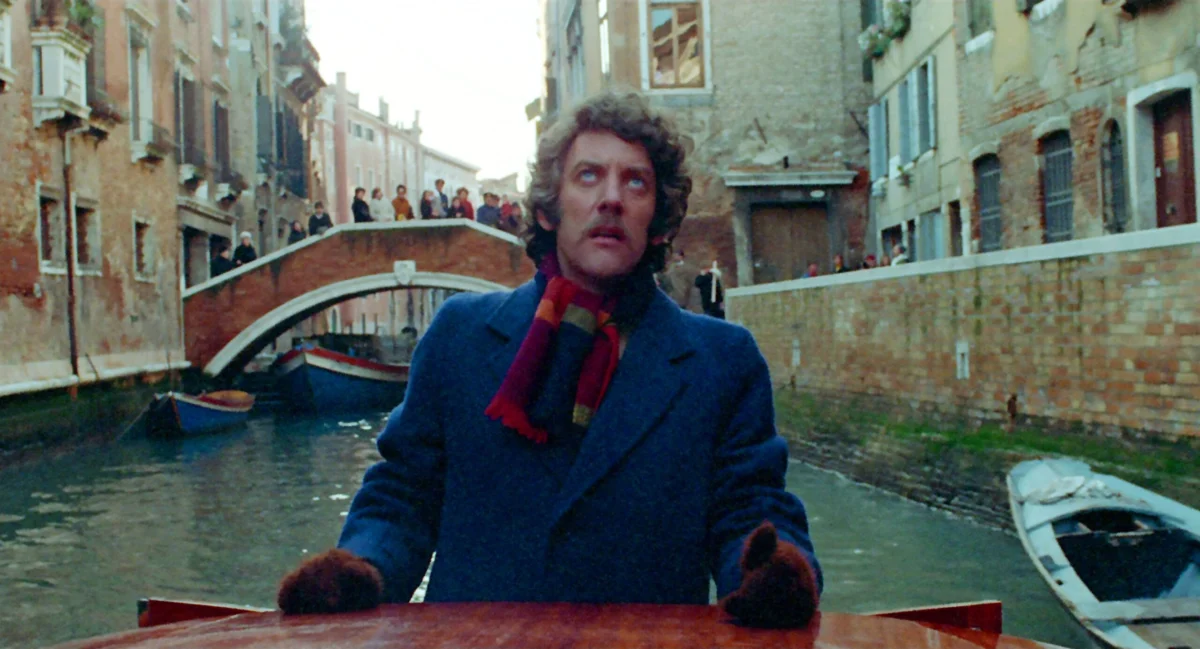
- Don’t Look Now (1973): Based on a Daphne du Maurier short story, this Venice-set thriller starring Donald Sutherland and Julie Christie is arguably Roeg’s masterwork. It functioned as cinema’s first modern gothic horror, anchoring its supernatural terror in authentic, agonizing marital grief.
- The Man Who Fell to Earth (1976): A sprawling science-fiction landmark starring David Bowie as Thomas Jerome Newton, an extraterrestrial seeking water for his dying planet who gets swallowed by human capitalism, addiction, and sensory overload.
The Later Years and Career Trajectory (1980–1990s)
Roeg’s cinematic power crested with 1980’s Bad Timing: A Sensual Obsession, a harrowing psychological post-mortem on male toxicity starring Art Garfunkel and Theresa Russell. Though hailed by critics as a masterclass in fractured editing and obsessive desire, it found a very limited audience due to its disturbing subject matter.
Subsequent efforts, such as the philosophical celebrity-encounter comedy Insignificance (1985) and the Roald Dahl adaptation The Witches (1990), showed flashes of his old brilliance but failed to recapture the cultural dominance of his 1970s output.
Supporting Data: The Anatomy of a Masterpiece
To understand Roeg’s impact, one must examine the technical daring that separated him from his contemporaries. His signature methodology relied on associative editing—cutting across time and space not to confuse the viewer, but to express how human consciousness actually works.
- The Don’t Look Now Editing Suite: The film’s most famous sequence—a tender, graphic love scene between Sutherland and Christie—remains legendary not just for its eroticism, but for Roeg’s structural gambit. He intercut the passionate lovemaking with shots of the couple quietly getting dressed afterward, humming with the mundane reality of everyday life. This temporal sleight-of-hand told the audience that ecstasy and routine are inextricably linked, and that all human actions exist within a pre-ordained circle of fate.
- Box Office and Critical Reception: While Don’t Look Now and The Man Who Fell to Earth were never massive commercial blockbusters in the vein of contemporary Hollywood fare, they achieved legendary status through critical reappraisal and midnight-movie culture. The Man Who Fell to Earth operated on a $1.5 million budget, yet constructed a sprawling, prophetic vision of modern media saturation that felt decades ahead of its time.
Official Responses and Industry Tributes
Following news of his passing, filmmakers, critics, and actors flooded media outlets with tributes honoring a director who operated entirely on his own terms.
Edgar Wright tweeted, "Nicolas Roeg was a true cinematic visionary. His films changed how I and many others viewed the possibilities of editing and storytelling."
Acclaimed directors noted that Roeg’s background as a cameraman gave him an intuitive understanding of composition that many traditional screenwriters-turned-directors lacked. Rather than relying solely on dialogue, Roeg allowed images to do the heavy lifting, trusting that audiences could piece together emotional landscapes through visual textures alone.
Theresa Russell, his frequent collaborator and former wife, noted in interviews that working with Roeg required a total surrender of conventional actorly ego. He demanded psychological nakedness, pulling performances from his cast that felt raw, exposed, and deeply unsettling.
Implications: The Road Not Taken and Modern Cinema
The legacy of Nicolas Roeg prompts a fascinating counterfactual historical question: What if his uncompromising aesthetic had found a more permanent alliance with mainstream Hollywood escapism?
Roeg was never an anti-industry radical for the sake of rebellion; he genuinely wanted wide audiences. Yet his refusal to flatten his complex, prismatic storytelling into neat three-act structures meant that his commercial window was inevitably narrow.
Nevertheless, the implications of his brief, brilliant heyday are felt deeply in today’s cinematic landscape. In an era where modern prestige television and independent cinema frequently employ fractured timelines, memory-matching, and stream-of-consciousness editing (seen in works ranging from True Detective to Everything Everywhere All at Once), Roeg’s DNA is everywhere.
He proved that horror could be sophisticated, that science fiction could be literary and poetic, and that human desire and trauma could be rendered on screen with the dizzying logic of a waking dream. Nicolas Roeg’s films remain as an invitation to dive into the abyss—reminding us that in the cinema, as in life, the past is always present, the climax is always a prelude, and the screen is a mirror of our deepest, most beautiful fears.
