
The Shifting Landscape of Magic: The Gathering: An In-Depth Analysis of Wizards of the Coast’s 2027 Booster Overhaul
For many veterans of Magic: The Gathering (MTG), the mere announcement of "product updates" or "streamlined configurations" from Wizards of the Coast (WotC) is enough to induce a collective groan. Over the past decade, the cadence of changes to card distribution, booster configurations, and pricing models has accelerated significantly.
In their latest official product policy announcement, Wizards of the Coast has outlined a sweeping overhaul of both Play Boosters and Collector’s Boosters set to take effect. While the changes introduce long-awaited fan favorites—such as the nostalgic return of "God Packs"—they also bring controversial reductions in pack contents and lingering questions regarding product value.
This deep dive examines the anatomy of the upcoming changes, looking at the chronological evolution of MTG packaging, the data surrounding secondary market impacts, official corporate justifications, and the broader implications for the global trading card game (TCG) community.
Main Facts: What is Changing in 2027?
The upcoming restructuring of Magic: The Gathering booster packs impacts both standard play products and premium collector items. The core modifications span nomenclature, drop rates, and physical composition:
- Simplification of Branding: Following the 2024 retirement of Draft and Set Boosters in favor of "Play Boosters," WotC is dropping the modifier altogether. Moving forward, standard packs will simply be designated as Booster Packs.
- The Return of God Packs: After a 13-year hiatus—having last appeared in the 2014 Journey into Nyx expansion—God Packs are making a comeback. The odds of pulling one have been significantly improved from 1 in 1,000 to 1 in 300.
- Japanese Showcase Cards: Exclusive alternate-art styles previously locked behind Collector’s Boosters will now occasionally appear in standard Booster Packs.
- Foil Rates Adjusted: Standard Booster Packs will feature increased drop rates for foil rares and mythics, though this comes amid wider structural shifts.
- Collector’s Booster Contraction: Collector’s Boosters are undergoing a content reduction, shedding specific card slots to allegedly "make room" for higher-impact pulls, despite maintaining their baseline price point.
Chronology: A History of Booster Evolution
To understand the weight of the 2027 adjustments, it is vital to trace how Wizards of the Coast has repeatedly restructured how players buy cards over the last decade.
2014: The Genesis of God Packs
During the Theros block, specifically within the Journey into Nyx expansion, WotC introduced an ultra-rare variant known colloquially as the "God Pack." Instead of a randomized spread of commons, uncommons, and rares, every card in the pack was a legendary God from the block. With a steep 1 in 1,000 drop rate, they became instant collector’s items and set a high-water mark for novelty unboxings.
2024: The Play Booster Experiment
In an effort to solve the friction between Limited players (Draft and Sealed) and Constructed collectors, WotC phased out traditional Draft and Set Boosters. They were merged into the Play Booster—a hybrid pack designed to provide the sealed-play functionality of a draft pack while maintaining the fun, higher-variance card slots of a set booster.
2027: The Current Overhaul
Now, WotC is wiping away the "Play" moniker, returning to a singular baseline name while fundamentally altering the internal mathematics of the packs. This rapid iteration cycle has left many consumers feeling that the product identity of MTG is in a perpetual state of beta testing.
Supporting Data: Odds, Values, and the Secondary Market
While the return of God Packs sounds exciting on paper, a closer look at the mathematics and the economics reveals potential friction points for collectors and competitive players alike.
Decoding the New God Packs
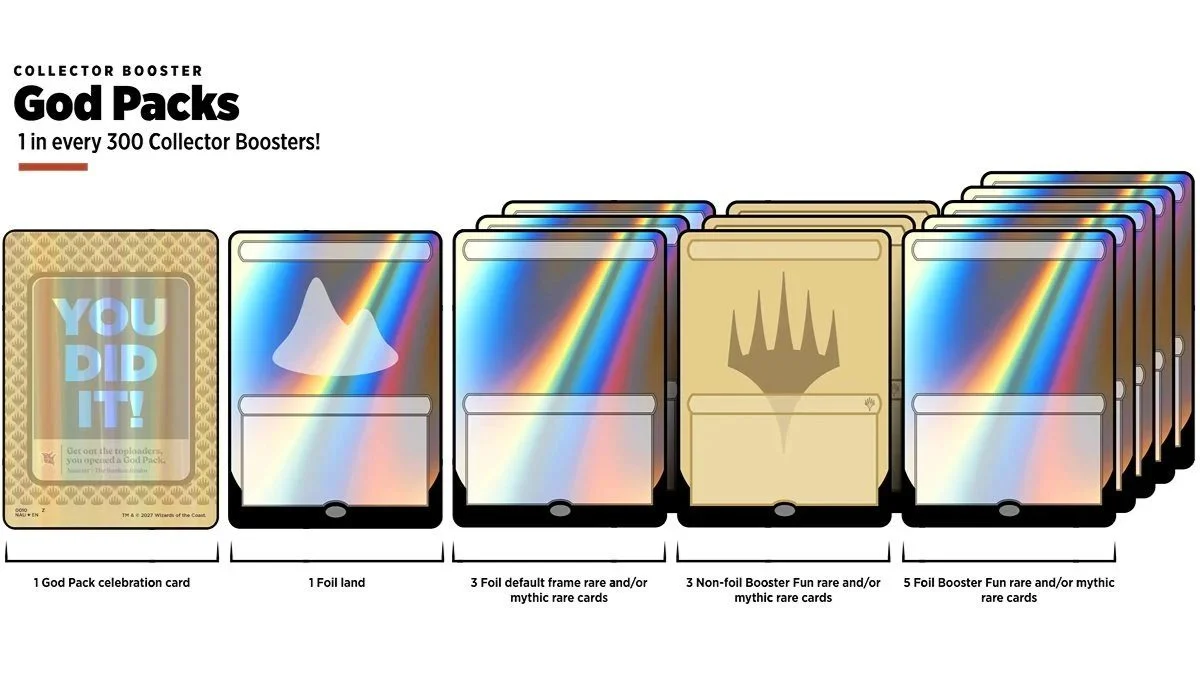
Under the updated 2027 parameters, pulling a God Pack is nearly three times more likely than it was in 2014 (1-in-300 vs. 1-in-1,000). However, the composition has evolved. The new God Packs contain:
- 1 "God Pack Celebration" card (which has drawn criticism from players who view it as a non-playable token rather than an actual game piece).
- 1 Foil Land.
- 3 Foil Frame Rare and/or Mythic cards.
- 3 Non-Foil Booster Fun Rare and/or Mythic cards.
- 5 Foil Booster Fun Rare and/or Mythic cards.
Despite being packed exclusively with Rares and Mythics, skeptics point out a harsh economic reality: not all rares are created equal. A pack containing fourteen bulk rares with low secondary-market utility may offer less financial and play value than a standard pack containing a single high-tier chase card.
The Foil Dilemma
Wizards of the Coast has heavily leaned into increasing foil availability across standard and premium lines. However, the community’s primary grievance regarding foils has never been a lack of availability—it has been card quality.

For years, players have contended with the phenomenon of "Pringling"—a structural defect where foils absorb ambient humidity and curve severely within hours of opening. In competitive environments, warped foils can constitute marked cards, making them illegal for tournament play. Flooding the market with more foils without addressing structural curling concerns risks exacerbating secondary market instability.
Official Responses: The Corporate Rationale
Faced with inevitable community pushback over reduced card counts in premium products, WotC’s communication team has stepped forward to justify the changes.
Addressing the controversial decision to prune specific cards from Collector’s Boosters, Blake Rasmussen, Communications Director for Wizards of the Coast, offered this explanation:
“How does removing cards make opening Collector Boosters more exciting? We’ll be honest here—it doesn’t. But we do know that most people who open Collector Boosters mostly skip past these cards. Not everyone, but enough of a majority. You can see it in virtually any Collector Booster opening video, where the video practically skips over that section of the booster. Removing isn’t about shrinking the experience; it’s about making room—in terms of both printing capacity and player psychology—for cards people actually get excited about.”
While WotC maintains that baseline booster prices will not increase alongside these configurations, consumer advocates note the inherent contradiction: paying the exact same amount of fiat currency for fewer physical cards is, effectively, a price hike.
Furthermore, the justification that creators and consumers "skip" certain cards on video streams ignores the functional role those uncommons, commons, and filler foils play in deckbuilding, limited play, and trading economies.
Implications: Accessibility, Shrinkflation, and Player Trust
The 2027 booster changes do not exist in a vacuum. They arrive at a time when the broader TCG landscape—including rival properties like the Pokémon TCG—is grappling with intense speculative hoarding, scalping, and retail volatility.
1. The Threat of Shrinkflation
As global economic pressures squeeze household budgets, entertainment expenditures face heavier scrutiny. By reducing card counts in premium products while holding prices steady, WotC is engaging in a classic "shrinkflation" model. For casual players and families, the barrier to entry for physical Magic continues to creep upward.
2. Erosion of Consumer Faith
While billion-dollar crossovers like Universes Beyond (incorporating intellectual properties like Lord of the Rings, Doctor Who, and upcoming major franchises) continue to line parent company Hasbro’s pockets, long-term purists feel alienated. The constant reinvention of booster packs creates fatigue. When products change names, configurations, and pricing structures every two to three years, confidence in the long-term collectibility and value retention of cards plummets.
3. Pushing Players Toward Proxies and Digital Alternatives
As physical paper Magic becomes increasingly expensive and logistically frustrating—compounded by curled foils and shifting rarity distributions—the community response has grown increasingly defiant. Many local game stores and playgroups are turning toward unofficial proxy cards for casual formats like Commander. Alternatively, players who feel priced out of physical cardboards are migrating permanently to Magic: The Gathering Arena.
Conclusion
Wizards of the Coast’s 2027 booster updates present a classic double-edged sword. On one hand, the nostalgic revival of God Packs with improved odds and the broader distribution of Japanese Showcase art provide genuine moments of unboxing excitement. On the other hand, reduced card counts in premium lines, tone-definiteness regarding foil quality issues, and an unrelenting corporate focus on shareholder returns risk alienating the grassroots community that built the game.
If Wizards wants to maintain long-term faith in the physical Magic: The Gathering ecosystem, they must balance their aggressive monetization strategies with respect for consumer value—ensuring that opening a pack feels less like a gamble against corporate optimization and more like the magic that captured fans’ imaginations in the first place.
