
The Unraveling of the Loop Tour: Ed Sheeran Navigates a Global Political Firestorm in Philadelphia
Introduction: A Stadium Under Siege
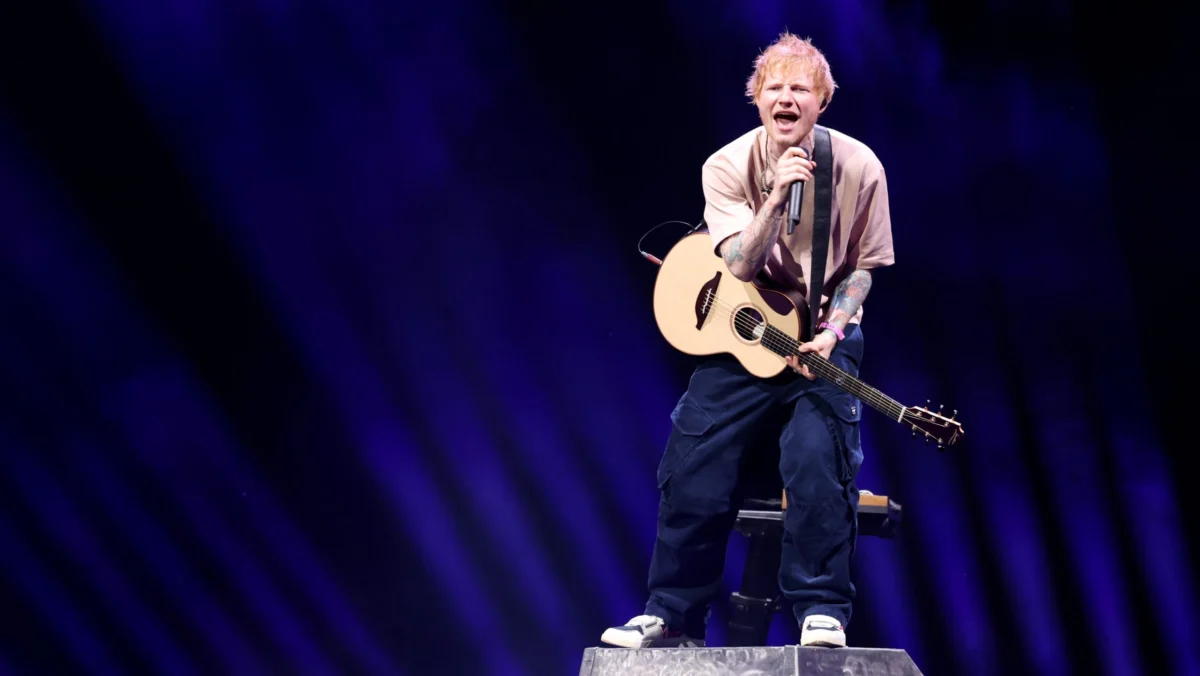
On Saturday night, the atmosphere at Philadelphia’s Lincoln Financial Field was marked by a palpable tension that rarely accompanies a pop concert. Ed Sheeran, one of the world’s most successful touring artists, stepped onto the stage for his Philadelphia stop of the "Loop Tour" not to the usual roar of a unified fanbase, but into a complex, high-stakes environment defined by ideological fracture.
For the first time in his career, the "Thinking Out Loud" singer felt compelled to pause his performance to address the elephant in the stadium: his recent decision to remove rapper Macklemore from his North American tour. The move, which triggered a domino effect of support act departures and public outcry, has forced the British star into the center of the most contentious geopolitical debate of the decade. As Sheeran navigated the evening, it became clear that the intersection of stadium-level entertainment and global human rights advocacy has created a new, precarious reality for artists in the public eye.
The Chronology of a Controversy
The conflict began in early September during Sheeran’s residency at MetLife Stadium in New Jersey. Macklemore, acting as a supporting act, utilized his platform to speak on the Israel-Hamas war, specifically calling for a "Free Palestine." During his performances on September 4 and 5, the rapper projected images of Gaza and delivered impassioned pleas regarding the humanitarian crisis.
Following these performances, a firestorm erupted. According to reports, several high-profile NFL stadium owners—including Robert Kraft of the New England Patriots, David Tepper of the Carolina Panthers, Arthur Blank of the Atlanta Falcons, and Jeffrey Lurie of the Philadelphia Eagles—allegedly threatened to block the tour from their venues if Macklemore remained on the bill.
The ultimatum proved effective. Shortly after, it was announced that Macklemore would be removed from the remainder of the U.S. tour. The fallout was immediate: Sheeran’s other opening acts, including Aaron Rowe, Finneas, and Lukas Graham, as well as his backing band, Beoga, withdrew from the tour in solidarity with the political message Macklemore had championed. By the time the tour reached Philadelphia, Sheeran was left to perform entirely on his own, with no supporting acts and a diminished backing team.
Inside the Philadelphia Show: A Personal Plea
Addressing the 50,000-strong crowd at Lincoln Financial Field, a somber Sheeran opened up about the personal toll the week had taken. "I’m used to my music being criticized, and I’m always happy to take that," he began. "But this week, the criticism was about something much more important, and I’ve had to take and make difficult decisions, and I am making mistakes, and I’m so, so sorry."
Sheeran, who has historically avoided political discourse, articulated his discomfort with the pressure placed upon him by venue owners. "I’m deeply worried about the idea that venues pre-approve content for performance," he stated. "This happens in so many places that I perform around the world, but it should never happen in the free world."
Breaking his silence on the conflict, Sheeran attempted to balance his stance. "What happened in Israel and at the Nova Music Festival on October 7th was horrific and compounded centuries of Jewish pain. What is happening in Gaza is catastrophic and unjustifiable, and disproportionate," he declared. He acknowledged his own limitations, admitting he was "listening and learning" and was currently working with stakeholders to find ways to contribute to humanitarian relief efforts.
The Financial and Operational Fallout
The logistical impact on the tour was significant. Beyond the loss of talent, the concert was plagued by a sharp decline in market value. Tickets that were priced at $90 on Thursday plummeted to approximately $54 by Friday night. By Saturday, the average resale price had stabilized at roughly $62—a 50 percent drop compared to the previous week’s metrics.
The schedule was also heavily disrupted. The concert, originally slated for a 5:30 p.m. start, was pushed to 8:00 p.m. to accommodate the absence of openers. Inside the stadium, fans were met with an "uneven energy." Some attendees expressed disappointment, while others, like one New Jersey mother who brought her daughter, noted that they felt obligated to attend despite the controversy. "I didn’t want to tell her that it wasn’t happening," she explained. "It’s the last thing I wanted to do."
Protests at the Gates: The Public Response
While fans were filing into the stadium, a different scene was unfolding in the parking lots. A coalition of activist groups, including Shut Down D&Z, Writers Against the War on Gaza, and the Philly SJP Coalition, held a protest aimed at both the venue owners and Sheeran himself.
The protest served as a counter-narrative to the "neutrality" Sheeran claimed to pursue. Adi Chattopadhyay, a press liaison for the protest organizers, emphasized that the goal was to amplify the message Macklemore was silenced for sharing. "Ed Sheeran is getting attention and Macklemore is getting attention because he wasn’t allowed to say ‘Free Palestine,’" Chattopadhyay stated. "But we are here to amplify what Macklemore’s actual message was—that as we speak, Palestinians in Gaza are still enduring barbaric conditions."
The protest also drew attention to the broader power dynamics at play, with speakers criticizing "Zionist billionaires" and the institutional control over public speech in professional sports venues.
Official Responses and the "Humanitarian" Response
The situation has prompted a flurry of statements from the involved parties. Macklemore, in his response, expressed his frustration with the perceived lack of courage from his tour-mate. He revealed that he had donated $1 million of his earnings from the tour to six organizations supporting Palestinians, directly challenging Robert Kraft to match the donation.
In a subsequent development, Robert Kraft confirmed that he and Sheeran had reached an agreement to donate $2 million each to humanitarian efforts in the region. Kraft justified his role in the controversy by citing "a broader history of antisemitic rhetoric and imagery" that he claimed was associated with Macklemore’s recent actions.
Sheeran, for his part, maintained that the decision to cut the rapper was ultimately "the promoter’s decision, not mine." He expressed that his primary obligation was to his crew, his staff, and his fans, stating, "I would never let down the fans who had made plans, nor would I abandon the touring crew and the other support acts and musicians who rely on me."
Implications for the Future of Live Music
The "Loop Tour" controversy raises profound questions regarding the future of artistic freedom in the age of corporate-owned stadiums. When venue owners, who serve as the gatekeepers of major cultural spaces, begin to exercise veto power over the content of performances, the definition of "safe space" becomes increasingly murky.
For artists, the incident serves as a cautionary tale. Sheeran’s experience shows that in an era of hyper-connectivity and intense political polarization, the "apolitical" stance is becoming harder to maintain. By attempting to stay neutral, Sheeran found himself abandoned by both his peers and his principles, eventually being forced to take a public stance regardless.
As the industry reflects on the Philadelphia concert, the implications are clear: the wall between entertainment and politics has been effectively demolished. Whether it is a solo pop star or a stadium-filling rapper, the ability to perform in a major venue now carries with it a set of implicit—and sometimes explicit—political constraints. For fans, this means that the concert experience is evolving into a space where they may find themselves confronting the very issues they hoped to escape.
In his final remarks of the night, Sheeran captured the exhaustion of a man caught in the middle. "I didn’t know whether I’d be even getting on stage again," he admitted. "I really didn’t know whether I even wanted to be an artist at all." As he continues his tour, the music world will be watching to see if he can reclaim his stage, or if the "Loop Tour" will remain forever defined by the week the music stopped, and the politics began.
