
Unlocking the Fourth World: How Batman’s Newest Gadget Connects Gotham to Jack Kirby’s Cosmic Pantheon

Main Facts: The Revelation of the Bat-Com in Batman #14
In the ever-evolving landscape of DC Comics, the Dark Knight’s arsenal has undergone a staggering technological renaissance. While cinematic adaptations like Matt Reeves’s The Batman (2022) lean heavily into a gritty, grounded reality where the Caped Crusader relies on rudimentary tools and practical gadgets, the current mainline comic book continuity is charting a radically different path. Under the creative direction of writer Matt Fraction, Batman’s toolkit has expanded into realms of science fiction that dwarf standard Wayne Enterprises engineering.
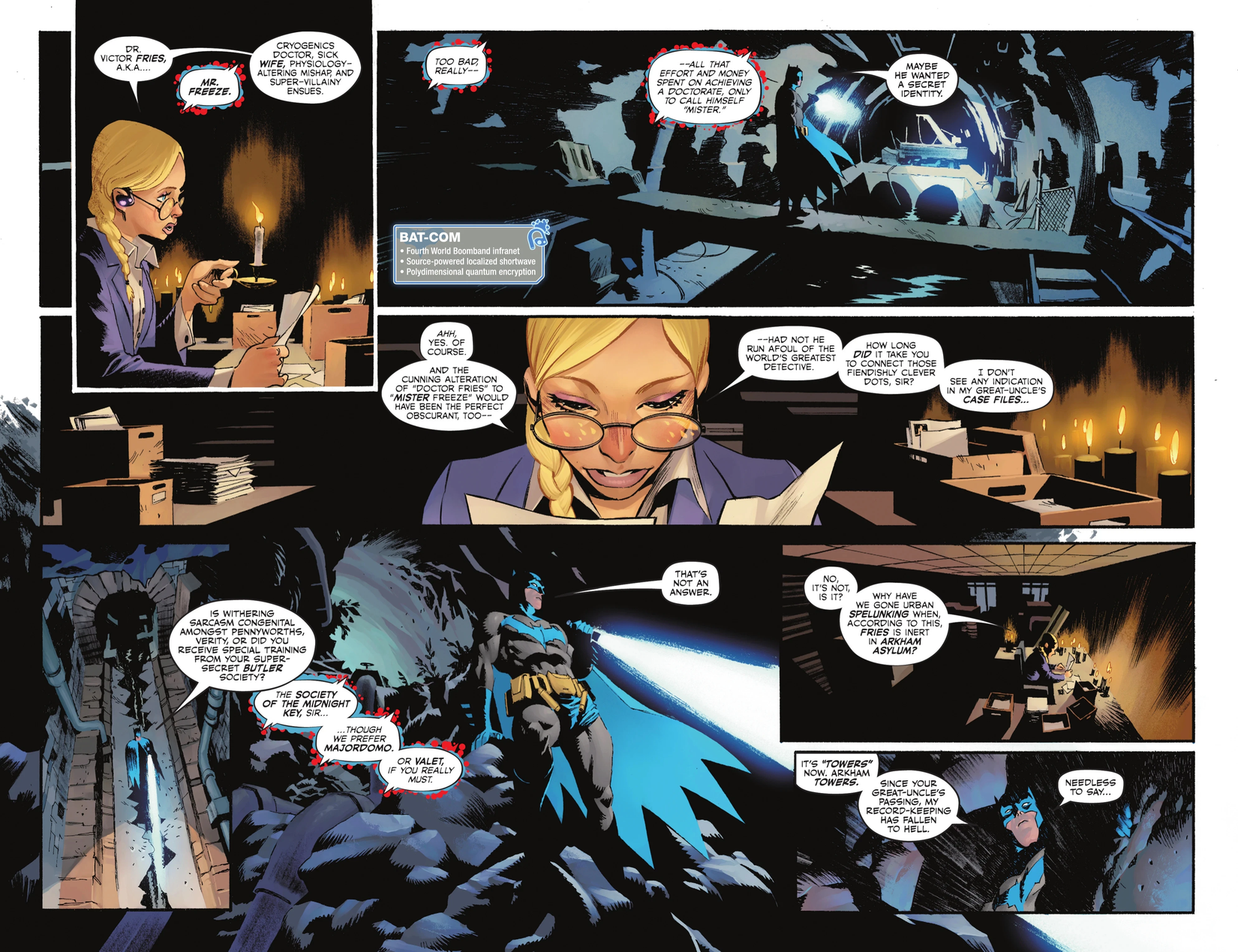
The peak of this technological escalation arrives in Batman #14, currently available on store shelves. The issue features a chilling descent as Bruce Wayne ventures deep beneath the freezing streets of Gotham City toward Victor and Nora Fries’s subterranean stronghold—the Kingdom of Cold and the Engine of Eternal Winter. As he navigates the sub-zero hazards, Batman remains in constant communication with Verity Pennyworth, the Wayne family’s sharp-witted new majordomo (who dryly questions why Mister Freeze insists on a title rather than a doctorate).
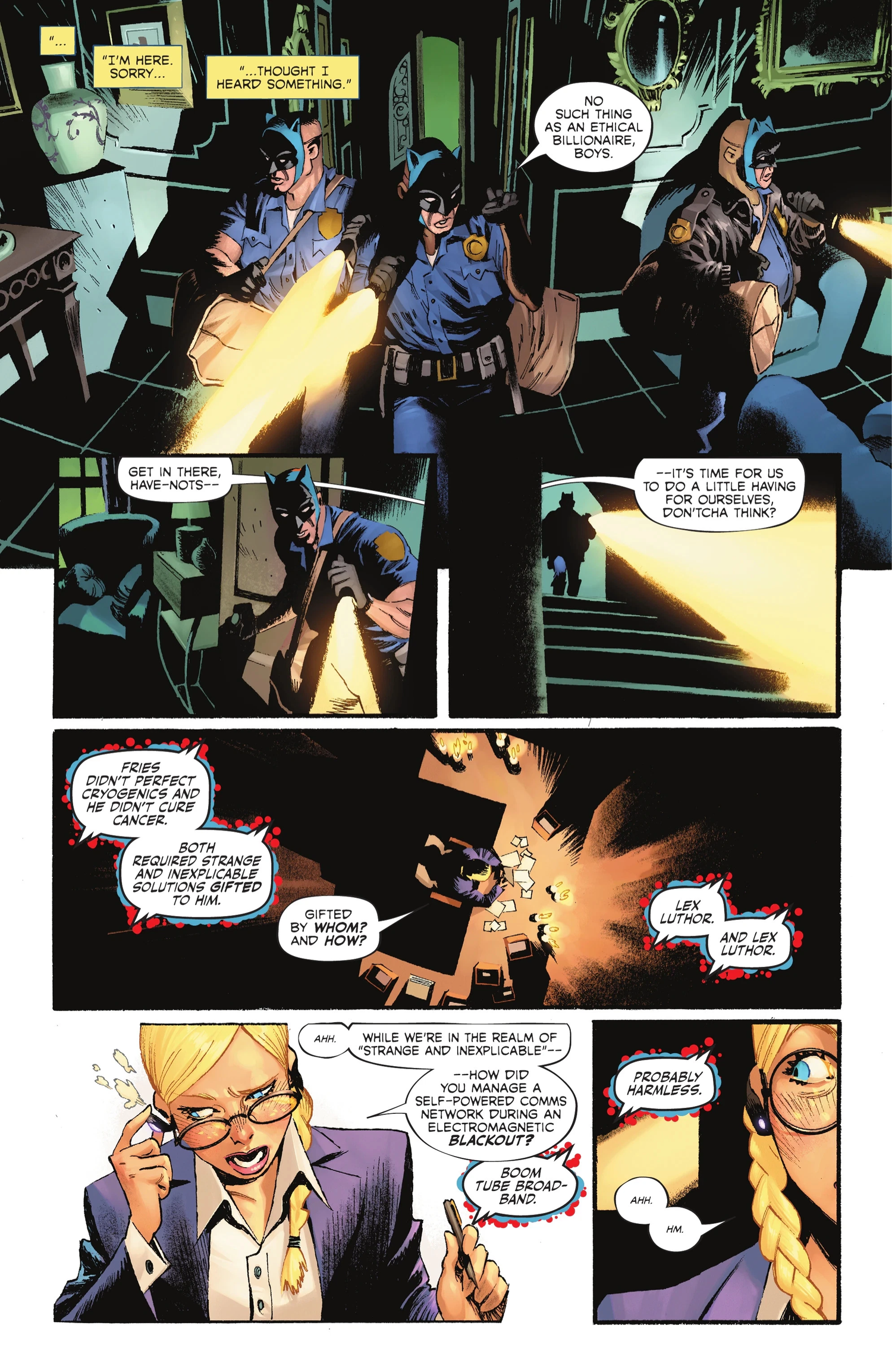
However, the nature of this conversation sparks an immediate tactical mystery. Verity pauses the mission briefings to interrogate Bruce on a glaring logistical impossibility: How is he maintaining a crystal-clear, self-powered communications network right in the middle of a massive electromagnetic blackout?
Bruce’s casual response turns the DC Universe’s power scaling upside down:

“Boom tube broadband. Probably harmless.”
With that single line, Fraction introduces the Bat-Com—an unassuming, earpiece-shaped device that draws its operational bandwidth not from WayneCorp satellites or terrestrial cellular towers, but directly from the divine, warp-gate technology of Jack Kirby’s Fourth World.
Chronology: The Evolution of Batman’s Tech from Grounded Detective to Cosmic Operator
To understand the sheer absurdity and magnitude of the Bat-Com, it helps to trace the historical pendulum swing of Batman’s gear throughout his 87-year publishing history.
- The Golden and Silver Ages (1939–1980s): Initially, Batman was defined by basic detective work, utilizing utility belt staples like Batarangs, smoke pellets, and a standard radio communicator. However, as science fiction permeated comic books during the Silver Age, Batman frequently rubbed shoulders with aliens, leaning into eccentric, high-concept gizmos without batting an eye.
- The Post-Crisis & Modern Era (Late 1980s–2010s): Following iconic runs like Frank Miller’s The Batman and the gritty realism of the 1990s, writers grounded the character. Gadgets became tactical, military-grade, and heavily encrypted, but they remained strictly bound by the laws of terrestrial physics and human engineering. Even when operating with the Justice League, Batman’s personal gear stayed relatively close to Earth-bound science.
- The Cinematic Counter-Movement: On the silver screen, directors like Christopher Nolan (The Dark Knight Trilogy) and Matt Reeves (The Batman) cemented the "grounded" aesthetic. In these iterations, seeing Batman use a wing-suit or a grappling hook feels monumental. The absence of fantastical sci-fi elements became a hallmark of cinematic success, widening the gap between street-level adaptations and cosmic-level comic storytelling.
- The Matt Fraction Era (Present): With the launch of the Batman: Bad Seeds overarching event, Fraction has deliberately shattered the glass ceiling of Batman’s technological boundaries. By introducing Fourth World architecture into standard Gotham operations, Batman is no longer just the World’s Greatest Detective; he is a shadow-ops operator utilizing divine celestial networks.
Supporting Data: Breaking Down the Bat-Com and Fourth World Tech
While the Bat-Com appears physically modest—disguised as a sleek, ergonomic earpiece that sits flush against the ear—its internal mechanics operate on a theological and dimensional scale previously reserved for characters like Superman, Mister Miracle, and Orion.

What is a Boom Tube?
In DC lore, introduced by legendary creator Jack Kirby in his Fourth World saga, a Boom Tube is a towering corridor of light used for instantaneous transportation across light-years, connecting planets like New Genesis and Apokolips. They operate via Mother Box frequencies, manipulating gravity, space, and local dimensional barriers.
By tapping into "Boom tube broadband," the Bat-Com essentially hooks into a multi-dimensional Wi-Fi network powered by New God machinery. This explains several key features of the device:
- Infinite Range: Traditional radios face atmospheric interference, curvature of the Earth, and lead-lined walls. A Boom Tube frequency bypasses physical space entirely, allowing clear communication across star systems, dimensions, and deep underground bunkers.
- Absolute Immunity to EMPs: Electromagnetic pulses fry traditional circuitry by inducing damaging electrical surges in copper wires and silicon chips. Because Fourth World tech is sub-dimensional and psionically/energetically driven, standard terrestrial blackouts are entirely irrelevant to it.
- Data Bandwidth: Transmitting high-definition tactical feeds, biometric data, and continuous audio from the absolute depths of Gotham’s permafrost requires data speeds that defy human fiber-optics.
Despite Verity Pennyworth’s valid concerns regarding the stability of running alien tech inside one’s own ear canal, Batman waves off the danger with characteristic stoicism, labeling it "probably harmless."
Official Responses and In-Universe Dynamics
The introduction of the Bat-Com has immediately shifted character dynamics within Wayne Manor, particularly regarding the newly introduced Verity Pennyworth. As the household’s new majordomo, Verity represents the pragmatic, hyper-observant voice of reason that traditionally fell to Alfred Pennyworth.
Where Alfred might have offered a weary sigh, a raised eyebrow, or a dry lecture on the dangers of playing with Apokoliptian hardware, Verity’s reaction is one of profound, lingering suspicion. Her verbal retreat—a skeptical "Ahh. Hm."—highlights the underlying tension of Matt Fraction’s run: Bruce is taking escalating, uncalculated risks with his hardware.
Fans and critics alike have taken to online forums and comic book communities to dissect the moment. The consensus splits into two distinct camps:
- The Purist Critique: Some readers argue that pushing Batman into New God-level tech dilutes what makes the character compelling. If Batman can effortlessly tap into Fourth World broadband, the tension of being trapped, isolated, or cut off from the Bat-Family evaporates.
- The Innovator’s Praise: Conversely, many applaud Fraction for injecting genuine sci-fi wonder back into the mythos. Batman has been a member of the Justice League for decades; it strains credibility to assume he hasn’t reverse-engineered alien technology for his own crime-fighting crusades.
Implications: Where Does Gotham Go From Here?
The debut of the Bat-Com in Batman #14 is much more than a throwaway gag or a convenient plot device to keep Bruce in touch with his support team during the Bad Seeds crisis. It carries massive implications for the future of the DC Universe and Batman’s individual storylines.
1. Opening the Door to the Fourth World
While Matt Fraction’s current narrative focus remains firmly anchored in Gotham City—dealing with psychological threats, underground kingdoms, and local corruption—the inclusion of Boom Tube broadband wedges a heavy foot in the door for future cosmic crossovers. If Batman has access to New God communication networks, what else has he tucked away in the Batcave? Does he possess Mother Box components? Are New Genesis or Apokolips aware that their frequencies are being siphoned off for local vigilante justice?
2. The Escalation Arms Race
As comic book heroes evolve, their villains inevitably adapt. If Batman’s gear is operating on divine, interdimensional frequencies, Gotham’s rogues gallery will eventually need to upgrade their own toolkits to remain competitive. A standard mobster or a chemical-based lunatic like Mister Freeze may soon find themselves outmatched not just by intellect, but by trans-dimensional tactical dominance.
3. The Psychological Toll on Bruce Wayne
Batman’s greatest strength has always been his mortality and his reliance on human ingenuity. When he begins utilizing god-like technology to solve earthly problems, it blurs the line between man and machine, hero and deity. Verity Pennyworth’s skepticism serves as a narrative warning flare for the audience: playing with divine cosmic power always comes with a hidden cost.
Conclusion
Batman #14 is available now in comic book stores everywhere. Whether the Bat-Com proves to be an invaluable asset or a ticking time bomb waiting to invite New Gods vengeance down upon Gotham, one thing is certain: Batman’s utility belt will never look the same again.
