
Crafting the "Fortress Zuckerberg": How Production Design Defined Aaron Sorkin’s The Social Reckoning
Main Facts
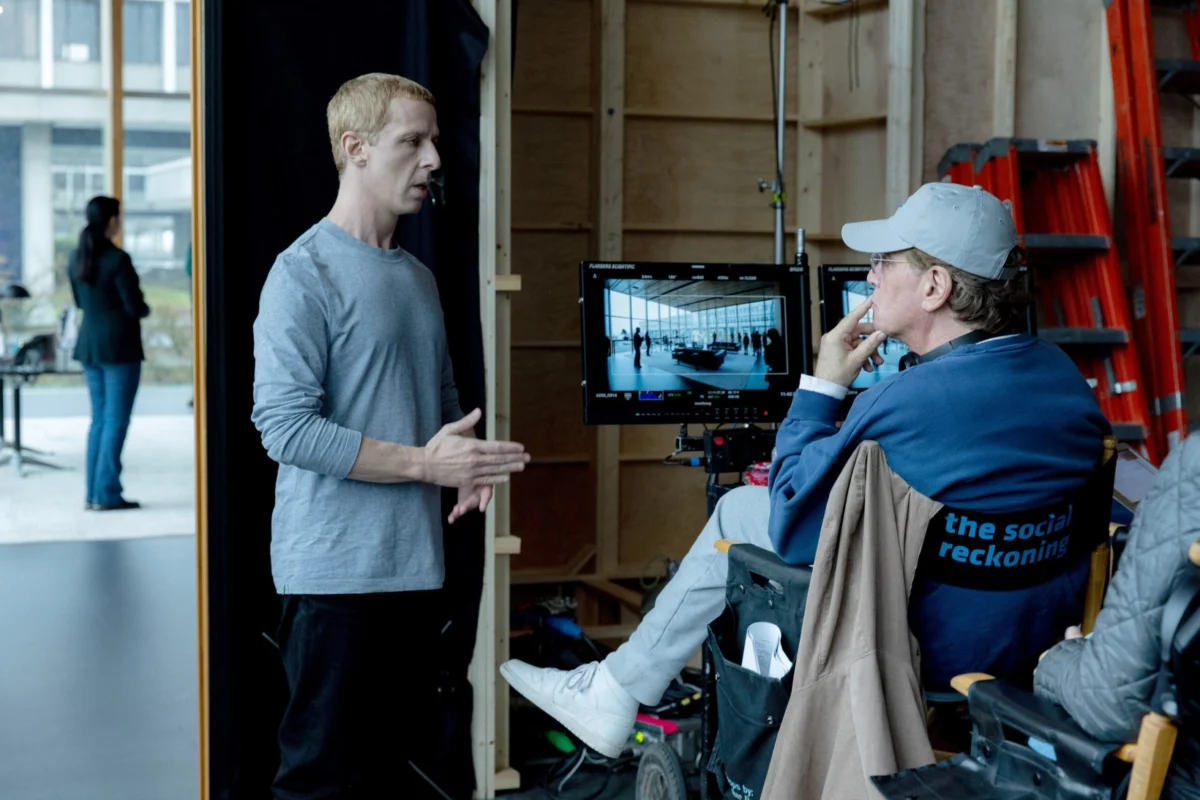
When writer and director Aaron Sorkin set out to make The Social Reckoning, the latest cinematic chapter examining the tectonic shifts and human costs of the social media era, he faced a massive logistical and creative hurdle. Sorkin and veteran production designer Jon Hutman—who previously shaped the dramatic prosceniums for dialogue in The West Wing and Being the Ricardos—needed to recreate the sprawling, hyper-modern universe of Meta (formerly Facebook) without ever stepping foot inside its actual Menlo Park headquarters.
Rather than attempting to build an exact, literal replica of the tech giant’s real estate empire, the production team took a conceptual approach. They headed north to Vancouver, British Columbia, utilizing the striking, monumental campus layouts of Simon Fraser University (SFU) and the University of British Columbia (UBC) to stand in for Northern California.
The resulting aesthetic is far removed from the reclaimed industrial chic commonly associated with Silicon Valley campuses. Instead, Hutman leveraged the stark, imposing lines of Canadian modernist and brutalist architecture to construct what the filmmakers call the "Fortress Zuckerberg." Starring Jeremy Strong as an embattled Mark Zuckerberg and Mikey Madison as future whistleblower Frances Haugen, The Social Reckoning uses its physical sets not merely as backdrops, but as active psychological participants that echo the paranoia, insularity, and immense scale of modern tech empires.
Chronology of Production Design: From Scrappy Dorms to Corporate Behemoths
To understand the spatial terror and grandeur of The Social Reckoning, one must trace the cinematic evolution of the social media landscape from its humble, scrappy origins to its current status as an untouchable global infrastructure.
Phase 1: The Scrappy Beginnings (The Social Network, 2010)
Fifteen years prior to The Social Reckoning, David Fincher’s The Social Network—also scripted by Sorkin—visualized Facebook’s genesis through cramped Harvard dorm rooms, dial-up connections, and makeshift Palo Alto houses. The physical environment of the early company was defined by claustrophobia, cluttered desks, and youthful energy. It was a chaotic garage-band era of tech development where the workspace felt human-scale and deeply permeable to the outside world.

Phase 2: Scouting and Conceptualizing the Behemoth (Pre-Production, 2024–2025)
When Sorkin and Hutman began planning The Social Reckoning, they immediately confronted the reality of modern corporate growth. Facebook’s headquarters had evolved into a massive, quarter-mile-long open-plan office—the largest of its kind in the world.
- The Scale Problem: Sorkin noted in an interview for IndieWire’s Filmmaker Toolkit podcast that building a physical set a quarter of a mile wide was an impossibility.
- The Architectural Solution: Hutman toured university campuses in British Columbia, realizing that institutions like SFU and UBC shared a critical design philosophy with big tech: they are engineered to keep massive populations centralized in single, highly controlled environments.
Phase 3: Construction and Filming in Vancouver (2025)
By utilizing the architectural masterworks of renowned Canadian architects Arthur Erickson and Geoffrey Massey at Simon Fraser University, the production team bypassed traditional soundstages for key sequences. They blended raw, imposing concrete exteriors with sleek glass interiors, capturing both the institutional weight and the fragile, hyper-exposed reality of tech leadership.
Supporting Data & Architectural Insights
The spatial dynamics of The Social Reckoning are built upon specific design choices intended to contrast the physical freedom of open-plan workspaces with the psychological cage of executive power.
- The Quarter-Mile Challenge: According to production notes and Sorkin’s commentary, Meta’s actual headquarters features an open-plan layout stretching a quarter of a mile from wall to wall.
- Architectural Lineage: The production relied heavily on SFU’s brutalist campus architecture, originally designed by Arthur Erickson and Geoffrey Massey, to evoke the impenetrable, fortress-like atmosphere of modern corporate campuses.
- Lighting and Scale: Cinematographer Jeff Cronenweth utilized SFU’s glass-cube cafeteria spaces to play with natural sunlight, emphasizing vast scale and the tense boundary separating the interior corporate world from the exterior public sphere.
- The Executive Office: Mark Zuckerberg’s on-screen office marries modern glass and light woodworking with an unsettling sense of hyper-visibility. In a telling detail revealed by Sorkin, Zuckerberg’s office even houses a bulletproof couch—a physical manifestation of extreme corporate paranoia.
Official Responses and Creative Perspectives
The filmmakers have been vocal about how the physical architecture of the film serves as a narrative vehicle. Rather than relying solely on dialogue to drive home the anxieties of institutional accountability, Sorkin and Hutman let the sets speak for the characters.
Speaking on the Filmmaker Toolkit podcast, Aaron Sorkin emphasized the sheer intimidation factor baked into the tech titan’s environment. Describing a tense sequence between Zuckerberg (Strong) and future whistleblower Frances Haugen (Madison), Sorkin highlighted how the scale of the room reduces employees to helpless observers:

"You find out in the movie, he has a bulletproof couch in his office," Sorkin said. "[In an office scene], as he says, ‘that’s 30 million people who just stopped scrolling,’ you see the fear. The incredible fear. And Francis’ supervisor, as they’re walking in, says, ‘Stand by the wall. You’re an extra in this scene.’ And she just has to stand there and just watch this going back and forth."
Jon Hutman expanded on the challenge of balancing the duality of Meta’s public image—youthful, innovative, and modern—with the grim reality of corporate consolidation and surveillance.
"One of the biggest design challenges of the movie was, ‘how do you capture the essence of one of the biggest, best-known companies in the world, and create that sense of youth, relevance, and modernity?’" Hutman explained. "The Facebook headquarters are massive. So, we created a version that is not a literal duplication but is faithful to the identity and vibe of the place."
Broader Implications: What The Social Reckoning Says About Modern Power
The production design choices in The Social Reckoning point to a larger cultural conversation about how modern institutions project power. In an era where digital networks dictate global discourse, the physical spaces inhabited by tech executives have evolved from scrappy startup hubs into modern-day citadels.
The Illusion of Transparency
Open-plan offices are historically marketed as egalitarian spaces that foster collaboration, break down hierarchical barriers, and encourage free-flowing communication. However, in The Social Reckoning, Hutman’s sets subvert this utopian promise. The sprawling glass walls and wide-open corridors do not create freedom; rather, they foster an environment of radical overexposure. Employees like Frances Haugen are constantly watched, turned into literal "extras" in the high-stakes drama of executive decision-making.

Brutalism and Corporate Might
By choosing brutalist architecture as a stand-in for Silicon Valley wealth, the filmmakers draw a direct line between classical expressions of state power and contemporary corporate dominance. The heavy concrete, imposing geometry, and fortress-like layouts of SFU communicate permanence, impenetrability, and detachment from ordinary human consequences. When Mark Zuckerberg adjusts platform algorithms to protect a mere 1% drop in user engagement—regardless of the societal collateral damage—he does so from within an architectural monument designed to withstand external pressure at all costs.
Ultimately, The Social Reckoning proves that the battle lines of the modern tech wars are drawn not just in code and policy papers, but in the very concrete and glass walls that shelter Silicon Valley’s ruling class.
“The Social Reckoning” is now playing in theaters.
