
The Vertical Frontier: How ‘Tenzing’ Reclaims the Summit of Mountaineering Cinema
The cinematic landscape has, for the better part of a decade, been gripped by a vertigo-inducing obsession with the world’s most formidable peaks. This "mountain-climbing moment" traces its roots back to 2018, a watershed year that brought us the visceral, heart-in-the-throat documentaries Free Solo and The Dawn Wall. These films served as an invitation to the audience to witness the thin, oxygen-deprived air of the places that climbers crave and most of us would never dare to approach. Yet, as these films proved, there is a profound, shared human yearning to stand where the earth meets the sky.
This new wave of mountaineering cinema represents a form of "delirious vicariousness." Leveraging technological advancements and a level of filmmaking bravado unimaginable three decades ago, movies like 14 Peaks, The Alpinist, and the high-altitude urban-rooftopping documentary Skywalkers: A Love Story chart the impossible. The very existence of these films—the footage captured in conditions that defy the laws of safety—is a core element of their exhilarating, scary appeal.
Into this flourishing genre steps Tenzing, a film that offers a stylistic departure. While the contemporary trend favors the immediate, jagged edge of the documentary, Tenzing leans into the grandeur of the classical drama. It is an old-school, sweeping narrative about the first successful summit of Mount Everest in 1953, a story of ambition, imperialism, and the often-erased contributions of the indigenous people who made such triumphs possible.
A Chronicle of Ambition and Imperialism
The 1953 expedition was, at its heart, a final, gasping act of the British Empire. Following eight failed attempts by previous teams, the British were desperate to stake their claim on the world’s highest point. It was a mission defined by "the stiff upper lip," military hierarchy, and an aggressive, colonial desire to "conquer" nature.
The conditions were, by any modern standard, suicidal. The team faced massive chasms, vertical rock faces, and storms that could shred a tent in minutes. The air was so thin it threatened to suffocate them with every breath. Yet, the British expeditionary force was fundamentally ill-equipped for the environment. They relied entirely on the Sherpa—the Tibetan ethnic group native to the region—who possessed a physiological and spiritual bond with the mountains that the Europeans could not replicate. While officially labeled "guides," the Sherpa were the heartbeat of the mission, possessing the technical knowledge and endurance that ultimately made the summit possible.
The film meticulously charts the timeline of this historic endeavor:
- The Early Years: Tenzing Norgay, growing up in the shadow of Chomolungma (the Tibetan name for Everest), dreams of the summit as a boy. He encounters the legendary British alpinist George Mallory, planting the seed of his lifelong obsession.
- The 1953 Logistics: Colonel John Hunt, played with rigid, military zeal by Willem Dafoe, organizes the expedition. His belief in strict hierarchy creates friction, as he struggles to balance the military order of the British with the indigenous expertise of the Sherpa.
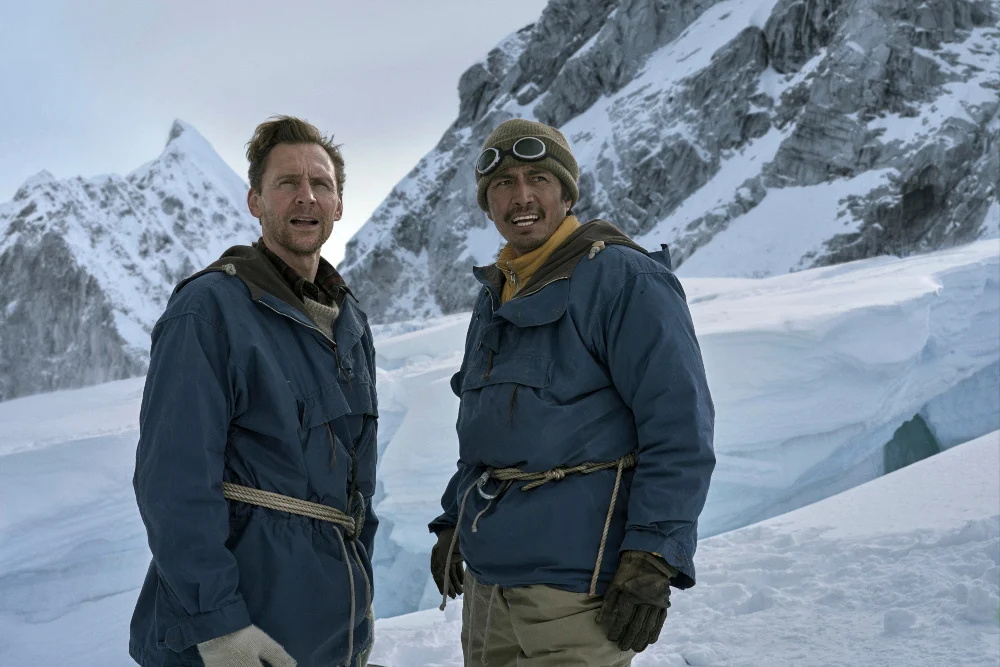
- The Final Push: After weeks of brutal attrition, the team is whittled down. Tenzing and the New Zealander Edmund Hillary (Tom Hiddleston) are identified as the only two climbers with the physical and mental stamina to make the final ascent.
- The Summit: On May 29, 1953, the two men reach the peak. It is a moment of global triumph, yet it sets the stage for decades of historical erasure.
Historical Implications: The Erasure of Tenzing Norgay
For decades, the narrative of the 1953 Everest ascent was framed through a Eurocentric lens. Edmund Hillary was immortalized as the face of the triumph, while Tenzing Norgay was relegated to the status of a "noble assistant." The geopolitical climate of the mid-20th century, coupled with lingering colonial biases, resulted in the systemic minimization of Tenzing’s role.
Tenzing serves as a cinematic reclamation. By dramatizing the climb with rigor, the film highlights that Tenzing was not merely a guide; he was a mountaineering visionary. The film’s director, Jennifer Peedom—whose 18-year career as a documentarian of the Himalayas provides an unparalleled foundation for this project—eschews the "showy" techniques of modern blockbusters. Instead, she employs a classicist aesthetic. One could easily imagine a director like John Huston or Howard Hawks behind the lens, focusing on the character-driven dynamics rather than just the spectacle of the climb.
Supporting Data: The Logistics of the Impossible
The production of Tenzing is a triumph of "you-are-there" authenticity. While the film is a drama, it draws its power from the technical lessons learned in modern mountaineering documentaries.
When a vast, crystalline plain of snow suddenly collapses on screen, the audience experiences a visceral, physical reaction—a sense of the ground beneath them falling away. This is not a result of digital artifice, but of an intimate understanding of the landscape.
The film explores the logistical challenges of the 1953 climb with a sharp, existential focus. The team’s survival was predicated on "the window"—a small, unpredictable opening in the weather where the summit was theoretically reachable. As the mission progressed, the window narrowed, and the dangers compounded. The movie successfully captures the claustrophobia of the tents, the biting, lung-searing cold, and the sheer psychological burden of walking toward an objective that might realistically kill you.
Official Responses and Creative Vision
Jennifer Peedom’s approach to the material is fundamentally humanist. She does not paint the British as mere villains, nor does she turn Tenzing into a saintly archetype. Instead, she highlights the ideological divide between the two parties.
In the film, John Hunt’s military approach is depicted as effective but limiting. He views the mountain as a battlefield, whereas Tenzing views it as a partner. As played by Genden Phunstok, Tenzing is a figure of quiet strength—a man of iron will and "velvet wit." His refusal to see the mountain as an adversary gives him an advantage; he seeks to "fuse" with the mountain, whereas the British seek to "conquer" it.
Tom Hiddleston’s portrayal of Edmund Hillary adds another layer of complexity. His Hillary is a man of "frosty empathetic reserve," a character who gradually sheds his own biases as the weight of the climb forces him to rely entirely on his partner. The rapport between Phunstok and Hiddleston is the anchor of the film, capturing the prickly, unspoken camaraderie that forms between two men who have seen the edge of existence together.
The Future of Mountaineering Cinema
The success of Tenzing suggests a maturing of the mountaineering genre. We are moving beyond the simple "man vs. mountain" trope and into a more nuanced exploration of what it means to push human boundaries.
The implications for the film industry are clear: audiences are hungry for stories that feel grounded in reality. In an age of heavy CGI and artificial spectacle, the "impossible" nature of a climb, when filmed with the reverence and technical precision seen in Peedom’s work, holds an unmatched power.
By bringing Tenzing Norgay out from the shadow of Hillary and into the light of his own narrative, the film does more than recount a historical event; it corrects a cultural record. It invites the audience to consider the cost of exploration and the identities of those who have paved the way for our modern understanding of the world. Tenzing is a testament to the fact that the most gripping stories are not those that invent danger, but those that understand the profound, quiet reality of the human spirit attempting the impossible.
As the credits roll on Tenzing, the audience is left with a lingering sense of awe. Not just at the peak of Everest, which looms like a god over the narrative, but at the tenacity of the human beings who stood atop it. It is an adventure movie stripped of all "corniness," a film that knows the truth is far more exhilarating than any fiction could ever hope to be.
