
The Architecture of Authority: A Review of Ava DuVernay’s ‘14th’
At the 64th Annual New York Film Festival, director Ava DuVernay unveiled her latest cinematic endeavor, 14th—a searing, meticulous, and profoundly unsettling examination of the fragility of American democracy. Serving as a spiritual and thematic successor to her seminal 2016 documentary 13th, the new film shifts its gaze from the historical scourge of mass incarceration to the contemporary erosion of constitutional protections and the institutional fracturing of the United States.
With an ensemble of heavy-hitting commentators—including Stacey Abrams, Sherrilyn Ifill, Alexandria Ocasio-Cortez, and Jelani Cobb—DuVernay crafts not merely a documentary, but a call to arms for the preservation of the rule of law.
The Main Facts: A Portrait of a Nation at a Crossroads
14th is an uncompromising audit of the American political climate, specifically focusing on how the 14th Amendment—once a beacon of equal protection and citizenship—is currently being tested by modern executive overreach. The film avoids the temptation of "both-sidesism," choosing instead to provide a forensic breakdown of how specific policies and administrative shifts under the Trump presidency have fundamentally altered the landscape of American rights.
DuVernay utilizes her signature style—an intricate weave of archival footage, expert testimony, and rhythmic editing—to illustrate how the principles laid out by the Founding Fathers are being systematically dismantled. The film posits that the current state of affairs is not a random series of political accidents, but a direct consequence of a disregard for the foundational frameworks that were intended to safeguard the citizenry.
Chronology: The Evolution of Institutional Decline
The narrative structure of 14th follows a deliberate, alarming trajectory. It begins by grounding the audience in the original intent of the 14th Amendment: the promise of due process and equal protection under the law.
The Turning Point
The documentary marks a distinct shift in the American timeline with the ascension of Donald Trump to the presidency. The film depicts this period not as a standard political cycle, but as a rupture. Through a series of well-documented events, the film traces the transition from normative governance to a model characterized by personal loyalty and administrative chaos.
Systematic Deconstruction
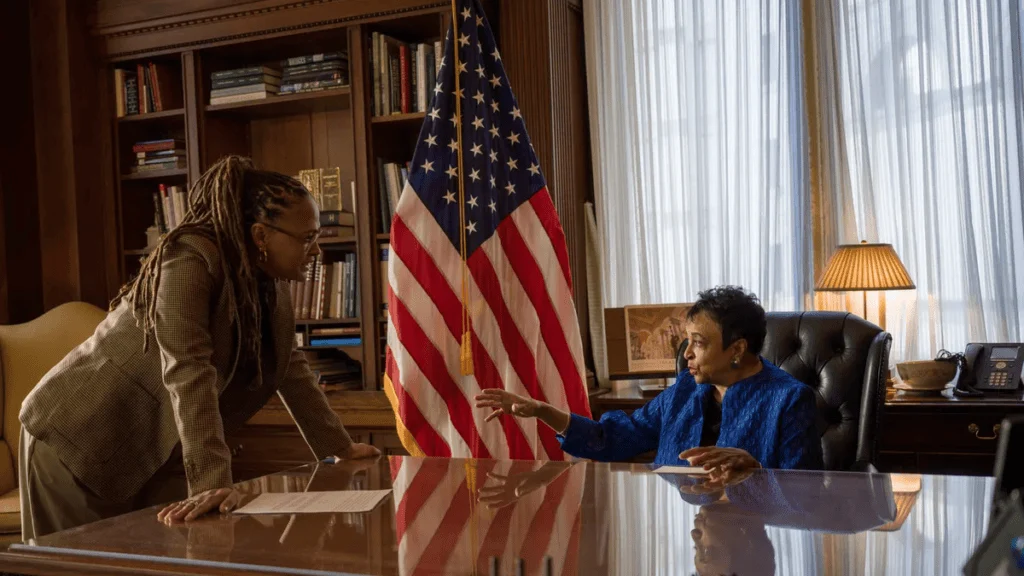
The chronology progresses through the administrative hurdles faced by various government institutions. A poignant segment of the film centers on the forced departure of Librarian of Congress Carla Hayden. Through interviews and evidentiary records, the film contrasts the official justifications for such actions with the reality of the political maneuvers behind them. This serves as a microcosm for a broader, recurring theme in the film: the removal of objective expertise in favor of partisan consolidation.
Supporting Data: Evidence in the Face of Controversy
What separates 14th from mere political commentary is its commitment to primary sources. DuVernay ensures that the weight of the film rests on the shoulders of the experts.
- Legal Perspectives: Attorney Sherrilyn Ifill provides the intellectual backbone of the film, offering a bracing analysis of the state of the judiciary and the necessity for deep-rooted constitutional reform. Her commentary serves as a guide for viewers attempting to navigate the complexities of current legal threats to civil liberties.
- The Human Cost: The film does not shy away from the visceral impact of policy. The segments regarding Immigration and Customs Enforcement (ICE) are among the most harrowing. By focusing on the faces and voices of those impacted by enforcement actions, DuVernay forces the viewer to reconcile abstract political rhetoric with the tangible human cost of these policies.
- Legislative and Academic Voices: The contributions of Stacey Abrams and Representative Alexandria Ocasio-Cortez provide a clear-eyed look at the mechanisms of legislative power and the efforts to curb voter suppression and disenfranchisement.
Official Responses and Political Implications
The documentary creates a space for a chorus of voices to weigh in on the implications of a changing America. While the film is inherently critical of the Trump administration, it maintains an objective distance by allowing the actions and quotes of the officials themselves to serve as the evidence.
The Challenge to Diversity
One of the most striking sequences in the film addresses the administration’s hostility toward diversity initiatives. The documentary captures the surreal nature of these debates, at one point featuring a comedian who highlights the absurdity of the "anti-diversity" rhetoric by painting a picture of a world where basic inclusion is treated as an illegal act. This moment of levity provides a necessary breath before diving back into the darker implications of policy, such as the systematic purging of civil servants based on ideological litmus tests.
![Film Review: 14TH: Ava DuVernay's Bold Film is an Incredible Accomplishment [NYFF 2026]](https://film-book.com/wp-content/uploads/2026/10/14th-1-1200x675-1.png)
The Loss of Freedom
The film’s most frightening assertion is that the American public is becoming desensitized to the slow erosion of civil rights. When the film captures a scene of a Senator being handcuffed, it acts as a visual metaphor for the state of the nation: a warning that if the pillars of the constitution can be bypassed at the highest levels of government, no citizen is safe from the long-term consequences.
The Societal Implications: Why ‘14th’ Matters
The ultimate power of 14th lies in its ability to force the viewer to look into the future. It is not a historical retrospective; it is a prophecy of sorts. By identifying the patterns currently emerging in the political landscape, DuVernay asks a fundamental question: at what point does the "new normal" become the permanent end of the ideals we claim to uphold?
A Call for Vigilance
The film suggests that the "Framing Fathers’" principles are not self-executing. They require an informed and active citizenry to protect them. The documentary serves as a diagnostic tool, allowing audiences to identify the symptoms of democratic decay—whether that be the politicization of neutral institutions or the degradation of the judicial branch—and understand their origins.
The Role of Art as Protest
The film concludes with the track "Makings of Tomorrow," a song that encapsulates the urgency of the message. The music serves as an emotional catharsis, underscoring the film’s central thesis: that there is still a window of opportunity to rectify the course, provided we have the courage to acknowledge the damage already done.
Critical Assessment and Conclusion
Ava DuVernay has, once again, proven herself to be one of the most vital documentarians of our time. 14th is an ambitious, exhausting, and essential piece of filmmaking. It succeeds because it refuses to be polite. It refuses to offer easy solutions to complex systemic failures, and it refuses to allow the audience to remain in a state of comfortable ignorance.
The film is not "black or white," as some political discourse might suggest. It is a nuanced look at the grey areas of governance, where small compromises in integrity eventually lead to large-scale systemic collapse. For those seeking to understand the trajectory of American politics in the 2020s, 14th is mandatory viewing. It is a mirror held up to a nation, reflecting not only the flaws of its leaders but the vulnerabilities of its people.
Rating: 9/10
14th stands as a benchmark for political documentary filmmaking. It is a stark reminder that while history is written by the victors, it is preserved by those who are brave enough to document the truth while it is still unfolding. As the film suggests, the "makings of tomorrow" are being decided today—and the window for meaningful intervention is closing fast.
Additional Commentary: The Intellectual Ensemble
The film’s effectiveness is bolstered by its eclectic cast of contributors. By blending the legal expertise of figures like Robert S. Chang with the political intuition of Stacey Abrams and the historical context provided by Eric Foner, DuVernay creates a multi-dimensional perspective. The inclusion of figures like Hasan Minhaj and Paul Mooney adds a layer of cultural critique that helps bridge the gap between academic theory and the lived experience of the American public. This diverse ensemble ensures that the film addresses the intersectionality of the issues it presents, acknowledging that the 14th Amendment’s failures do not impact all communities equally.
In closing, 14th is more than a film; it is a vital document of a tumultuous era. It is an invitation to engage, to argue, and most importantly, to act. As the credits roll, the audience is left with a sense of gravity that few films can achieve—a realization that the defense of democracy is not a one-time event, but a daily, difficult, and necessary task.
