
Into the Jaws of History: Re-Evaluating The Ghost and the Darkness Three Decades Later
By Hasitha Fernando
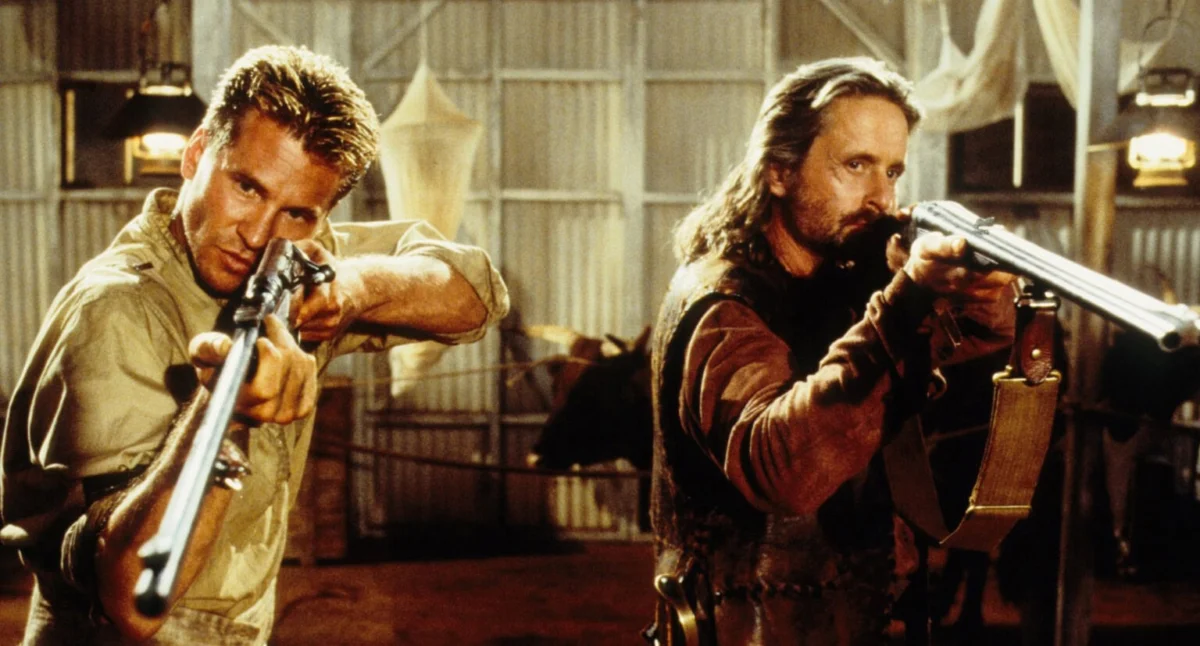
Thirty years after its theatrical release, Stephen Hopkins’ historical adventure-thriller The Ghost and the Darkness remains a fascinating anomaly of 1990s Hollywood filmmaking. Pitched initially to studio executives as a cross between Jaws and Lawrence of Arabia, the film brought together legendary screenwriter William Goldman, an all-star cast led by Val Kilmer and Michael Douglas, and a legendary production crew. Yet, despite its heavy pedigree, the film’s path from historical text to big-screen spectacle was paved with unprecedented logistical nightmares, clashing creative egos, and a troubled post-production cycle that fundamentally altered its original vision.

As the film marks its milestone anniversary, a retrospective look reveals The Ghost and the Darkness not merely as a flawed box-office disappointment, but as a uniquely atmospheric, richly textured creature feature that has rightfully earned its status as a cult classic.
Main Facts: The Legend of the Tsavo Man-Eaters
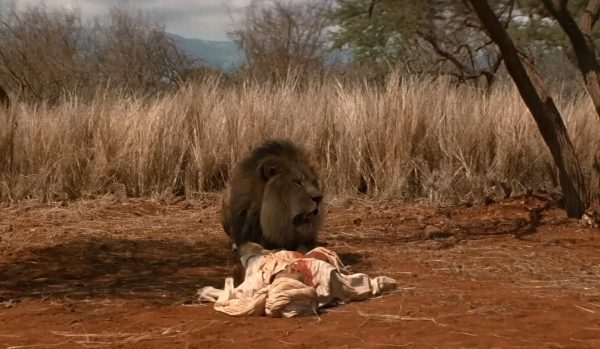
At its core, The Ghost and the Darkness is a cinematic adaptation of Lieutenant-Colonel John Henry Patterson’s 1907 semi-autobiographical account, The Man-Eaters of Tsavo. The book chronicled the harrowing nine-month period in 1898 when Patterson, a British military engineer, supervised the construction of a critical railway bridge over the Tsavo River in East Africa for the Uganda Railway. During this time, a pair of rogue, manless male lions terrorized the encampment, dragging workers from their tents and halting construction amid an atmosphere of palpable dread.

Patterson’s account has generated fierce debate among historians, zoologists, and conservationists for over a century—investigating why these particular lions developed a systematic taste for human flesh, how many people they actually killed (popularly cited as upwards of 135, though modern scientific studies suggest a lower figure), and whether biological anomalies or environmental pressures drove their behavior.
Hollywood, however, has never let historical exactitude stand in the way of a compelling narrative. Before the 1996 film, the Tsavo events inspired early cinematic ventures such as 1952’s Bwana Devil and 1959’s Killers of Kilimanjaro. But it was master screenwriter William Goldman who elevated the material into high-concept myth-making. While vacationing in Africa in 1984, Goldman encountered the legend and envisioned a screenplay that treated the predatory cats not merely as wild animals, but as supernatural manifestations of malice. As Goldman famously remarked regarding the lions:

"My particular feeling is that they were evil. I believe that for nine months, evil popped out of the ground at Tsavo."
Chronology: From Development Hell to the Big Screen
The journey of The Ghost and the Darkness from concept to completion was a grueling multi-year ordeal characterized by shifting studio leadership, cast turnover, and persistent misfortune.

1. Conception and Early Development (1984–1990)
Following his African vacation, William Goldman spent years percolating the premise before pitching it to Paramount Pictures in 1989. The studio loved the concept of Jaws set against the sprawling backdrop of colonial Africa and commissioned a script, which Goldman delivered by 1990.
2. The Director and Star Shuffle (Early 1990s)
For a prolonged stretch, the project languished in development hell. Paramount initially targeted Michael Mann to direct. When negotiations fell through, Kenneth Branagh—fresh off his directorial success with Henry V (1989)—was approached. Later, visionary filmmaker Brian De Palma was attached to direct, with Kevin Costner eyed to star as Patterson after Tom Cruise passed on the role. However, following the colossal box-office failure of De Palma’s The Bonfire of the Vanities (1990), Paramount grew risk-averse and withdrew its backing. Costner subsequently exited to star in The Bodyguard.

3. Rescue and Production (Mid-1990s)
The project found new life when actor-producer Michael Douglas moved his fledgling production company, Constellation Films, to Paramount. Captivated by Goldman’s script, Douglas stepped in to produce. Up-and-coming action director Stephen Hopkins (Predator 2) was brought on board to helm the project, and Val Kilmer—eager to work in Africa—signed on to play Patterson. When high-profile casting choices for the fictional hunter Charles Remington (including Sean Connery and Anthony Hopkins) fell through, Douglas took on the role himself, permanently altering the cinematic landscape of the film.
Supporting Data: Production Statistics and Behind-the-Scenes Realities
The production of The Ghost and the Darkness was famously plagued by dangerous environmental conditions, logistical challenges, and interpersonal tension.
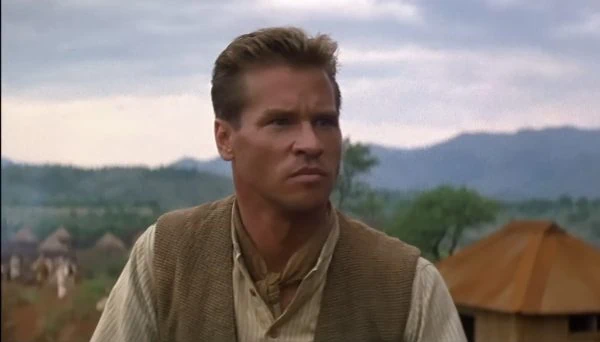
- Budget and Box Office: The film was produced on a substantial budget of $58 million. Upon its release, it brought in a modest $75 million globally, falling short of studio expectations.
- Critical Reception: The film holds a 51% approval rating on Rotten Tomatoes based on 53 reviews, reflecting a critical consensus that praised its suspenseful adventure elements while criticizing its reach for supernatural profundity.
- Accolades: Despite mixed reviews, the film triumphed at the Academy Awards, securing the Oscar for Best Sound Editing at the 69th Academy Awards. Conversely, Val Kilmer received a Razzie Award nomination for Worst Supporting Actor for his work in both this film and the troubled The Island of Dr. Moreau.
- Harrowing Conditions: Shot primarily in South Africa, the production faced relentless extreme weather. Temperatures regularly surpassed 100 degrees Fahrenheit, compounded by torrential rains, lightning storms, flash floods, and wildlife hazards. Director Stephen Hopkins noted multiple crew injuries and tragic fatalities during the shoot, including two drownings.
- The Animatronic Lions: Stan Winston Studios constructed a mechanical lion that was built 10 percent larger than a real lion to emphasize the mythic, monstrous nature of the beasts. However, this animatronic was only used for a single pivotal scene; the rest of the film utilized five trained live African lions sourced from North America and Europe.
Official Responses and Creative Friction
The collision of strong personalities behind the camera proved just as volatile as the man-eaters on screen. The dynamic between star-producer Michael Douglas and director Stephen Hopkins was tense from the outset, exacerbated by Douglas’s dual role as an executive and a lead actor.
Matters escalated dramatically during post-production. Wishing to maximize his screen presence, Douglas exercised his producer leverage to re-cut portions of the film. This decision deeply alienated screenwriter William Goldman and director Stephen Hopkins. In his memoir Which Lie Did I Tell?, Goldman lamented how expanding Douglas’s character—originally written as an enigmatic, mysterious figure named Charles Remington—stripped the character of his mythic weight, reducing what was intended to be an imposing archetype into a compromised narrative device.
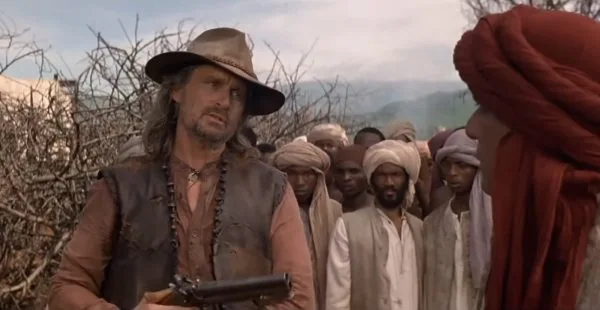
Despite initial friction with cinematographer Vilmos Zsigmond (whom producers forced onto the project instead of Hopkins’ preferred regular Director of Photography, Peter Levy), Hopkins ultimately praised Zsigmond’s breathtaking visual contributions, which imbued the African landscape with an oppressive, sun-baked majesty.
Similarly, legendary composer Jerry Goldsmith delivered a towering, ethnically textured musical score that seamlessly interwove traditional African percussion with haunting Irish folk melodies, earning universal acclaim despite being passed over for an Oscar nomination.
Implications: The Birth of a Cult Classic
Three decades later, the historical and cultural footprint of The Ghost and the Darkness has undergone a significant reassessment. While initial audiences and critics struggled to categorize its unique blend of historical drama, colonial critique, and monster-movie horror, time has been remarkably kind to the picture.
The film stands as a monument to a bygone era of Hollywood filmmaking—an era when major studios were still willing to finance original, high-budget historical adventure epics shot on location with practical effects, real animals, and sweeping orchestral scores. Val Kilmer delivers a grounded, emotionally resonant lead performance, while the tactile, physical danger captured on screen radiates through every frame, giving the creature-feature elements a visceral authenticity that CGI-heavy modern blockbusters frequently struggle to replicate.

Ultimately, The Ghost and the Darkness has transcended its troubled production history and lukewarm box-office beginnings. It endures as a masterclass in atmospheric tension, a showcase of legendary craftsmanship by artisans like Goldsmith and Zsigmond, and a thrilling cinematic monument to one of the most bizarre and terrifying true stories in human history.
What are your thoughts on The Ghost and the Darkness? Let us know on our socials @FlickeringMyth.
