
Tamron Expands APS-C Ecosystem with the Versatile 16-50mm F/2.8 A Lens
By the Editorial Team
Published: March 2026
Main Facts
Tamron has officially announced the global release of the Tamron 16-50mm F/2.8 A, a high-performance standard zoom lens engineered specifically for APS-C mirrorless camera systems. Combining a highly versatile focal range with a bright, constant f/2.8 maximum aperture, the new optic is designed to bridge the gap between casual everyday photography, professional travel documentation, and dynamic video production.
One of the most remarkable aspects of this release is Tamron’s commitment to cross-platform compatibility. The 16-50mm F/2.8 A will be made available in four major mirrorless mounts: Sony E, Canon RF, Nikon Z, and Fujifilm X. In the United States, pricing will begin at an aggressive $529, positioning the lens as an accessible, high-value alternative to OEM variable-aperture kit lenses and expensive professional glass.
Despite packing a fast constant aperture, physical weight and dimensions have been kept remarkably low. The lens weighs just 305 grams (10.8 ounces) for the Sony, Canon, and Fujifilm variants, while the Nikon Z mount version weighs a mere 315 grams. All four variations feature a uniform 55mm filter thread size, making it exceptionally easy for filmmakers and photographers to share polarizers, ND filters, and diffusion glass across mixed-camera environments.
Chronology of Development and Market Expansion
The announcement of the 16-50mm F/2.8 A marks the latest chapter in Tamron’s aggressive expansion into third-party lens manufacturing for multiple camera ecosystems.
- The Third-Party Shift: Historically known primarily for DSLR lenses, Tamron underwent a radical transformation with the rise of mirrorless technology, initially focusing heavily on Sony E-mount full-frame optics. The massive success of lenses like the 28-75mm f/2.8 Di III VXD proved that independent manufacturers could rival—and often surpass—first-party options in value and portability.
- Diversification into APS-C and Multi-Mounts: Over the past few years, Tamron has gradually broadened its portfolio to support crop-sensor bodies, recognizing a massive, underserved market of creators who want professional performance without the heavy bulk or high cost of full-frame setups.
- The Canon RF Opening: For years, Canon’s RF mount remained strictly closed to third-party autofocus lens manufacturers. As Canon began selectively licensing its protocol, independent brands gained the green light to develop native RF-S lenses. Tamron’s inclusion of a Canon RF mount version for the 16-50mm F/2.8 A is a significant milestone, representing the maturing ecosystem of cross-brand third-party options.
- Official Announcement and Rollout: Tamron formally revealed the lens in March 2026, outlining staggered release schedules depending on the specific mount. Pre-orders immediately went live through major retail partners, with initial shipments expected to hit shelves in the spring.
Supporting Data and Technical Specifications
To truly understand where the Tamron 16-50mm F/2.8 A fits into a modern creator’s bag, it is essential to examine its optical design, physical metrics, and focusing mechanics.

Focal Range and Field of View Equivalency
The 16-50mm focal length provides a flexible range stretching from wide-angle vistas to short-telephoto close-ups. Because of the sensor crop factors inherent to APS-C cameras, the full-frame equivalent field of view varies slightly by brand:
- Sony E, Nikon Z, and Fujifilm X (1.5x crop): Equivalent to a 24–75mm field of view. This is widely considered the ultimate "holy grail" standard zoom range for walk-around shooting, street photography, and documentary work.
- Canon RF-S (1.6x crop): Equivalent to an approximate 25.6–80mm field of view, offering a slightly tighter telephoto reach that is ideal for headshots and product framing.
Optical Construction and Aperture Control
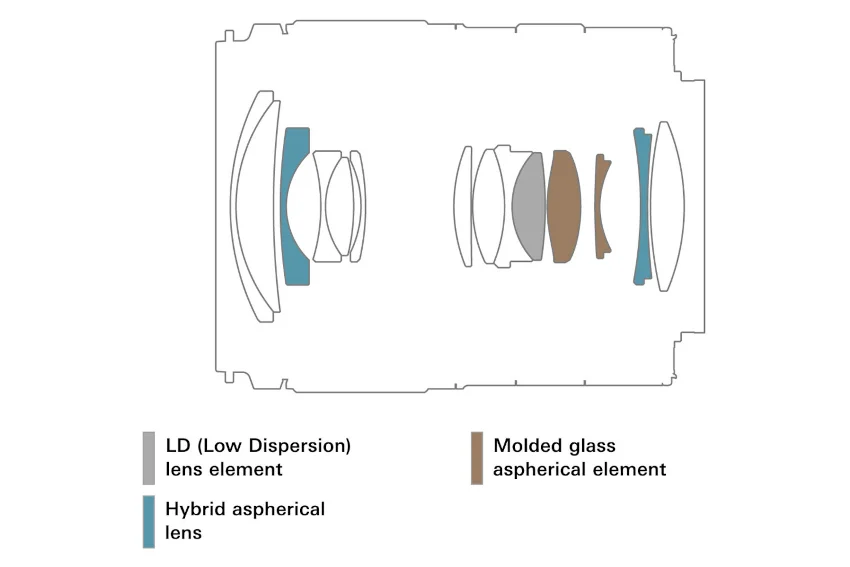
- Optical Formula: Built with 14 elements arranged in 10 groups, engineered to manage chromatic aberrations and edge-to-edge sharpness across the frame.
- Aperture Blades: A 7-blade circular diaphragm delivers smooth, rounded bokeh when shooting wide open at f/2.8.
- Aperture Range: Spans from f/2.8 down to f/16, maintaining constant light transmission throughout the entire zoom sweep.
Close-Focusing Capabilities
The lens features impressive macro-like capabilities, though it is not classified as a dedicated macro lens:
- Minimum Object Distance: 15 cm (6 inches) at the 16mm wide end; 29 cm (11.5 inches) at the 50mm telephoto end.
- Maximum Magnification Ratio: 1:4.5 at 16mm and 1:4.8 at 50mm. This allows creators to capture tight, detailed macro-style shots of food, small products, textures, and nature elements without swapping lenses.
Autofocus Performance via VXD Linear Motor
Tamron has equipped the lens with its proprietary VXD (Voice-coil eXtreme-torque Drive) linear motor focus mechanism.
- Speed and Precision: The VXD system is designed for lightning-fast, highly accurate autofocus acquisition and reliable subject tracking.
- Silence in Video: The motor operates almost silently, eliminating unwanted focus-actuator noise on audio tracks during video recording sessions.
Physical Dimensions and Weather Sealing
- Sony E: 79.6mm (3.2 inches) long, 305g.
- Fujifilm X: 79.9mm long, 305g.
- Canon RF: 77.6mm long, 305g.
- Nikon Z: 81.6mm long, 315g.
- Filter Size: Uniform 55mm across all variants.
- Build Quality: Features a moisture-resistant construction and a fluorine coating on the front element to repel water droplets, grease, and dust, simplifying field maintenance.
Official Responses and Industry Positioning
In its official product launch briefs, Tamron emphasized that the 16-50mm F/2.8 A was conceptualized to solve a common dilemma faced by hybrid content creators: the compromise between the light weight of a kit zoom and the low-light power of professional glass.
Industry analysts and early-access reviewers have noted that Tamron is directly targeting photographers and videographers using bodies like the Sony a6700, Fujifilm X-T5, Nikon Zfc/Z50, and Canon EOS R7/R50. By offering a constant f/2.8 aperture in a package that weighs roughly 300 grams, Tamron aims to capture the market of creators who prioritize ergonomic mobility—such as travel vloggers, mobile journalists, street shooters, and event videographers operating on gimbals.
While official statements from Tamron note the inclusion of moisture-resistant sealing, the company has transparently stated that the lens is not waterproof. Furthermore, early technical specifications do not explicitly quantify focus breathing metrics or optical image stabilization (OIS), meaning creators relying on manual focus pulls or un-stabilized camera bodies will need to evaluate these characteristics based on real-world reviews.

Implications for Photographers, Videographers, and the Market
The introduction of the Tamron 16-50mm F/2.8 A carries several notable implications for the broader photographic landscape:
1. The Death of the Traditional Variable-Aperture Kit Lens?
For years, buying an APS-C camera meant accepting a slow, variable-aperture kit zoom (such as an f/3.5-5.6 lens) that struggled indoors and rendered muddy background separation. At an introductory price point of $529, lenses like Tamron’s new offering make professional-grade light-gathering capabilities accessible to entry-level enthusiasts, potentially phasing out interest in cheap, uninspiring kit glass.
2. A Boon for Lightweight Filmmaking and Gimbal Users
For solo videographers, weight distribution is everything. Balancing a heavy full-frame rig on a compact motorized gimbal can lead to wrist fatigue and motor strain. A sub-315g lens with a constant f/2.8 aperture allows filmmakers to build featherlight video packages that can be packed into a small shoulder bag, run all day on a light gimbal, and perform admirably in dim restaurant interiors or moody event venues.
3. Strengthening Third-Party Ecosystems Across Brands
The inclusion of Canon RF, Nikon Z, and Fujifilm X alongside Sony E proves that third-party manufacturers are no longer content catering to a single ecosystem. As lens mounts become more universally supported by independent optics, consumers enjoy greater freedom of choice, knowing they aren’t "locked in" to an expensive first-party upgrade path if they decide to switch camera brands down the line.
Conclusion
The Tamron 16-50mm F/2.8 A stands out as a pragmatic, high-performance tool for modern visual storytellers. By pairing a universally loved focal range with a bright constant aperture, weather-resistant engineering, swift linear autofocus, and a featherlight footprint, Tamron has delivered a compelling option that will likely become a permanent fixture in countless camera bags worldwide.
