
One Take Wonders: How Julianne Moore and Paul Giamatti Stunned Director Jesse Eisenberg on the Set of ‘The Debut’
Main Facts: A Masterclass in Efficiency on an Independent Set
In the often-chaotic world of independent filmmaking, where every dollar counts and time is an excruciatingly limited resource, efficiency is the holy grail. For writer-director Jesse Eisenberg, that elusive dream became a reality on the set of his latest cinematic venture, The Debut. Featuring two acting powerhouses—Academy Award winner Julianne Moore and Oscar nominee Paul Giamatti—the production experienced a level of professional precision that even seasoned industry veterans rarely witness.
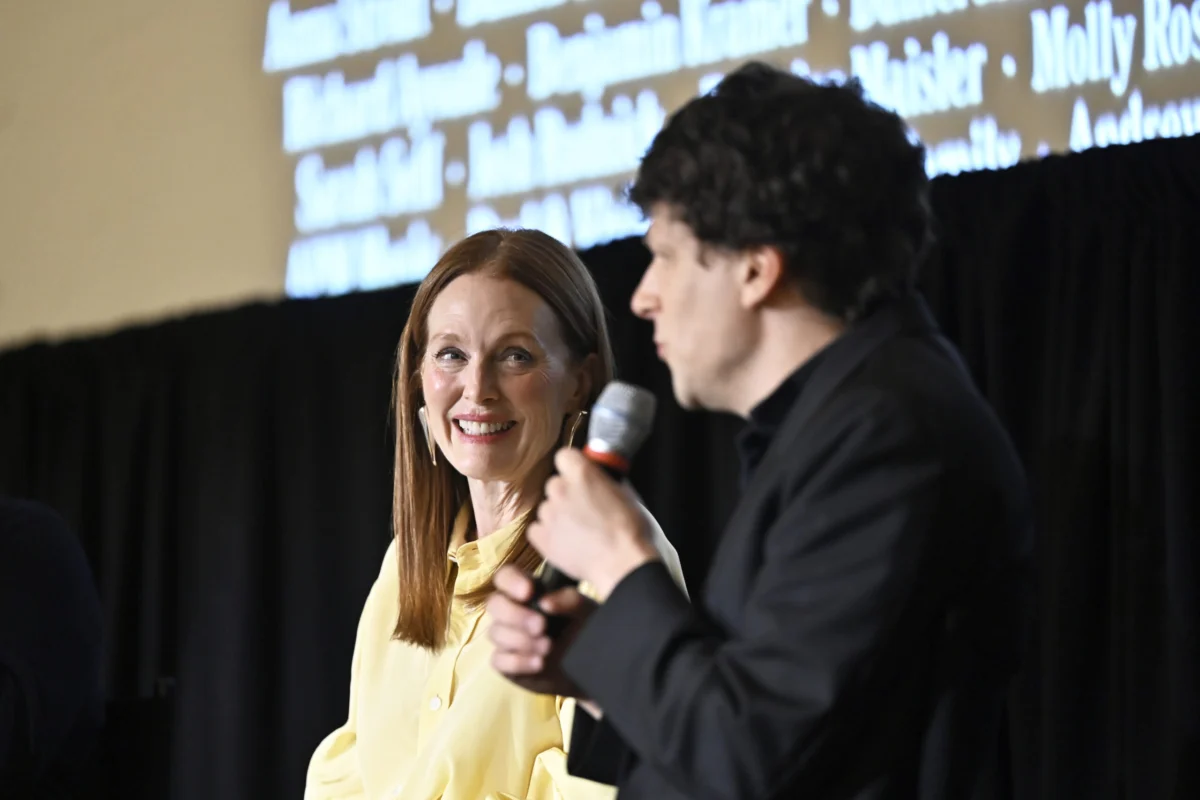
Speaking to an enthusiastic audience at the prestigious Middleburg Film Festival, where The Debut proudly served as the opening-night selection, Eisenberg pulled back the curtain on what it was like to direct two of the most respected performers of their generation. Seated alongside Moore during the festival panel, Eisenberg marveled at his lead actors’ uncanny ability to nail complex scenes—complete with intricate dialogue, synchronized choreography, and challenging physical props—on the very first try.
For Eisenberg, whose directorial profile has been rapidly ascending following his acclaimed work on A Real Pain, the experience shattered conventional filmmaking norms. While most major motion pictures require principal actors to push through five, six, or even ten takes to dial in their comfort levels with blocking, lighting, and line delivery, The Debut operated under an entirely different paradigm. Because Moore and Giamatti delivered near-flawless performances almost immediately, the production saved precious time, kept its modest independent budget secure, and dramatically accelerated its shooting schedule.
Chronology: From Concept to Middleburg’s Opening Night
The journey of The Debut has been marked by rapid development, ambitious creative swings, and eventual triumph on the autumn film festival circuit.
- Pre-Production and Casting: Jesse Eisenberg, transitioning further into the realm of writer-director-songwriter, assembled an enviable cast. Securing Julianne Moore and Paul Giamatti immediately elevated the project from a standard indie endeavor to a high-profile cinematic event. However, despite the towering talent attached, the film remained fiercely independent with a tightly constrained budget.
- Principal Photography: As production commenced, the realities of a low-budget independent schedule set in. The crew had mapped out an aggressive and demanding timeline—including a heavily choreographed, eight-day block dedicated entirely to massive musical numbers and complex ensemble sequences.
- The On-Set Breakthrough: Almost immediately, the schedule was upended—in the best way possible. Thanks to the extraordinary proficiency of Moore and Giamatti, the meticulously planned eight-day musical block was executed and completed in a staggering single day. Scenes that directors typically labor over for hours were wrapped after just one or two takes because the initial execution left nothing to be desired.
- Fall Festival Circuit Debut: Transitioning from the editing suite to the red carpet, The Debut was selected as the coveted opening-night film at the Middleburg Film Festival. The screening drew rave reviews, setting the stage for broader conversations about the film’s unique blend of humor and musical elements.
- The Middleburg Panel Reveal: During a post-screening discussion, Eisenberg publicly detailed the miraculous efficiency of his stars, offering film fans a rare glimpse into the mechanics of low-budget, high-talent filmmaking.
Supporting Data: The Economics and Mechanics of One-Take Filmmaking
To fully appreciate Eisenberg’s astonishment, one must understand the operational realities of modern independent cinema. Financial parameters dictate that every hour spent on a soundstage or location carries a measurable dollar amount. When a scene requires multiple retakes, production costs compound rapidly through overtime crew pay, equipment rentals, and location fees.
The Math of Independence
- Budgetary Constraints: As Eisenberg candidly noted in previous interviews with IndieWire, The Debut is a small-budget movie. "[Nobody got paid oodles of money]," he remarked, emphasizing that the project relied on artistic passion and professional goodwill rather than blockbuster financing.
- Time Compression: The decision to pivot when an actor is "good" is a survival mechanism in indie filmmaking. Eisenberg explained his philosophy bluntly: "When they were good, we would go to the next scene."
- Celluloid and Digital Preservation: In the era of digital cinematography, "wasting film" has transformed into wasting storage, compute power, and—most importantly—time. Eisenberg noted that after viewing a flawless first take, the internal calculation for a director becomes simple: "We can do it again, but we would waste film? It’s perfect."
The Musical-Number Miracle
Perhaps the most striking statistical anomaly of The Debut production was the collapse of the shooting schedule for its musical sequences. Musical numbers inherently demand exhaustive repetitions to sync vocals, playback, choreography, and camera movement.

- Scheduled Time: 8 days allocated for ensemble musical numbers.
- Actual Time: 1 day required to capture the required footage.
- Efficiency Gain: An 87.5% reduction in scheduled time for some of the film’s most logistically complex sequences, directly preserving the film’s financial stability.
Official Responses and Industry Insights
The revelation at Middleburg sparked considerable discussion among industry insiders, film critics, and aspiring filmmakers alike. The synergy between a director known for his hyper-articulate, neurotic screen presence and actors renowned for their chameleonic depth created a uniquely collaborative environment.
Julianne Moore, listening intently as Eisenberg sang her praises on stage, represents the pinnacle of Hollywood longevity. With an Oscar for Still Alice, four additional nominations, and decades of transformative performances ranging from Far from Heaven to Boogie Nights, Moore brings a level of technical mastery that allows her to inhabit characters instantaneously.
Similarly, Paul Giamatti—whose celebrated career spans searing independent dramas like Sideways and American Splendor to populist hits and recent awards glory with The Holdovers—is widely regarded as a actor’s actor. Though Giamatti was unable to attend the Middleburg panel due to illness, his absence did little to diminish the collective awe directed at his craft.
Eisenberg’s comments highlight an ongoing industry conversation about the merits of spontaneity versus perfectionism. While some legendary auteurs—such as David Fincher or Stanley Kubrick—are famous for demanding dozens, sometimes scores, of takes to achieve a specific psychological state or mechanical precision, Eisenberg’s experience on The Debut proves that lightning can, indeed, strike on the very first try when paired with elite-tier preparation and talent.
"I feel like I have trouble describing this to people who don’t make movies every day, because it’s so unusual," Eisenberg reiterated to the Middleburg audience, emphasizing that the baseline expectation in Hollywood is a slow, iterative climb toward a usable take. Finding actors who can instantly merge technical blocking, emotional authenticity, and prop manipulation on take one is, in his words, an extreme rarity.
Implications: What The Debut Signals for Eisenberg’s Directorial Future
As Jesse Eisenberg continues to carve out a formidable second act as a writer-director, the lessons learned from The Debut will undoubtedly shape his creative trajectory. Having earned recent Oscar buzz for A Real Pain, Eisenberg has proven that his distinct comedic voice and emotional acuity translate seamlessly behind the camera.

1. Attracting Top-Tier Talent
The glowing endorsement from a director known for high intellectual standards serves as a powerful beacon for other heavyweight actors. Performers want to work with directors who respect their preparation and trust their instincts. Knowing that Eisenberg can run an efficient, respectful, and actor-friendly set—while still achieving cinematic excellence—makes him an exceptionally attractive collaborator in the independent sphere.
2. Redefining the Indie Playbook
The Debut offers a case study in how to maximize limited financial resources through sheer performance caliber. By refusing to burn resources on unnecessary safety takes, an indie production can redirect funds toward post-production, sound design, or securing music licensing rights (crucial for a comedy-musical hybrid).
3. The Evolution of Eisenberg’s Creative Voice
Expanding into songwriting and directing musical sequences introduces new variables to Eisenberg’s artistic portfolio. By navigating these complex waters successfully—and doing so in a fraction of the expected time—he has demonstrated a logistical adaptability that matches his narrative ambition.
Ultimately, The Debut stands not only as an anticipated highlight of the modern indie landscape but also as a testament to the staggering power of professional mastery. When actors of Julianne Moore and Paul Giamatti’s caliber step onto a set, they don’t just act—they redefine what is possible in a single breath, a single frame, and a single take.
