
The Filmmaker’s Digital Sandbox: Why "Beat" is Changing the Pre-Production Landscape
In an era defined by subscription fatigue, cloud-locked ecosystems, and aggressive data harvesting, the professional creative software market has become increasingly restrictive. Filmmakers, long accustomed to paying monthly premiums for project management tools that often feel bloated or disconnected from the actual physical needs of a set, have found an unexpected savior. Enter Beat, a local-first, free macOS application that is quietly revolutionizing how directors, cinematographers, and production designers bridge the gap between abstract storytelling and technical execution.
Developed by João Lutz, a filmmaker and creative director based in São Paulo, Brazil, Beat is not just another planning app—it is a manifesto against the current state of software-as-a-service (SaaS). With a core philosophy centered on privacy, portability, and pure functionality, Beat offers a comprehensive suite of tools that allows creators to map out stories, design lighting rigs, and utilize AI integration without ever surrendering control of their data.
The Genesis of Beat: A Filmmaker’s Solution
From Frustration to Functionality
The development of Beat did not emerge from a boardroom of software engineers looking to capture a market share; it was born from the lived experience of a practitioner. João Lutz encountered the same hurdles every filmmaker faces: the fragmentation of the pre-production workflow. Storyboards often live in one app, scripts in another, and complex lighting diagrams are frequently relegated to cumbersome CAD software or—worse—hand-drawn sketches on napkins.
Lutz recognized that the "local-first" philosophy was the missing ingredient. By building an application that lives entirely on the user’s hard drive, he ensured that projects remain the property of the creator. There are no accounts to create, no servers to log into, and no tracking cookies monitoring creative progress. It is a "no strings attached" utility that respects the sanctity of the filmmaker’s intellectual property.
Chronology of the Project
The project’s trajectory has been one of grassroots adoption. Initially conceived as a personal workflow optimization tool, the software quickly gained traction within Lutz’s professional circles before being released as a public utility.
- Initial Conception: Lutz identifies the lack of an integrated "node-based" canvas that allows for both creative narrative work and technical set planning.
- The Development Phase: Focus was placed on the "infinite canvas" architecture, allowing users to zoom out from the broad strokes of a three-act structure to the granular details of a specific lighting fixture’s beam falloff.
- Beta and Refinement: Through iterative testing, the app integrated media handling, allowing users to scrape images and video directly from the web—a critical feature for mood boarding.
- The AI Integration: With the rise of Large Language Models (LLMs), the decision was made to integrate Claude AI. Crucially, the integration was designed to be local-first, utilizing the Model Context Protocol (MCP) so the AI could "read" the project files without requiring the user to copy-paste sensitive script data into external web browsers.
The Architecture of Creativity: Features and Workflow
The Infinite Canvas
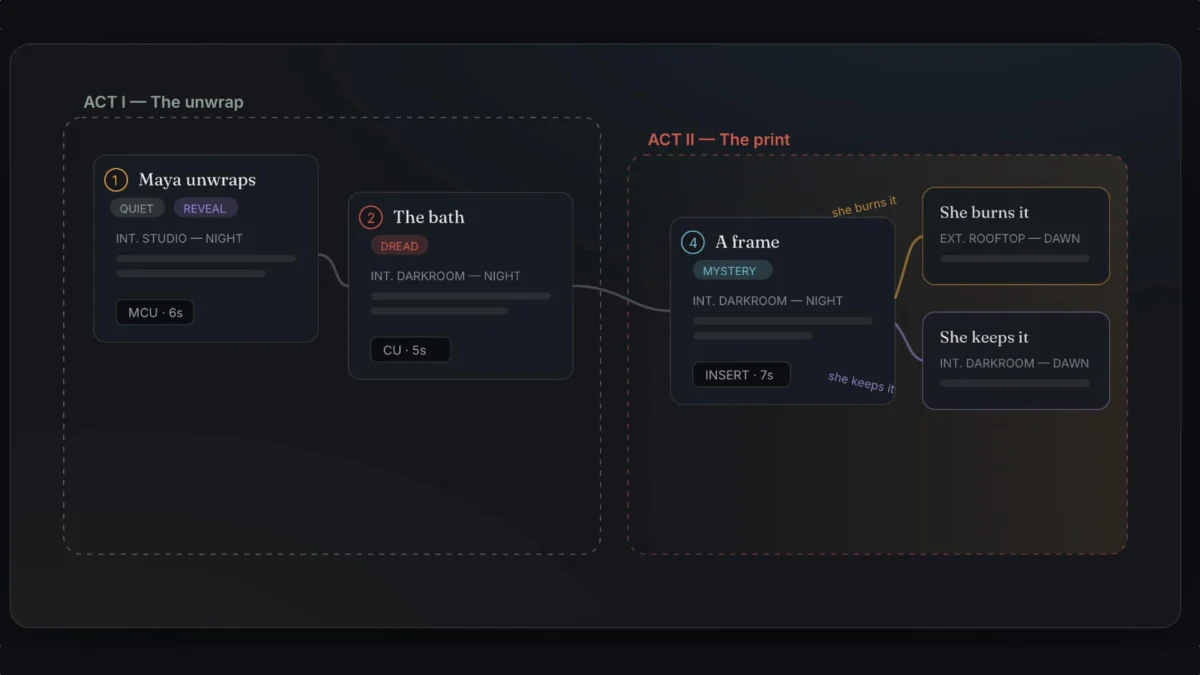
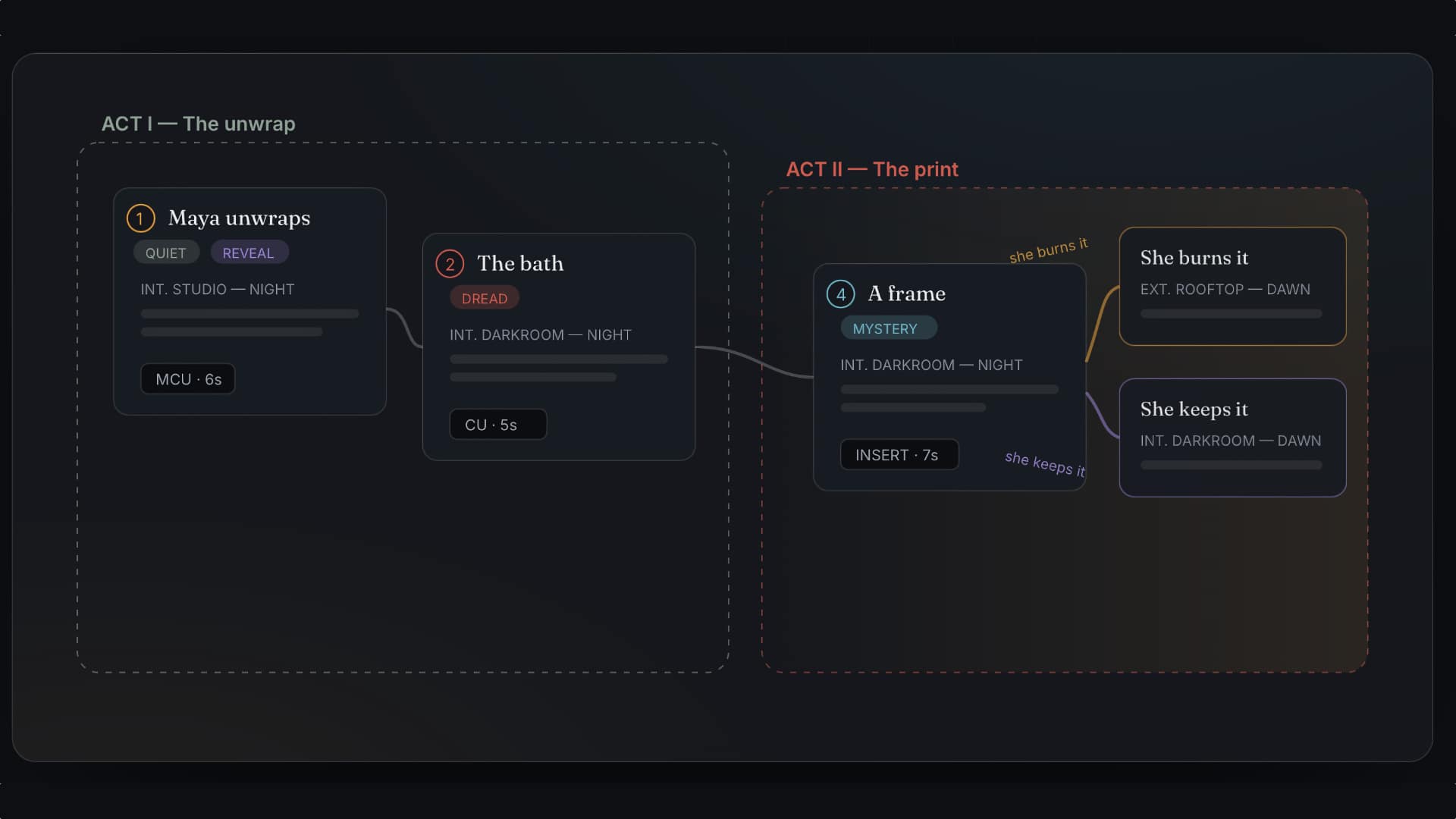
At the heart of Beat lies a node-based visual canvas. Unlike traditional linear software, which forces a rigid structure, Beat treats story beats as modular, movable entities. A user can create a "spine" for their narrative, then branch off into alternate versions of a scene side-by-side.
This environment is highly metadata-rich. Each beat can contain:
- Narrative Elements: Slug lines, tone, and character notes.
- Technical Metrics: Shot type, duration, and a live, ticking runtime meter that updates as the script evolves.
- Templates: For those struggling with structure, the app includes pre-built frameworks like the Hero’s Journey, Save the Cat, and the Story Circle, which can be dragged and dropped into the canvas to provide an immediate structural foundation.
The Media Pool and Web Integration
The app’s ability to pull references directly from the internet is a massive time-saver. By leveraging a built-in player, users can capture stills or GIFs from web-based video content frame-by-frame. This allows a director to curate a visual lexicon for their project without the tedious "screenshot-and-upload" loop, ensuring that the "look" of the film is tethered directly to the shots that require it.
Technical Precision: The Set Planner
Lighting and Blocking at Scale
Perhaps the most impressive facet of Beat is the Set Planner. While many apps stop at simple floor plan layouts, Beat introduces a physics-lite approach to lighting and blocking.
Users can model rooms in real-world scales (meters or feet). The "Cameras" tool accounts for the actual field of view based on the chosen focal length, allowing a cinematographer to see exactly what will be in the frame before they ever step onto a soundstage.
The lighting fixtures are remarkably granular. Users can deploy:
- Hardware: Softboxes, Fresnels, LEDs, Kinos, China balls, and practicals.
- Parameters: Each light includes adjustable beam falloff, color temperature (Kelvin), and intensity.
- Simulation: The software simulates how light interacts with the environment—bouncing off walls, passing through windows, or being blocked by flags and diffusion.
This turns the app into a powerful pre-visualization tool, allowing the Director of Photography to demonstrate the lighting setup to the gaffer or the production designer with professional-grade accuracy.
The Role of AI in the Modern Workflow
Claude AI and MCP Integration
The integration of Claude AI via the Model Context Protocol (MCP) represents a forward-thinking approach to generative technology. Most AI-assisted writing tools require the user to copy and paste text into a browser window, which breaks the flow and poses security risks.
Beat’s approach is different. The AI is "project-aware." Because the app operates on the local file system, the AI can be granted read/edit access to the project’s actual data structure. This allows for nuanced, context-aware suggestions. Whether a filmmaker needs to refine dialogue, analyze the pacing of a scene, or troubleshoot a narrative hole in their story spine, the AI acts as a collaborative partner that understands the totality of the project.
Implications for the Industry
Disrupting the SaaS Paradigm
The existence of Beat challenges the assumption that professional tools must come with a monthly subscription fee. By providing a high-end, feature-rich application for free, Lutz is signaling that there is a viable path for "independent" software development that prioritizes the user over the shareholder.
For the freelance filmmaker, this is a significant development. It reduces the overhead costs of pre-production, enabling those with smaller budgets to produce high-level planning documents that were previously only available to those using expensive, corporate-tier software.
The Security and Privacy Advantage
In an industry where scripts, storyboards, and project concepts are highly sensitive intellectual property, the "local-first" model is the ultimate competitive advantage. When a project exists only as a folder on a hard drive, the risk of a cloud-based data breach or a server-side outage disappears. The user is in total control of their backup strategy and their project’s security.
Professional Utility
While the app is free, it is not "lite" software. The level of detail in the Set Planner and the robustness of the node-based canvas make it a viable alternative for professional production environments. As adoption grows, we are likely to see Beat become a standard for indie productions, commercial shoots, and short films where time and budget efficiency are paramount.
Official Stance and Future Outlook
The creator’s pitch is as refreshing as his product: "Completely free. Not for sale. No account, no tracking. Your files stay yours." This statement resonates deeply with a generation of creators who are tired of being treated as data points for analytics companies.
By refusing to monetize through user data, Lutz has built a tool that earns its keep through utility rather than coercion. The software is currently available for download at beatforfree.com, distributed via a simple file transfer method that reinforces its commitment to simplicity.
Looking ahead, the potential for Beat to grow is immense. As the community of users expands, the demand for more templates, more fixture types, and more advanced AI integrations will likely grow with it. However, the core identity of the app—a private, local, and filmmaker-centric canvas—remains the foundation.
Final Thoughts
Beat serves as a reminder that the best tools are often those that understand the user’s craft from the inside out. By bridging the gap between the creative (story beats) and the technical (lighting diagrams and shot planning), João Lutz has created a unified ecosystem that actually makes the process of filmmaking more intuitive.
In a market saturated with complex, expensive, and invasive software, Beat stands out as an essential tool for the modern filmmaker. It is a testament to the power of open, thoughtful design—and a challenge to every other software developer in the industry to rethink how they serve the creative community. For those tired of the "locked-in" nature of current production software, Beat offers a liberating, powerful, and entirely free alternative. Whether you are a student filmmaker sketching your first short or a seasoned pro planning a feature, Beat provides the canvas; the rest is up to your imagination.
