
Bringing the Bear to Life: The Technical Mastery Behind Season 2 of Ted
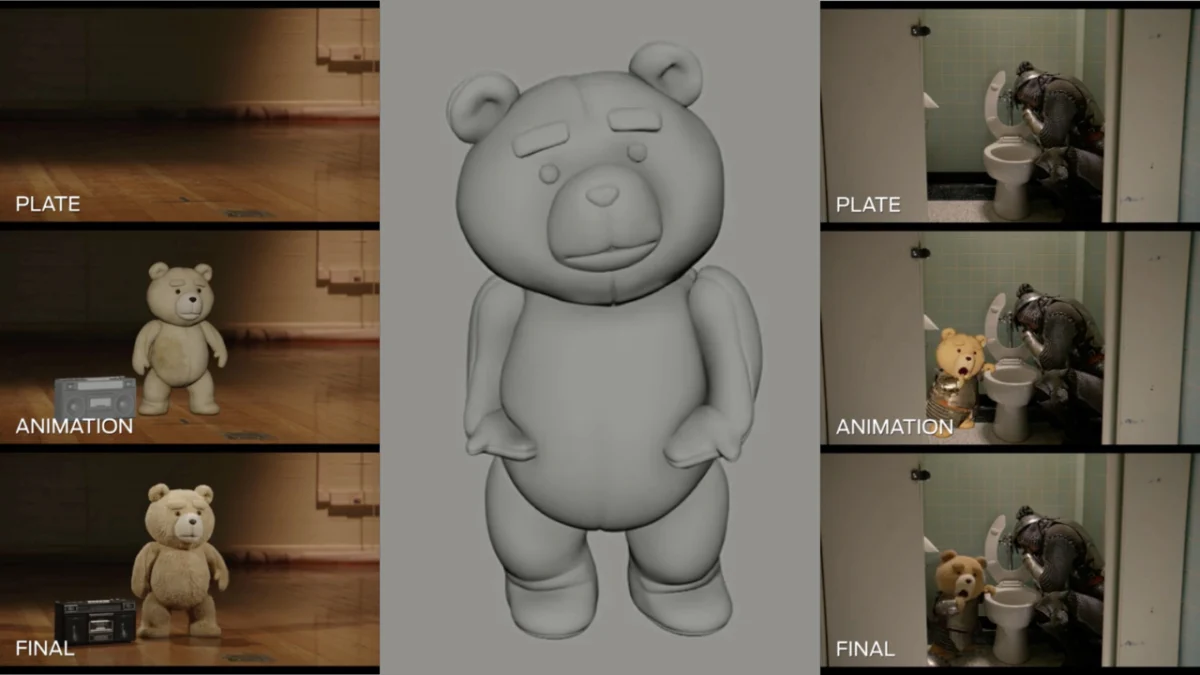
In the landscape of modern television, few characters present a more daunting technical challenge than a foul-mouthed, sentient teddy bear. In the second season of Seth MacFarlane’s Ted series, the production team faced the perennial obstacle of blending a CG character into a live-action world while maintaining the razor-sharp comedic timing that MacFarlane’s audience demands.
Today, on the befores & afters podcast, we peel back the curtain on this intricate process. Joining us are visual effects (VFX) supervisors Hoyt Yeatman and Blair Clark, who provide an exhaustive look at how they bridged the gap between a "stuffy" on set and a fully realized performance by Framestore. Beyond the animation, the production team shares the untold story of their pivot toward cutting-edge artificial intelligence to solve a particularly complex cameo: the appearance of Bill Clinton.
The Foundation: Crafting Comedy Through CG
The "Stuffy" Process and On-Set Dynamics
The creation of Ted begins long before the render farm starts humming. For the actors on set, the challenge is maintaining a conversational rhythm with an inanimate object. Yeatman and Clark emphasize that the success of the character hinges on the "stuffy pass"—a technical requirement where a physical reference prop (the stuffy) is placed on set to provide lighting, eyeline, and interaction cues for the cast.
"It’s not just about having a bear in the room," says Yeatman. "It’s about having a bear that respects the physics of the environment." This means every scene is shot multiple times: once with the actor interacting with the prop, and once as a "clean" plate to allow for the digital character to be composited into the frame later. The synergy between the actors and the VFX team is paramount; if the lighting on the stuffy doesn’t match the ambient light of the set, the illusion collapses.
Framestore’s Animation Pipeline
Once the live-action plates are captured, the data is handed over to the animation wizards at Framestore. The goal is to imbue Ted with a soul. Because Ted is a teddy bear, his facial expressions are inherently limited by his fabric construction. The team must rely on subtle shifts in posture, ear movement, and mouth placement to convey nuanced emotions.
"The humor is in the timing," Clark explains. "If the animation is even a frame too slow, the joke misses the landing." Framestore’s pipeline involves high-fidelity fur simulation, which requires significant computational power, as each individual strand must react to the character’s movements and the lighting conditions of the scene.
The Clinton Cameo: A Pivot to Deepfake Technology
One of the most discussed segments of the season is the surprise appearance of Bill Clinton. For a show that prides itself on realism, the team initially attempted to achieve the effect using traditional prosthetic make-up and standard CG compositing.
The Failure of Traditional Methods
Initial tests with make-up and traditional digital warping proved insufficient. The uncanny valley effect—where a digital likeness looks almost human but feels "off"—was in full force. The team realized that to truly sell the performance of Seth MacFarlane portraying Bill Clinton, they needed to move beyond traditional CG modeling.
The AI Revolution
Faced with a deadline and a high creative bar, the production turned to emerging AI-driven deepfake techniques. By training a neural network on hours of archival footage of Bill Clinton, the team was able to map MacFarlane’s facial movements onto the former president’s likeness with unprecedented accuracy.
This approach was not merely a shortcut; it was a necessary evolution in visual effects. The AI allowed the team to capture the micro-expressions—the subtle lip quivers and eye movements—that are nearly impossible to animate by hand. The result is a performance that feels organic, reactive, and, most importantly, believable within the comedic context of the show.
Chronology of Production
- Pre-Production: VFX supervisors work with the script to identify interaction points for Ted. Stuffy prototypes are designed to match the physical scale of the final CG model.
- Principal Photography: Scenes are shot with both the "stuffy pass" and clean plates. Actors practice timing with the physical prop to ensure natural conversation.
- Animation (Framestore): The animation team begins rigging the digital Ted, focusing on fur dynamics and facial performance.
- The Clinton Challenge: Initial attempts at a traditional Bill Clinton cameo are deemed unsatisfactory by the creative team.
- AI Integration: The VFX team pivots to deepfake technology, training an AI model on historical footage to achieve a photorealistic likeness.
- Compositing and Final Polish: The final CG layers are integrated into the live-action footage, with color grading applied to unify the digital and real-world elements.
Supporting Data and Technical Challenges
The technical overhead of Ted is massive. Framestore reported that the fur simulation alone required thousands of hours of render time. When discussing the AI deepfake implementation, Yeatman noted that the primary challenge was the "source material variability." Because archival footage of Bill Clinton varies in resolution and lighting, the AI had to be "taught" to normalize these variables to ensure the final output looked consistent throughout the scene.
| Component | Technology Used | Primary Challenge |
|---|---|---|
| Ted (Body) | Maya/RenderMan | Fur interaction & lighting |
| Ted (Face) | Proprietary Animation Rig | Micro-expression nuance |
| Bill Clinton | AI-Driven Deepfake | Realistic skin texture & motion |
| Environment | HDR Lighting Capture | Matching real-world set lighting |
Official Responses and Perspectives
When asked about the ethical implications of using deepfake technology, the production team remains focused on the creative intent. "Our goal was never to deceive, but to facilitate a performance," Clark clarifies. "In the context of a comedy series, the viewer knows they are watching a curated experience. The AI was just another tool in our kit, much like a green screen or a digital camera."
The production team also notes that Seth MacFarlane himself was deeply involved in the process, providing the reference performances that fueled both the CG animation and the AI training data. His ability to mimic the cadence of other public figures was the vital catalyst that made the deepfake approach viable.
Implications for the Future of VFX
The production of Ted Season 2 marks a significant milestone in the television industry. It demonstrates that the line between "traditional" VFX and "AI-generated" content is blurring. For future productions, this suggests a move toward hybrid workflows where the speed and accuracy of machine learning are used to augment, rather than replace, the artistic talent of human animators.
The Democratization of High-End Effects
As AI techniques become more refined and accessible, we may see smaller productions achieving visual fidelity that was previously the exclusive domain of blockbuster films. However, the befores & afters discussion serves as a reminder that technology is only as good as the creative team wielding it. The soul of the show—the character of Ted—still relies on the meticulous work of animators who understand the timing of a joke and the weight of a performance.
Ethical Considerations
While the use of deepfake technology in Ted was used for comedic effect, it raises broader questions about digital likeness and intellectual property. As the technology matures, industry standards regarding the use of AI to replicate public figures will likely become a point of contention for guilds and unions. For now, the team behind Ted has set a high bar for how these tools can be used ethically and effectively to enhance storytelling.
Conclusion
The second season of Ted is more than just a crude comedy; it is a technical showcase. By successfully blending traditional character animation with state-of-the-art AI deepfake techniques, the production team has pushed the boundaries of what is possible in episodic television. Whether it is the subtle fur-dynamics of a teddy bear or the eerily accurate digital recreation of a president, the work of Hoyt Yeatman, Blair Clark, and the team at Framestore proves that the future of visual effects is not just about "making it look real"—it’s about making it feel real.
To hear the full conversation and learn more about the technical nuances, listen to the latest episode of the befores & afters podcast. For a visual breakdown of the VFX pipeline, visit the Framestore website.
