
Beyond the Prompt: Autodesk Flow Studio Redefines Generative AI for Filmmakers with Directable 3D Control

By Tech & Film Industry Desk
Published: August 2026
Main Facts: Bridging the Gap Between Generative AI and Directorial Control
For all the dizzying progress made by generative video models over the past few years, a persistent bottleneck has continued to frustrate professional filmmakers: the tyranny of the text prompt. While modern artificial intelligence can conjure up breathtaking cinematic imagery from a few descriptive words in seconds, it has historically lacked the precision, spatial coherence, and directability required on a professional film set.
Autodesk is looking to shatter that limitation. With the rollout of Autodesk Flow Studio, the software giant is pivoting away from purely prompt-driven video generation toward a hybrid workflow that combines interactive 3D scene construction with the visual power of generative 2D models.
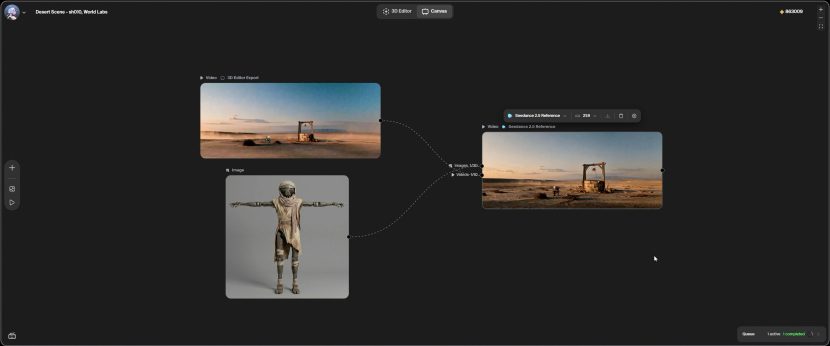
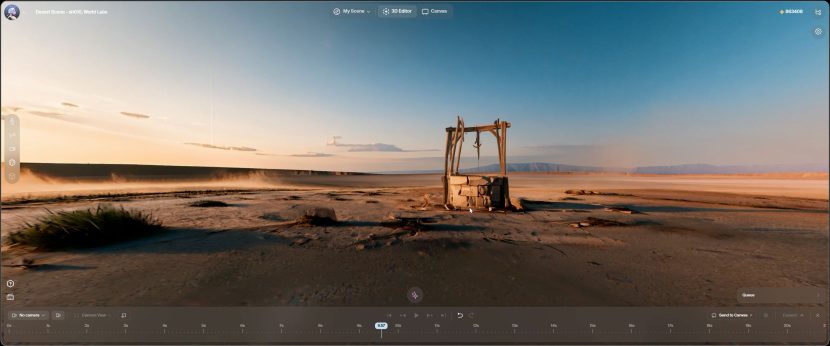
At the center of this new ecosystem is the 3D Editor + Canvas, a dual-environment system that allows creators to direct scenes in three-dimensional space—positioning cameras, blocking actors, shaping physical performances, and locking down compositions—before handing the heavy lifting of lighting, atmospheric texturing, and simulation over to AI.

Rather than aiming to "make an entire movie from a single prompt," Autodesk Flow Studio is engineered to integrate AI safely and predictably into established production pipelines. By empowering creators to control the staging, performance, and camera movement first, Flow Studio addresses the creative community’s most common critique of generative tools: that they produce unpredictable, generalized "AI slop" devoid of intentional artistry.
Chronology: The Evolution from Wonder Dynamics to Autodesk Flow Studio
To understand the architectural philosophy behind Flow Studio, one must look at the lineage of the engineering team driving it.
- The Wonder Dynamics Era: The foundational roots of this technology trace back to Wonder Dynamics, an AI company co-founded by Nikola Todorovic. The original Wonder Dynamics platform was an ambitious leap forward in computer vision and machine learning, combining roughly 25 distinct AI systems to automatically detect actors in live-action footage and seamlessly replace or integrate CG characters with accurate lighting and composition.
- The Autodesk Acquisition: Recognizing the potential to scale these computer-vision and generative breakthroughs into an industry-standard production suite, Autodesk acquired Wonder Dynamics, absorbing Todorovic and his engineering team into its broader ecosystem.
- The Birth of Flow Studio: Following the acquisition, the team set out to solve a larger problem: moving beyond simple object replacement to complete, controllable scene generation. This development cycle culminated in the introduction of Flow Studio and its core innovations—the 3D Editor and the node-based 2D Canvas.
- Integration with Spatial Computing Partners: As the platform evolved, Autodesk integrated cutting-edge spatial capture technologies. Notably, partnerships with innovators like World Labs (leveraging tools like Marble) allowed Flow Studio to incorporate spatially coherent environments—such as Gaussian splat-based worlds—directly into the layout and camera design process.
- The 2026 Launch & Podcast Reveal: In the latest fxpodcast, Nikola Todorovic detailed the operational mechanics of Flow Studio’s new architecture, charting its course from an experimental concept to a cloud-backed production platform ready for deployment across indie and studio pipelines alike.
Supporting Data & Technical Architecture: How Flow Studio Operates
Flow Studio’s technical infrastructure is built to balance the rigorous demands of traditional computer graphics with the rapid inference capabilities of modern generative models.
The 3D Editor vs. The 2D Canvas
The platform is split into two complementary environments, designed to give artists the right tool for the job at any given stage of production:

- The 3D Editor: Creators assemble shots using characters, animation data, motion-capture streams, camera tracks, and generated environments. Artists can mix and match sources—for instance, pulling performance data from one reference video and camera movement tracks from another, or keyframing virtual cameras by hand. Spatially coherent worlds built via Gaussian splats provide accurate geometry for blocking and layout.
- The Canvas: Once the physical staging is locked, artists move into Canvas, a node-based 2D environment where state-of-the-art generative video models take over. These models handle what they do best: integrating cinematic lighting, rendering atmospheric simulations, and applying final photographic finishes.
Performance Metrics and Cloud Infrastructure
- Cloud-Native Interactivity: Flow Studio operates as a cloud-backed service. The 3D Editor is engineered to maintain high interactivity, ensuring that spatial adjustments happen in real time.
- Processing Latency: Generation times within the Canvas vary depending on the chosen AI model, shot length, and target resolution. Meanwhile, complex world-generation tasks—such as processing Gaussian splat environments—currently take several minutes to compile.
- The 80/20 Rule of AI: According to Todorovic, generative tools are exceptional at delivering the first 80 percent of an asset or shot with minimal friction. Flow Studio’s architecture specifically targets the remaining 20 percent—the excruciatingly difficult phase where a director asks for a precise alteration, such as shifting an actor’s position by two feet or tweaking a lens focal length without destroying the rest of the shot.
Official Responses and Industry Insights
In his conversation on the fxpodcast, Nikola Todorovic offered deep insights into the creative philosophy guiding Autodesk’s new platform. He emphasized that the industry must move past the novelty of text-to-video tricks and return to foundational cinematic principles.
Performance Before Prompting
One of Flow Studio’s most distinct philosophies is its prioritization of recorded human performance over text- or audio-only generation.
"Todorovic is unconvinced that audio alone, or a prompt describing a performance, can consistently produce distinctive acting," notes the platform’s development ethos.
While audio-driven animation has its place, it frequently results in generalized gestures, generic expressions, and flat emotional delivery. Flow Studio’s preferred workflow begins with a real actor. Video and audio from a recorded human performance drive the digital character, preserving precise timing, micro-expressions, and psychological intent before generative models step in to reshape the final aesthetic. Autodesk is actively working to expand audio integration so that source-performance audio carries seamlessly through the entire pipeline.
Directing Over Building
Traditional CG pipelines often force technical artists to construct vast amounts of hidden geometry just in case a camera angle shifts during production. Flow Studio shifts this burden. By offloading complex technical calculations to background AI systems, artists are free to focus exclusively on what actually hits the finished frame.
"This is not about replacing filmmaking with a prompt," Todorovic explains. "Filmmakers have always relied on specialists without personally solving every physical equation involved. The opportunity is to give more storytellers access to complex techniques without requiring mastery of every layer of the underlying mathematics."
Implications: The Adoption Curve and the Future of Filmmaking
The introduction of Autodesk Flow Studio signals a mature turning point for artificial intelligence in professional media production. No longer viewed simply as a disruptive threat or a toy for social media clips, generative video is being systematically institutionalized into enterprise software architecture.
The Phased Adoption Curve
Todorovic outlines a familiar technological adoption curve that Flow Studio is expected to traverse:
- Experimentation & Social Content: New tools invariably begin as playthings for internet creators and viral experiments.
- Commercials & Music Videos: Due to tight turnarounds and high visual demands, fast-paced advertising and music video directors adopt the tech to test boundaries.
- Independent Productions: Small teams (typically ranging from 3 to 5 people) utilize cloud-based tools to punch above their weight class, producing feature-quality visuals on micro-budgets.
- Major Studio Pipelines: Once stability, asset management, and proprietary security protocols are proven, the technology integrates into major Hollywood VFX studios.
Democratizing Cinematic Control
By bridging the gap between 3D spatial direction and 2D generative finishing, Autodesk has effectively lowered the barrier to entry for complex visual effects. Solo creators and small indie teams can now block out scenes with the precision of a seasoned pre-visualization supervisor, while major studios gain a granular editing suite that eliminates the chaos of prompt-only lottery systems.
Ultimately, Flow Studio represents a philosophical reconciliation between human artistry and machine generation. It proves that the future of AI in cinema is not about abandoning the director’s chair—it is about giving the director a bigger, more responsive console.
