
Cutting Deep, Stalling Out: A Critical Assessment of Peacock’s ‘Friday the 13th’ Prequel Series ‘Crystal Lake’
Main Facts: The Anatomy of a Slasher Prequel
In the ever-expanding landscape of modern television horror, Peacock’s upcoming eight-episode prequel series, Crystal Lake, attempts something genuinely distinct. Developed by showrunner Brad Caleb Kane, the series deliberately sidesteps many of the prevalent tropes that currently dominate the genre. It is neither a remixed remake, a cynical cash-grab rip-off, nor a stealth family drama wrapped in genre clothing. Furthermore, it aggressively rejects the pervasive trends of "trauma horror"—where every supernatural or physical threat serves as a heavy-handed metaphor for repressed emotions—and "social commentary horror," which posits that the real monster is the American health care system.
Yet, despite its refreshing refusal to lean on contemporary psychological crutches, Crystal Lake finds itself hamstrung by the very medium it occupies. The series stars Linda Cardellini as Pamela Voorhees and Callum Vinson as a young Jason Voorhees, charting the dark, winding path that transforms a grieving mother and her misunderstood son into cinematic history’s most infamous mass murderers. While the first season boasts an impressive array of inventive, throwback slasher elements—complete with freeze-frame cuts, screeching orchestral cues, and buckets of visceral gore—it struggles mightily under the weight of an extended eight-hour runtime.
Ultimately, Crystal Lake arrives on Peacock as a paradox: a technically proficient, unapologetically bloody throwback that suffers from severe pacing issues, culminating in a structural miscalculation that reduces six hours of narrative buildup to a single, easily skippable flashback episode.
Chronology: From the Docks of Camp Crystal Lake to the Present Day
To understand the trajectory of Crystal Lake, one must examine how the series doles out its narrative beats across its inaugural season, which premieres in full on Thursday, October 15.
The series wastes no time establishing its foundational mythology. The cold open of the pilot episode plunges viewers directly into the tragedy that birthed the legend. Pamela Voorhees is working as a cook at Camp Crystal Lake. Her young son, Jason, is in attendance. In strict accordance with established franchise lore, Jason meets a tragic fate during an unsupervised swim while the teenage lifeguards tasked with watching him are busy stealing moments of intimacy in a vacant storage shed. This entire sequence plays out before the title card even drops, setting a brisk, uncompromising tone.

From there, the narrative leaps forward nine months. Camp Crystal Lake has remained shuttered since the accident—largely because Jason’s body was never recovered from the murky depths of the lake. The local community is attempting to move on, and preparations are underway to reopen the campgrounds for a brand-new summer season.
Pamela, however, cannot move on. She exists in a state of perpetual torment, visiting the water’s edge daily. She is entirely untethered from normal human existence, driven by a desperate need to feel something, even if that sensation is pure agony. As she remarks in the series, "He and I, we’re joined at the heart. I don’t want to heal. I want to find my son."
Over the middle stretch of the season, Pamela’s unchecked grief mutates into a relentless wave of violence. She targets strangers who accidentally trigger her dormant rage, colleagues who fail to comprehend her trauma, and menacing figures from her past who catch wind of a grieving mother operating on the fringe.
The climax of this slow-burn mystery is concentrated almost entirely in Episode 7, titled "Friday…", a dedicated flashback episode that answers virtually every lingering question regarding Pam’s past, her ties to an ominous corporate entity, and her fixation on the lake. The final episode then arrives as a perfunctory wrapper, attempting to summarize the consequences of the origin story without requiring much heavy lifting from the preceding six hours of television.
Supporting Data and Production Details: Cast, Crew, and Creative Choices
The production of Crystal Lake features a notable roster of talent behind and in front of the camera, balancing high-profile network backing with indie-cred performances.

- Platform: Peacock (All eight episodes dropping simultaneously on Thursday, October 15).
- Showrunner: Brad Caleb Kane.
- Key Cast Members:
- Linda Cardellini as Pamela Voorhees.
- Callum Vinson as Jason Voorhees.
- William Catlett as Chief Levon Brooks.
- Cameron Scoggins as Dorf.
- Visual and Audio Style: Heavy reliance on 1980s slasher aesthetics, featuring practical gore effects, freeze-frame transitions, and aggressive orchestral stingers reminiscent of the original Friday the 13th films.
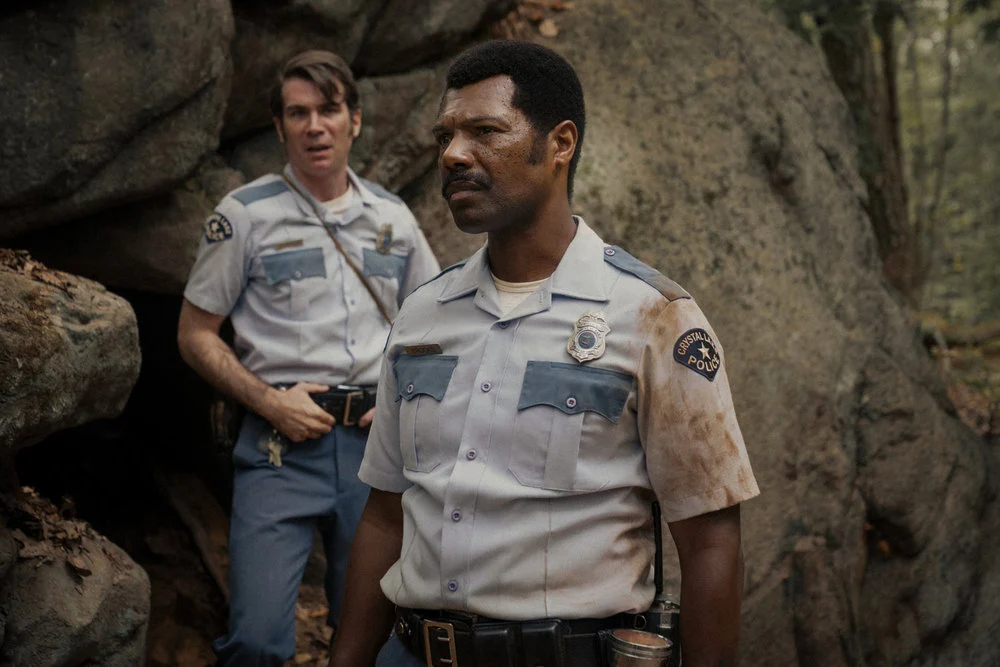
A standout element of the supporting cast is William Catlett’s portrayal of Chief Levon Brooks. Catlett injects a grounding, gruff sympathy into the proceedings. His character’s blind infatuation with Pamela complicates the local police department’s investigation into a string of bizarre, escalating murders around the lake. Catlett manages to anchor the town’s growing panic, balancing high-stakes horror with small, humanizing character moments.
Meanwhile, Linda Cardellini executes a difficult tightrope walk as Pamela. The actor captures opposing extremes with precision: she transitions effortlessly from a forlorn, isolated recluse to a voracious, unhinged force of nature. Cardellini’s performance sells the character’s descent, giving weight to a script that often treats its characters as moving pieces on a chessboard designed for slaughter.
Official Responses and Industry Context: The Slasher vs. Prestige TV Debate
The development of Crystal Lake has been heavily scrutinized by industry analysts and horror enthusiasts alike, particularly given the tortuous legal and developmental history surrounding the Friday the 13th intellectual property. Original series developer Bryan Fuller was famously attached to the project before parting ways with A24, leaving Brad Caleb Kane to steer the ship toward a more streamlined, traditional slasher vision.
Critics have pointed out the fundamental friction of adapting a cinematic slasher franchise into a multi-episode television format. Slasher films are inherently lean, mean, and built for velocity. They rely on the kinetic energy of creative kills, immersive escapism, and tension that snaps within a 90-to-120-minute window. Sustaining that exact brand of tension across an eight-hour television arc proves nearly impossible, especially when viewers are acutely aware of which characters exist solely to pad the body count.
Furthermore, industry commentators have noted the exhaustion surrounding the modern television trend of saving the entire origin story for the penultimate episode. By withholding the fundamental answers to Pamela and Jason’s psychology until Episode 7, the series risks alienating viewers who tuned in for a sustained narrative rather than a drawn-out mystery box.

Implications: What Crystal Lake Means for the Future of Horror Franchises
The release of Crystal Lake carries significant implications for how legacy horror properties are adapted for streaming platforms. For years, studios have attempted to "elevate" classic slasher villains by drowning them in social allegories, generational trauma metaphors, and prestige-drama pacing.
In this regard, Crystal Lake achieves a notable victory. It refuses to frame Pamela Voorhees as a misunderstood victim of the American health care system, a product of Cold War paranoia, or a sympathetic crusader acting "for the right reasons." The series boldly allows Pamela to be a baddie—unapologetically ruthless, violent, and cold. She is not a symptom of her environment; she is an active architect of terror.
However, the creative trade-off required to achieve this television format highlights a cautionary tale for future IP revivals. By forcing a lean, mean cinematic premise into an elongated eight-hour structure, the series dilutes its own momentum. The realization that viewers can theoretically skip straight to Episode 7 without missing vital narrative scaffolding underscores the ongoing struggle streaming platforms face when trying to stretch cinematic concepts past their natural breaking points.
For franchise die-hards, Crystal Lake offers enough practical gore, commendable performances from Cardellini and Catlett, and nostalgic flair to warrant a watch. Yet, it also serves as proof that sometimes, less is infinitely more—and that some legends are best left to the swift, unyielding brutality of a two-hour runtime.
Grade: C
“Crystal Lake” premieres Thursday, October 15, on Peacock.
